A preparar o relatório

A carregar as informações e as referências disponíveis

Consultando el registro arqueológico...

Recopilando registros antiguos

Saltar para o conteúdo principal
Miraflores (Middle Horizon), Titicaca Basin
Cultura de destaque

Miraflores (Middle Horizon), Titicaca Basin

Two Middle Horizon individuals linking Miraflores archaeology to ancient Andean DNA

765 CE - 965 CE
Titicaca Basin, Bolivia
Desplázate para começar
Capítulo I

A História

Comprender la cultura Miraflores (Middle Horizon), Titicaca Basin

Archaeological and genomic data from two Miraflores-era individuals (765–965 CE) in the Titicaca Basin suggest deep Native American lineages (Y‑Q; mtDNA B2/B2b). Limited samples mean conclusions are preliminary, but findings hint at local continuity and regional interaction during the Middle Horizon.

Time Period

765–965 CE (Middle Horizon)

Region

Titicaca Basin, Bolivia

Common Y-DNA

Q (observed)

Common mtDNA

B2b, B2 (observed)

Capítulo II

Cronologia

Momentos-chave da história desta cultura

600 CE

Broader Middle Horizon emergence

Middle Horizon cultural networks expand across the southern Andes, setting the stage for regional interaction.

765 CE

Earliest dated Miraflores sample

One of the two analyzed individuals is dated to this year, anchoring Miraflores DNA to the late Middle Horizon.

965 CE

Latest dated Miraflores sample

The second analyzed individual dates to this year, extending the sampled sequence into the late Middle Horizon.

Capítulo III

Origins & Emergence

Along the wind-swept high plains of the Titicaca Basin, Miraflores communities emerged within the broad tapestry of the Middle Horizon (roughly 600–1000 CE). Radiocarbon-calibrated contexts for the two analyzed individuals place them between 765 and 965 CE, a period of intensified social reorganization and long-distance networks across the southern Andes. Archaeological data indicates that Miraflores material culture—characterized in regional surveys by distinct ceramic motifs and settlement patterns—shares affinities with contemporary Tiwanaku expressions, suggesting interaction, exchange, or overlapping spheres of influence rather than a single, monolithic polity.

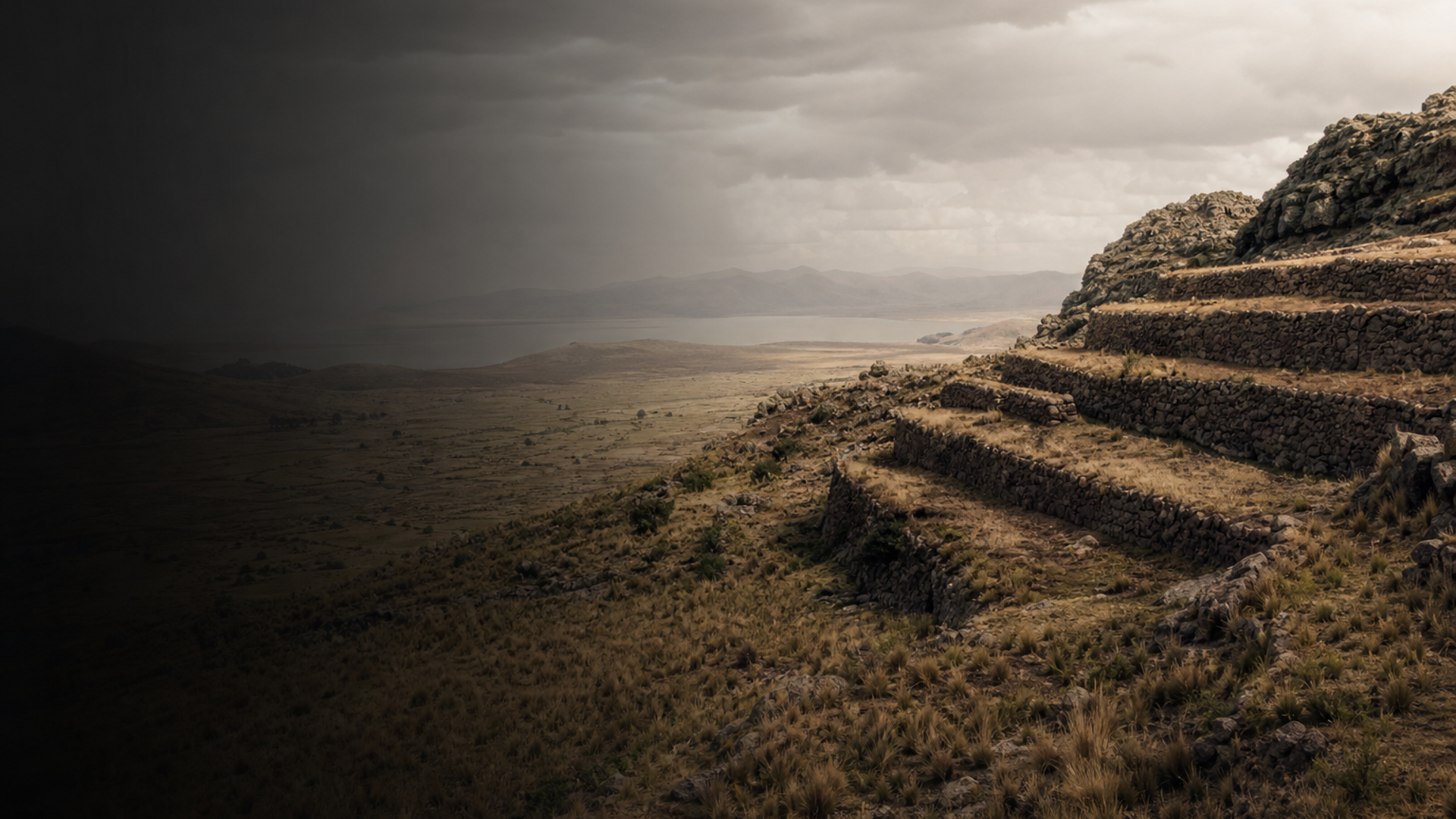
Excavations at Miraflores-associated loci in the Titicaca Basin reveal habitation on raised terraces and graves containing goods that imply pastoral economies and trans‑altiplano trade. Limited evidence suggests that environmental management (irrigation, raised fields) and camelid herding underwrote resilience in a high-altitude landscape. However, the archaeological record is still uneven: many Miraflores attributions rely on stylistic links rather than prolonged stratigraphic sequences, so interpretations of origin and scale remain provisional.

In short, Miraflores appears as a regional expression of Middle Horizon lifeways—rooted in the high Andes, engaged in exchange, and positioned within shifting political landscapes—yet many basic questions about its distinctiveness and reach persist pending broader excavation and dating.

  • Miraflores dates fall within the Middle Horizon (765–965 CE).
  • Material culture shows affinities with Tiwanaku-era styles, implying interaction.
  • Archaeological sequences for Miraflores are patchy; origin narratives remain provisional.
Capítulo IV

Daily Life & Society

Life in the Miraflores context would have unfolded against dramatic altiplano panoramas—thin air, stoney soils, and a sky that turns rapidly from sun to storm. Archaeological indicators from the Titicaca Basin suggest economies based on a mix of highland agriculture and camelid pastoralism: quinoa and tuber cultivation on terraces and the herding of llamas and alpacas for meat, fiber, and transport. Ceramic assemblages and weaving fragments recovered in Miraflores contexts point to local craft specialization and household production, with stylistic motifs that both reflect local identities and echo broader Middle Horizon aesthetics.

Burial practices recovered at Miraflores-associated sites show variation: offerings and bundled interments indicate social differentiation and ritual care for the dead. Exchange networks across the highlands and down-valley corridors likely brought exotic goods, salts, and raw materials to Miraflores settlements, embedding them in regional circuits. Seasonal mobility—transhumance—may have structured social life, with communities moving herds to different pastures across the year.

Archaeological data indicates adaptability as a defining feature: infrastructure for water control, compact settlements, and a reliance on mixed subsistence strategies enabled people to persist in a challenging environment. Yet the exact social hierarchy, political organization, and population density of Miraflores remain incompletely known due to limited systematic excavation.

  • Mixed economy: terrace agriculture and camelid herding supported communities.
  • Craft production and burial variability suggest social differentiation and regional ties.
Capítulo V

Genetic Profile

Ancient DNA from two individuals attributed to Bolivia_MH_Miraflores (Titicaca Basin) provides a tantalizing, if preliminary, window into Middle Horizon genetic landscapes. Both samples date between 765 and 965 CE. The paternal lineage observed is haplogroup Q—a lineage commonly found among Indigenous populations of the Americas and consistent with deep pre‑Columbian ancestry in the high Andes. Maternal lineages include mtDNA B2b and B2, subclades that are similarly widespread among Native American groups and are frequently observed in Andean populations.

Genomic signals here are concordant with archaeological expectations of local continuity: the haplogroups point to genetic roots that predate Middle Horizon interactions and reflect long-term residence in the Andes. Nevertheless, with only two individuals (sample count <10), strong inferences about population structure, admixture, or influxes from neighboring polities would be premature. Limited sampling inflates the role of chance—observed haplogroups may reflect household-level inheritance rather than population-level patterns.

Where genetic data and archaeology intersect, they suggest continuity of autochthonous lineages alongside cultural connections to broader Middle Horizon networks. Future, broader sampling (more individuals, genome-wide data, and comparative datasets from Tiwanaku and surrounding regions) will be necessary to test hypotheses about gene flow, kinship organization, and demographic change during the Middle Horizon.

  • Observed paternal haplogroup Q aligns with deep Native American ancestry.
  • Maternal haplogroups B2 and B2b are common in Andean populations; conclusions remain preliminary given only two samples.
Capítulo VI

Legacy & Modern Connections

The Miraflores imprint endures in the highland cultural landscape: ceramic designs, agricultural strategies, and settlement forms echo in later Andean traditions and the lifeways of contemporary indigenous communities around Lake Titicaca. Genetically, the presence of Native American haplogroups in these Middle Horizon individuals reinforces a narrative of longstanding local ancestry. This continuity resonates with modern Aymara and Quechua-speaking populations who inhabit the Bolivian altiplano, though direct lines of descent require careful, dense sampling to verify.

Because only two Miraflores-era genomes are available, bridging past and present must be cautious: preliminary genetic matches could reflect broader regional continuity or idiosyncratic familial lineages. Nevertheless, the combined archaeological and genetic picture evokes resilient highland communities—crafting identity through landscape stewardship, exchange, and kinship—that contributed threads to the complex tapestry of Andean history.

Ongoing multidisciplinary work—more excavations, secure radiocarbon sequences, and expanded ancient DNA sampling—will be key to illuminating how Miraflores lifeways fed into the cultural and genetic makeup of modern Andean peoples.

  • Genetic signals support long-term local ancestry but larger samples are needed.
  • Archaeological legacies persist in highland agricultural and craft traditions.
Com IA

Assistente de IA

Haz preguntas sobre la cultura Miraflores (Middle Horizon), Titicaca Basin

Assistente de IA por DNAGENICS

Desbloquear esta função
Pregunta sobre la cultura Miraflores (Middle Horizon), Titicaca Basin. El asistente con IA puede explicar hallazgos genéticos, contexto histórico, pruebas arqueológicas y conexiones modernas, con sus límites de interpretación.

Exemplo de análise com IA

La cultura Miraflores (Middle Horizon), Titicaca Basin representa un capítulo de la historia humana...

A análise genética permite estudar semelhanças com populações anteriores e possíveis adaptações. As amostras de DNA antigo fornecem informações para investigar padrões migratórios e relações entre populações, com limites que dependem do estudo e do contexto arqueológico.

Esta é uma antevisão da análise com IA. Aceder ao assistente completo para explorar informações sobre:

  • Composição e similaridade genética
  • Padrões migratórios e origens
  • Vida cotidiana e práticas culturais
  • Contexto genético moderno

Explore mais culturas antigas

Descubra a história de civilizações de diferentes partes do mundo antigo