A preparar o relatório

A carregar as informações e as referências disponíveis

Consultando el registro arqueológico...

Recopilando registros antiguos

Saltar para o conteúdo principal
Timacum-Minus: Slavic Burials
Cultura de destaque

Timacum-Minus: Slavic Burials

Early Medieval Slavic community in eastern Serbia, seen through archaeology and ancient DNA

775 CE - 1021 CE
Eastern Serbia (Zaječar District)
Desplázate para começar
Capítulo I

A História

Comprender la cultura Timacum-Minus: Slavic Burials

Archaeological and ancient-DNA analysis of six Early Medieval burials (775–1021 CE) from Timacum-Minus (Zaječar District) reveals a mixed genetic profile consistent with local Balkan ancestry and incoming Slavic traditions. Results are preliminary due to small sample size.

Time Period

775–1021 CE

Region

Eastern Serbia (Zaječar District)

Common Y-DNA

I (2), E (1), J (1), R (1), 1 unassigned/low coverage

Common mtDNA

H (3), J (1), K (1), H9a (1)

Capítulo II

Cronologia

Momentos-chave da história desta cultura

775 CE

Earliest dated burials at Timacum-Minus

Initial burials in the analyzed series date to around 775 CE, marking Early Medieval occupation in eastern Serbia.

Capítulo III

Origins & Emergence

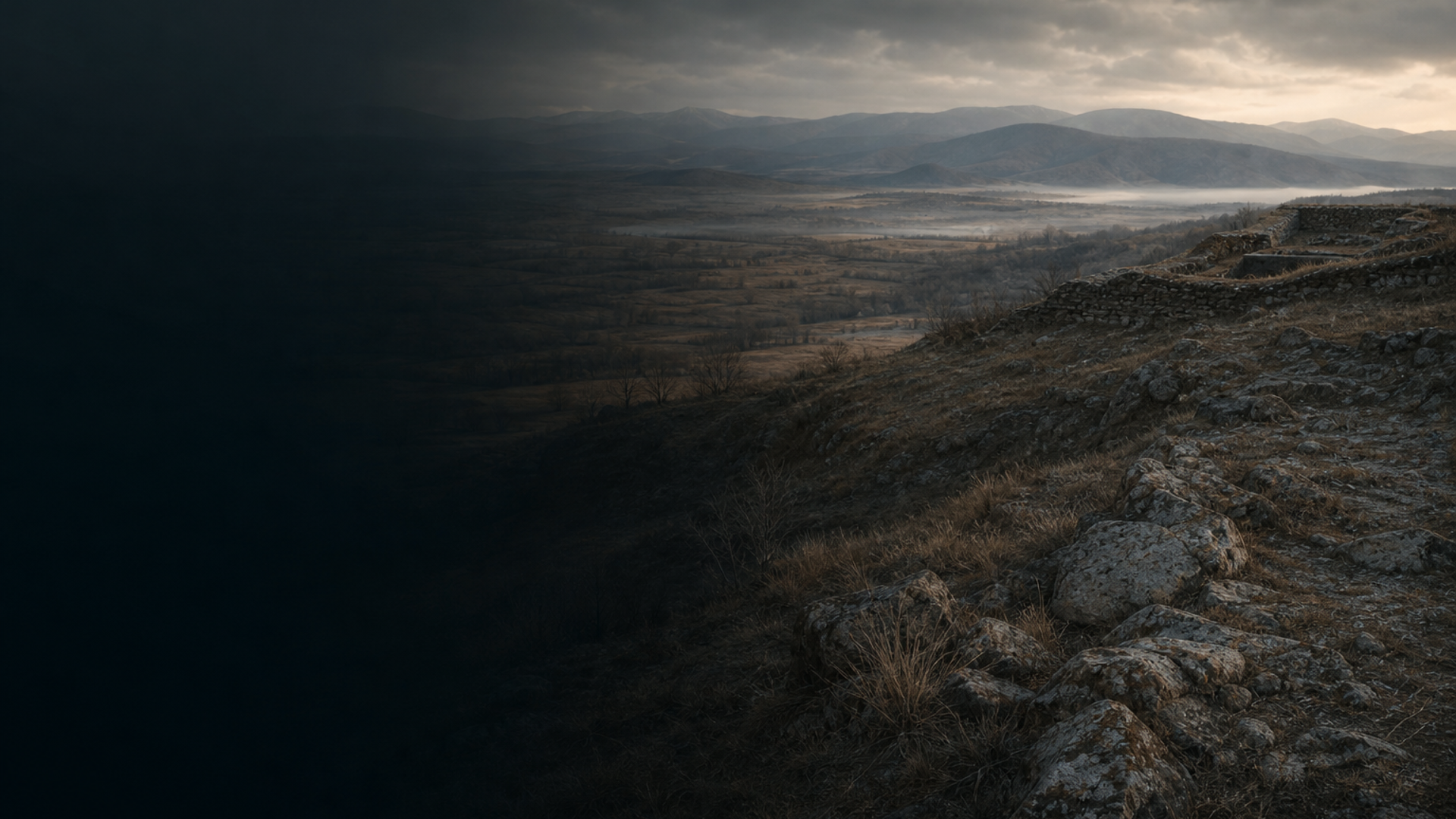
The Timacum-Minus burials, dated between 775 and 1021 CE, sit at a crossroads of late antique frontier memory and the dynamic reshaping of the Balkans in the Early Middle Ages. Archaeological data indicates reuse of landscape corridors near Roman-era routes around Timacum-Minus-Kuline (Zaječar District, Knjaževac Municipality, Ravna), where small cemeteries and isolated graves speak to mobile communities negotiating new social orders.

Material culture from nearby finds—simple belt fittings, bead types, and burial orientations—echo broader patterns attributed to Slavic-speaking groups entering and settling the central Balkans after the 6th century CE. Limited evidence suggests continuity in some mortuary practices that may reflect local population persistence or rapid cultural assimilation rather than wholesale population replacement.

The ceramic and metal fragments recovered in the region show both locally produced wares and objects influenced by Byzantine and steppe-derived styles. This material palimpsest emphasizes that the emergence of a recognizable Early Medieval Slavic identity in eastern Serbia was a process of cultural blending across centuries rather than an instantaneous migration event. Given only six analyzed samples from Timacum-Minus, interpretations of demographic origins remain provisional and should be integrated with broader regional datasets.

  • Site: Timacum-Minus-Kuline (Zaječar District, Ravna)
  • Date range: 775–1021 CE (Early Medieval period)
  • Evidence points to cultural blending, not simple replacement
Capítulo IV

Daily Life & Society

Archaeological traces around Timacum-Minus evoke a landscape of small farming hamlets, seasonal pastures, and lanes tracing older Roman roads. Botanical remains from the wider region indicate mixed agriculture—cereals, pulses, and animal husbandry—supporting a subsistence economy that could sustain growing, dispersed settlements.

Burial customs recorded at Timacum-Minus are modest: single inhumations with limited grave goods, often placed in simple pits. These practices suggest communities organized around kin networks rather than monumental elite structures. The material record—simple jewelry, belt fittings, and tool fragments—hints at daily life focused on household production, weaving, metalworking, and pastoral mobility.

Archaeological data indicates contact with Byzantine trade and influence from neighboring Balkan groups; imported or imitated items point to exchange along established routes. Yet the small size of excavated assemblages makes it difficult to reconstruct fine-grained social hierarchies. Ethnogenesis of Slavic identity in this area likely involved both adoption of new social practices and continuity of local customs.

The human remains themselves, now subject to ancient DNA analysis, add personal dimension to these traces: each genome is a voice from the past that can confirm kinship patterns, sex ratios, and mobility when combined with isotopic and material evidence.

  • Subsistence: mixed agriculture and pastoralism
  • Burials: modest inhumations with limited grave goods
Capítulo V

Genetic Profile

Six individuals from Timacum-Minus were analyzed for ancient DNA, a small but informative sample. The Y-chromosome results show diversity: haplogroup I (2 individuals), E (1), J (1), R (1), and one individual with low-coverage or unassigned Y data. Maternal lineages are dominated by haplogroup H (3), with single occurrences of J, K, and H9a.

This mix fits a pattern often seen in Early Medieval Balkan contexts: predominant European maternal lineages (H and its subclades) alongside paternal diversity that can include both locally rooted lineages (I) and haplogroups associated with broader Mediterranean and Near Eastern networks (E, J, R). Archaeogenetic data therefore suggest a community shaped by local ancestry with admixture from neighboring regions.

Because the dataset contains fewer than 10 samples, conclusions must be cautious. Limited sample size increases the chance that observed haplogroup frequencies do not represent the wider population. Nevertheless, these genomes provide preliminary evidence for demographic complexity: possible local continuity (I, H), interactions with southern Balkans and Byzantine-influenced gene pools (E, J), and broader Eurasian connections (R).

Future work combining larger aDNA series, isotopic mobility studies, and regional comparisons will better resolve whether the genetic pattern at Timacum-Minus reflects migration, marriage networks, or long-term local admixture.

  • Y-DNA: diverse — I (2), E (1), J (1), R (1), 1 unresolved
  • mtDNA: largely H (3) with J, K, H9a — suggests European maternal continuity
Capítulo VI

Legacy & Modern Connections

The Timacum-Minus assemblage offers a cinematic glimpse into the roots of populations that contributed to modern genetic landscapes in Serbia and the central Balkans. Archaeological continuity in the region, paired with genetic signatures of both local European and wider Mediterranean ancestry, mirrors the layered historical processes—migration, assimilation, and trade—that shaped medieval Balkan communities.

These ancient genomes, though preliminary, align with broader patterns in Balkan ancient DNA showing admixture between local Late Antique populations and incoming groups during the Early Medieval period. For modern populations, this means that ancestry in Serbia likely traces to a tapestry of local continuity with episodic influxes from neighboring regions rather than a single source.

As more samples from the Early Medieval Slavic Culture of Serbia are analyzed, the story will sharpen: what now reads as a murmur of mixed origins may reveal clear pulses of migration, persistent local lineages, or shifting marriage networks. For now, Timacum-Minus stands as an evocative waypoint in the long human journey across the Balkans.

  • Preliminary genetic links to modern Balkan diversity
  • Reflects layered ancestry: local continuity plus regional admixture
Com IA

Assistente de IA

Haz preguntas sobre la cultura Timacum-Minus: Slavic Burials

Assistente de IA por DNAGENICS

Desbloquear esta função
Pregunta sobre la cultura Timacum-Minus: Slavic Burials. El asistente con IA puede explicar hallazgos genéticos, contexto histórico, pruebas arqueológicas y conexiones modernas, con sus límites de interpretación.
Exemplo de análise com IA

La cultura Timacum-Minus: Slavic Burials representa un capítulo de la historia humana...

A análise genética permite estudar semelhanças com populações anteriores e possíveis adaptações. As amostras de DNA antigo fornecem informações para investigar padrões migratórios e relações entre populações, com limites que dependem do estudo e do contexto arqueológico.

Esta é uma antevisão da análise com IA. Aceder ao assistente completo para explorar informações sobre:

  • Composição e similaridade genética
  • Padrões migratórios e origens
  • Vida cotidiana e práticas culturais
  • Contexto genético moderno

Explore mais culturas antigas

Descubra a história de civilizações de diferentes partes do mundo antigo