A preparar o relatório

A carregar as informações e as referências disponíveis

Consultando el registro arqueológico...

Recopilando registros antiguos

Saltar para o conteúdo principal
Tiwanaku Echoes
Cultura de destaque

Tiwanaku Echoes

Voices from the Lake: people of the Tiwanaku heartland, 650–1200 CE

650 CE - 1200 CE
Tiwanaku, Lake Titicaca basin, La Paz, Bolivia
Desplázate para começar
Capítulo I

A História

Comprender la cultura Tiwanaku Echoes

Ancient DNA from four individuals at Tiwanaku (La Paz, Bolivia; 650–1200 CE) shows predominantly Y haplogroup Q and mtDNA B2/C1c, suggesting local Andean ancestry. Archaeology and genetics together illuminate a powerful Middle Horizon polity—preliminary results given small sample size.

Time Period

c. 650–1200 CE (Middle Horizon & after)

Region

Tiwanaku, Lake Titicaca basin, La Paz, Bolivia

Common Y-DNA

Q (majority of 4 samples)

Common mtDNA

B2 (3), C1c (1)

Capítulo II

Cronologia

Momentos-chave da história desta cultura

500 CE

Early monumental construction

Initial building phases at Tiwanaku begin, laying foundations for later monumental architecture.

700 CE

Cultural apogee

Tiwanaku reaches its architectural and ritual peak, influencing wide regions around the southern Andes.

1000 CE

Regional transformation

Signs of sociopolitical change and regional restructuring appear; classic Tiwanaku patterns wane.

Capítulo III

Origins & Emergence

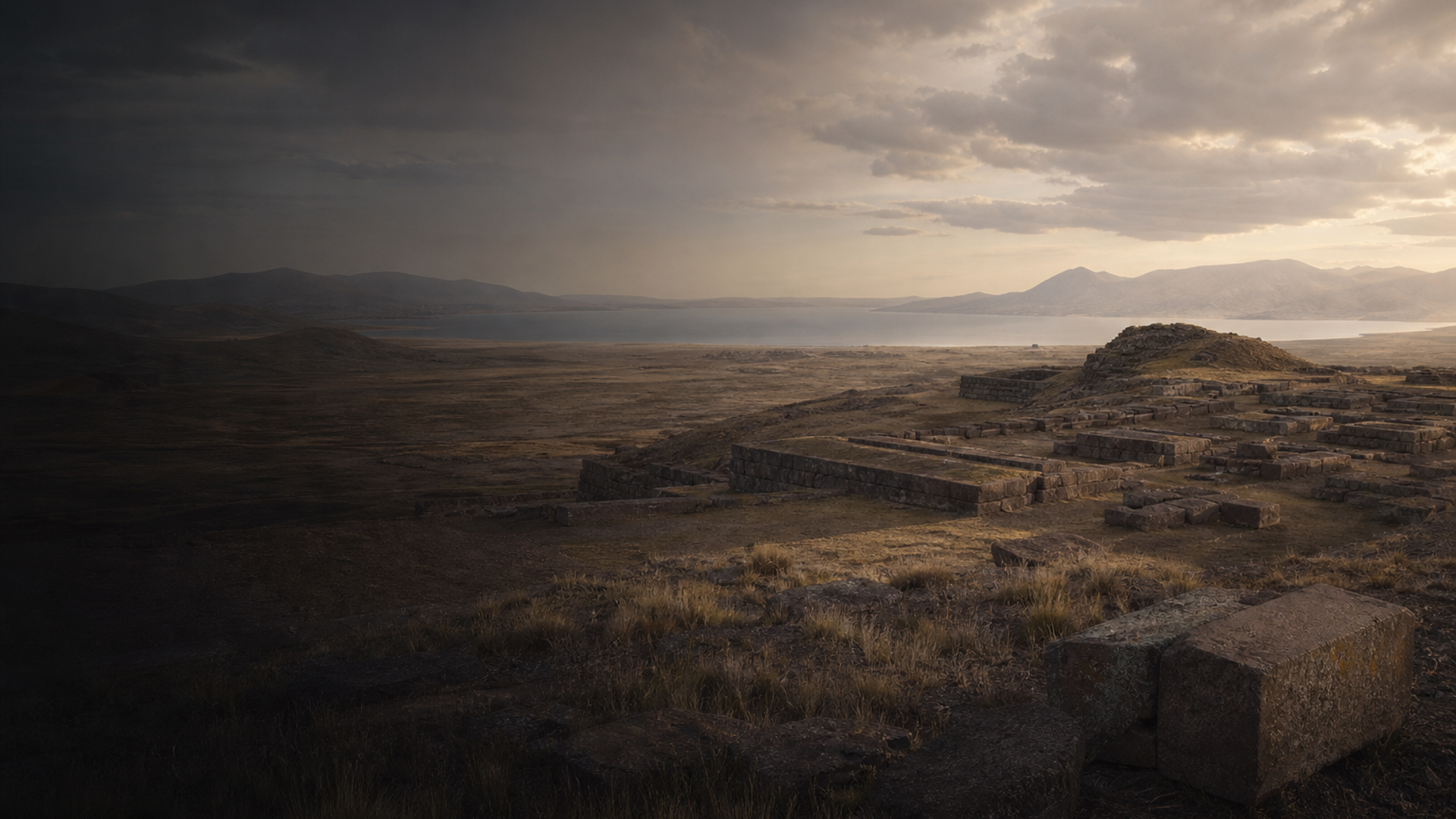
Tiwanaku rose like stone cathedral-work on the cold shores of Lake Titicaca. Archaeological data indicates the site of Tiwanaku (near modern Tiwanaku village, La Paz department) became a focal center of the Middle Horizon from roughly the 6th through the 10th centuries CE, with monumental platforms such as Akapana, the Kalasasaya courtyard, the Semi-Subterranean Temple, and adjacent precincts including Pumapunku. Radiocarbon-dated construction phases and stratigraphy point to a crescendo of architectural expansion and long-distance exchange between about 600 and 900 CE.

Material culture—fine polychrome ceramics, carved stone iconography, and engineered landscapes of raised fields (suka kollus)—testifies to an integrated economic and ritual system capable of supporting dense populations at high altitude. Archaeological evidence indicates Tiwanaku’s influence radiated across the southern Andes through networks of pilgrimage, trade, and stylistic emulation rather than straightforward colonial settlement. Yet the biological origins of people associated with the monumental core have remained a crucial question. Limited ancient DNA from the site begins to place bodies within these stone narratives, suggesting strong local Andean ancestry but reminding us that the full story of demographic formation requires larger, geographically wider samples.

  • Core site: Tiwanaku near Lake Titicaca, La Paz, Bolivia
  • Architectural peaks: Akapana, Kalasasaya, Pumapunku
  • Cultural florescence during Middle Horizon (c. 600–900 CE)
Capítulo IV

Daily Life & Society

Daily existence in the Tiwanaku heartland balanced the pragmatic demands of high-altitude life with elaborate ritual expression. Agricultural engineering—raised fields, terracing, and wetland management—enhanced productivity of tubers and grains and supported camelid herding. Llamas were both pack animals and a critical economic commodity; their wool fed a sophisticated textile industry renowned across the Andes.

Craft specialists produced distinctive ceramics, metalwork, and textiles that articulated community identity and ritual roles. The urban core likely functioned as a ceremonial-political center: processions, feasting, and votive deposition appear in the archaeological record. Human remains recovered from ceremonial contexts show traces of formalized ritual behavior; archaeological data indicates offerings and mortuary variability, though interpretations of social hierarchy and population composition remain debated. Life in the Tiwanaku world was thus a weave of agricultural ingenuity, specialist crafts, long-distance exchange, and deeply staged ritual practices.

  • Agriculture: raised fields (suka kollus), tubers, camelid herding
  • Specialization: textiles, ceramics, metalwork; ceremonial center activity
Capítulo V

Genetic Profile

Ancient DNA from four individuals excavated at Tiwanaku (La Paz, Bolivia; dated between 650 and 1200 CE) yields a preliminary genetic portrait. Three of the four males carry Y-chromosome haplogroup Q, a lineage widely found among Indigenous peoples across the Americas and commonly interpreted as one of the major founding paternal clades of Native American populations. On the maternal side, three individuals carry mtDNA haplogroup B2 and one carries C1c—both are subclades frequently observed in Andean and broader South American ancient and modern populations.

These genetic signals are consistent with substantial local Andean ancestry in the Tiwanaku population sampled. However, with only four individuals, conclusions about population structure, migration, or social organization are provisional. Limited evidence suggests continuity with earlier Andean lineages, but the sample is too small to detect subtle admixture events, sex-biased mobility, or regional heterogeneity. Future sampling from peripheral Tiwanaku-influenced sites and contemporaneous communities will be necessary to test hypotheses about demographic expansion, interregional marriage networks, and genetic connections to present-day Aymara and Quechua-speaking groups. For now, ancient DNA complements the archaeological picture by anchoring Tiwanaku people within longstanding Andean genetic lineages while highlighting the need for broader datasets.

  • Major paternal lineage: Y haplogroup Q dominant among the 4 samples
  • Maternal lineages: mtDNA B2 (3 samples) and C1c (1 sample); sample size small
Capítulo VI

Legacy & Modern Connections

Stone and strand converge: Tiwanaku’s architectural and ritual vocabulary persists in the highlands’ cultural memory and in patterns of settlement around Lake Titicaca. Archaeological continuity and shared material practices suggest cultural influence on later Andean polities. Genetically, the presence of founding Native American haplogroups in Tiwanaku-era remains aligns with lineages still present among highland populations, offering a biological thread between past and present.

Caveats are essential. The genetic sample is small, so assertions of direct continuity with specific modern groups (for example, Aymara or Quechua communities) remain tentative. Nevertheless, the combined archaeological and genetic evidence paints a portrait of a society rooted in the Andes—adaptive, connected, and influential—whose echoes still inform identity and ancestry studies in the region. Ongoing aDNA research promises to refine these connections and reveal the demographic rhythms behind Tiwanaku’s enduring presence.

  • Cultural influence persists in Andean rituals and landscape engineering
  • Genetic links to modern Andean groups are plausible but remain tentative due to small sample size
Com IA

Assistente de IA

Haz preguntas sobre la cultura Tiwanaku Echoes

Assistente de IA por DNAGENICS

Desbloquear esta função
Pregunta sobre la cultura Tiwanaku Echoes. El asistente con IA puede explicar hallazgos genéticos, contexto histórico, pruebas arqueológicas y conexiones modernas, con sus límites de interpretación.
Exemplo de análise com IA

La cultura Tiwanaku Echoes representa un capítulo de la historia humana...

A análise genética permite estudar semelhanças com populações anteriores e possíveis adaptações. As amostras de DNA antigo fornecem informações para investigar padrões migratórios e relações entre populações, com limites que dependem do estudo e do contexto arqueológico.

Esta é uma antevisão da análise com IA. Aceder ao assistente completo para explorar informações sobre:

  • Composição e similaridade genética
  • Padrões migratórios e origens
  • Vida cotidiana e práticas culturais
  • Contexto genético moderno

Explore mais culturas antigas

Descubra a história de civilizações de diferentes partes do mundo antigo