A preparar o relatório

A carregar as informações e as referências disponíveis

Consultando el registro arqueológico...

Recopilando registros antiguos

Saltar para o conteúdo principal
Voices of Roman Lebanon
Cultura de destaque

Voices of Roman Lebanon

Human stories from Qornet ed-Deir between 200–650 CE, where bones meet history

200 CE - 650 CE
Lebanon (Qornet ed-Deir)
Desplázate para começar
Capítulo I

A História

Comprender la cultura Voices of Roman Lebanon

Archaeological and genetic data from Qornet ed-Deir (Lebanon) illuminate lives in Roman-era Lebanon (200–650 CE). Four ancient genomes reveal Y haplogroup T and diverse maternal lineages (HV, T, U3b, H). Limited samples make conclusions preliminary but suggest Eastern Mediterranean continuity with regional mobility.

Time Period

200–650 CE

Region

Lebanon (Qornet ed-Deir)

Common Y-DNA

T (observed in 1/4 samples)

Common mtDNA

HV, T, U3b, H (each 1/4 samples)

Capítulo II

Cronologia

Momentos-chave da história desta cultura

200 CE

Provincial Roman life

Archaeological layers at Qornet ed-Deir date to the Roman provincial era, reflecting local settlement and integration into Mediterranean networks.

330 CE

Byzantine transformations

Administrative and religious shifts during the late Roman/early Byzantine period reshape provincial institutions and ritual landscapes in the Levant.

636 CE

Early Islamic transition

Military and political changes across the region mark the end of Byzantine dominance and the start of new cultural and administrative frameworks.

Capítulo III

Origins & Emergence

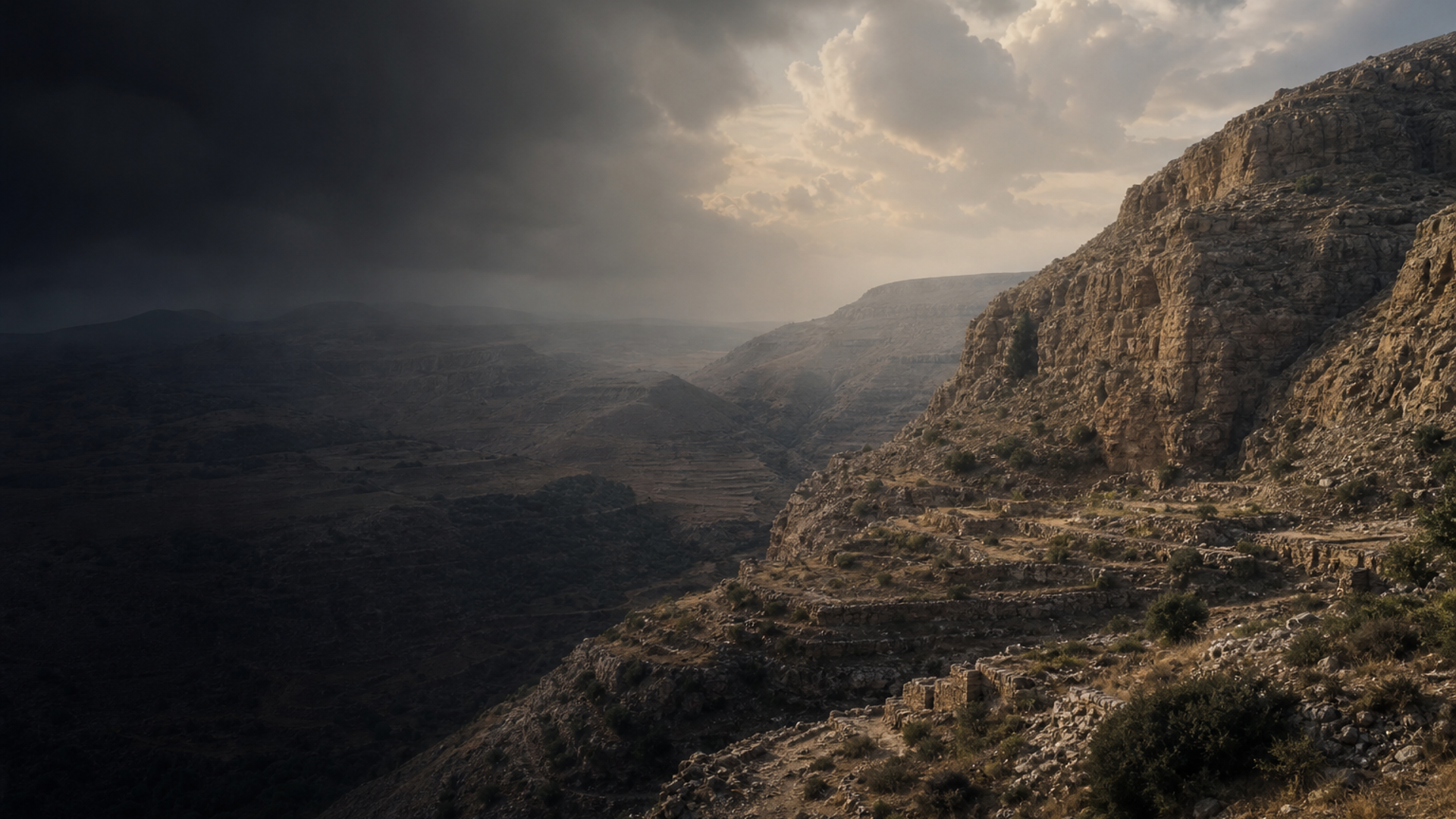
The period from roughly 200 to 650 CE in what is now Lebanon unfolds against the backdrop of Roman provincial administration transitioning into Byzantine rule and, later, early Islamic governance. Archaeological data from Qornet ed-Deir situate human activity within this long arc: settlement layers, funerary deposits, and small finds indicate local communities embedded in wider Mediterranean networks. Material traces suggest continuity of Levantine lifeways—agriculture on terraced hillsides, seasonal movement between upland and coastal zones, and participation in trade that threaded through Syrian-Palestinian ports.

At Qornet ed-Deir the stratigraphy and associated artifacts record a landscape shaped by both local traditions and imperial currents. Stone-built features and ceramic assemblages show adaptations to Roman economic and administrative structures without erasing indigenous practices. Limited evidence suggests that population mobility increased during this era: soldiers, merchants, and officials traveling along maritime and inland routes brought people and ideas, creating a culturally layered provincial world.

Because direct genetic sampling from this site is small, the archaeological record remains essential for interpreting how these communities lived and moved. Together, the material culture and the emerging genetic signal allow us to glimpse how a Levantine population negotiated continuity and change under the Roman and Byzantine spheres.

  • Roman and Byzantine occupation layers at Qornet ed-Deir (200–650 CE)
  • Material culture indicates local lifeways within imperial networks
  • Evidence for increased mobility and cultural layering
Capítulo IV

Daily Life & Society

Daily existence in Roman Lebanon blended the tactile rhythms of land and sea with provincial cosmopolitanism. Archaeological contexts from Qornet ed-Deir reveal domestic architecture, storage facilities, and hearths suggesting households organized around mixed farming—cereals, olives, and possibly viticulture—as well as pastoral activities. Small finds such as tools, spindle whorls, and personal items point to gendered craft production and household economies sustained across generations.

Ceramics, coins, and imported objects recovered in the region testify to participation in Mediterranean exchange: amphorae and tablewares moved along coastal routes, while local pottery traditions persisted alongside imported forms. Funerary contexts at the site reflect a spectrum of mortuary behaviors; these burials, when combined with osteological analysis, provide windows into diet, health, and demographic structure.

Archaeological evidence indicates that religious and social identities could be plural and overlapping—pagan cultic traces, Christian communities emerging in the Byzantine era, and continued local rites coexist in the record. Such cultural patchworks are consistent with a province where local families maintained continuity even as networks of trade and administration connected them to distant horizons.

  • Mixed farming, craft production, and household-based economy
  • Evidence of Mediterranean trade alongside persistent local traditions
Capítulo V

Genetic Profile

Four individuals sampled from burial contexts at Qornet ed-Deir provide a first glimpse into the genetic landscape of Roman Lebanon. The small dataset includes one male carrying Y-chromosome haplogroup T and four mitochondrial lineages represented by HV, T, U3b, and H. These maternal haplogroups are well-attested across the wider Near East and Mediterranean and reflect a diverse matrix of maternal ancestries in the region.

Y haplogroup T is observed at low to moderate frequencies in parts of the Near East and Mediterranean; its presence here is consistent with the long-term genetic substratum of the Levant. The mtDNA variation—HV, T, U3b, and H—points toward a mixture of local Near Eastern maternal lineages with haplogroups that also appear throughout southern Europe and the eastern Mediterranean. Taken together, the genetic signals are compatible with archaeological evidence for both local continuity and episodic mobility linked to trade, military movement, and administrative networks under Roman and Byzantine rule.

Crucially, these interpretations are highly preliminary. With only four genomes, statistical resolution is limited and patterns of affinity or admixture cannot be robustly quantified. Further sampling across sites and time periods is necessary to distinguish long-term continuity from short-term migration events. Nevertheless, the current data align with a picture of Eastern Mediterranean population heterogeneity and connectivity during the Roman era.

  • Small sample (n=4): results are preliminary and interpretive caution required
  • Y haplogroup T and diverse mtDNA (HV, T, U3b, H) suggest Eastern Mediterranean continuity with regional mobility
Capítulo VI

Legacy & Modern Connections

The genetic and archaeological traces from Qornet ed-Deir offer a cinematic but grounded vista of ancestry in Roman Lebanon. The observed lineages are not exotic outliers but part of the broader tapestry of the eastern Mediterranean—an area defined by long-standing local communities repeatedly reshaped by movement and exchange.

For modern populations of Lebanon and the Levant, these ancient genomes provide cautious signposts: they hint at persistence of regional genetic components alongside layers added by centuries of migration and cultural transformation. Archaeological continuity in daily life, combined with genetic diversity in a small sample, underlines the mosaic nature of ancestry—palimpsests where local traditions endure even as new elements are incorporated.

Because the dataset is tiny, these results should be viewed as the start of a narrative rather than its conclusion. Expanding the number of sampled individuals and integrating isotope, archaeological, and historical data will sharpen our understanding of how Roman-era lifeways contributed to the genetic heritage of the modern Levant.

  • Findings suggest continuity of Eastern Mediterranean ancestry with layers of mobility
  • Expanded sampling is needed to connect ancient genomes to modern Lebanese diversity
Com IA

Assistente de IA

Haz preguntas sobre la cultura Voices of Roman Lebanon

Assistente de IA por DNAGENICS

Desbloquear esta função
Pregunta sobre la cultura Voices of Roman Lebanon. El asistente con IA puede explicar hallazgos genéticos, contexto histórico, pruebas arqueológicas y conexiones modernas, con sus límites de interpretación.
Exemplo de análise com IA

La cultura Voices of Roman Lebanon representa un capítulo de la historia humana...

A análise genética permite estudar semelhanças com populações anteriores e possíveis adaptações. As amostras de DNA antigo fornecem informações para investigar padrões migratórios e relações entre populações, com limites que dependem do estudo e do contexto arqueológico.

Esta é uma antevisão da análise com IA. Aceder ao assistente completo para explorar informações sobre:

  • Composição e similaridade genética
  • Padrões migratórios e origens
  • Vida cotidiana e práticas culturais
  • Contexto genético moderno

Explore mais culturas antigas

Descubra a história de civilizações de diferentes partes do mundo antigo