A preparar o relatório

A carregar as informações e as referências disponíveis

Consultando el registro arqueológico...

Recopilando registros antiguos

Saltar para o conteúdo principal
Voices of the High Andes
Cultura de destaque

Voices of the High Andes

Machu Picchu peoples at the twilight of the Inca world, seen through bones and genomes

1420 CE - 1532 CE
Peru (Machu Picchu, Cusco region)
Desplázate para começar
Capítulo I

A História

Comprender la cultura Voices of the High Andes

Archaeological and genetic data from Machu Picchu (1420–1532 CE) illuminate maternal lineages common in the central Andes. Modest sample sizes suggest continuity with Andean founder mtDNA clades, while Y‑chromosome data are limited in this dataset.

Time Period

1420–1532 CE

Region

Peru (Machu Picchu, Cusco region)

Common Y-DNA

Not reported in this dataset / limited Y-DNA recovery

Common mtDNA

B2 (4), A (4), B2b (3), C (2), C1b (2)

Capítulo II

Cronologia

Momentos-chave da história desta cultura

1450 CE

Major construction phase at Machu Picchu

Architectural and stratigraphic evidence places substantial building activity in the mid‑15th century, often associated with Inca state expansion.

1532 CE

Onset of Spanish contact in the Inca realm

Spanish incursions into the Inca Empire begin, initiating cascading social and demographic changes across the Andes.

Capítulo III

Origins & Emergence

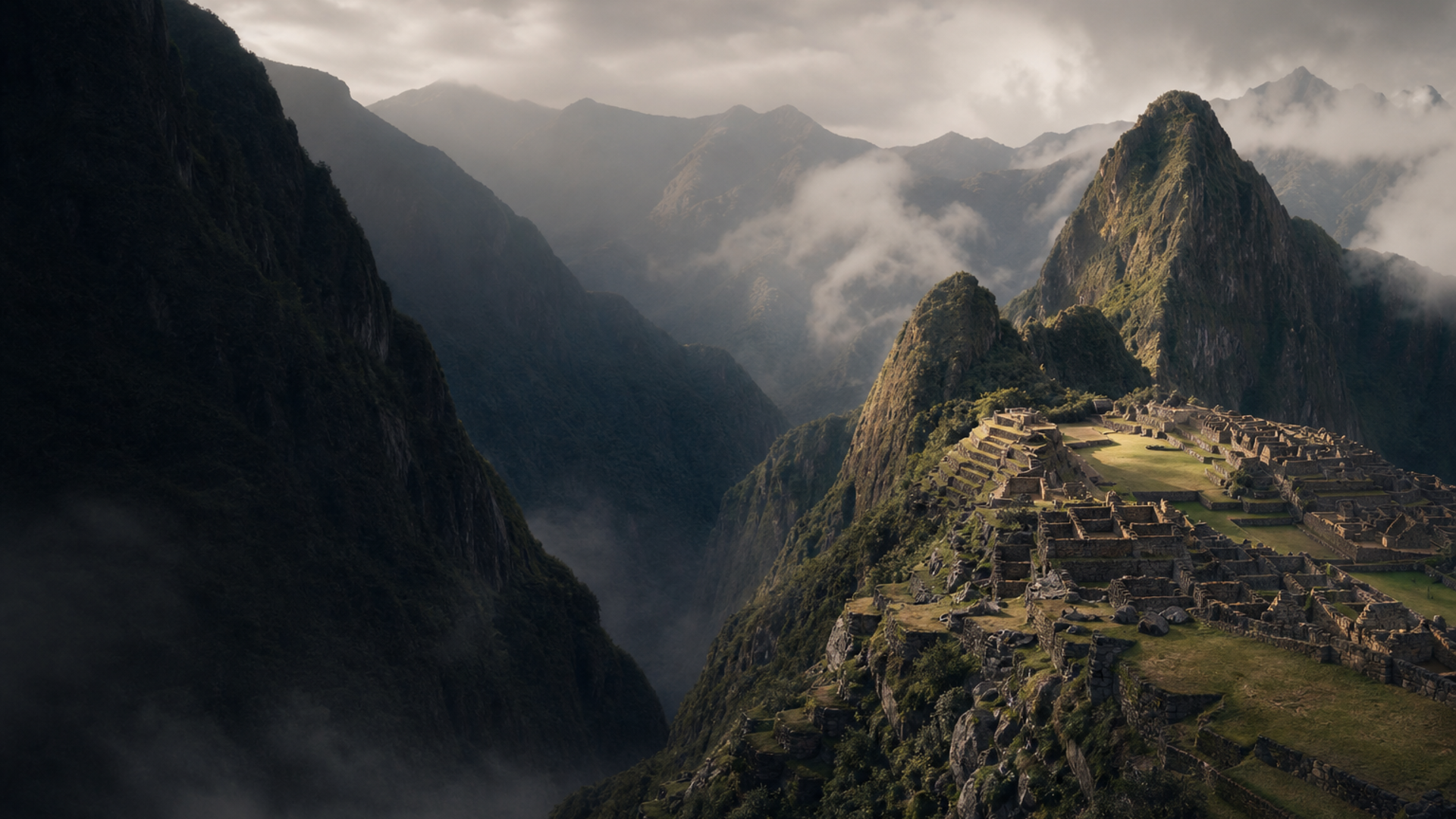
High on the eastern slopes of the Andes, Machu Picchu sits like a mirror to empire. Archaeological layers and architectural styles indicate intensified occupation and monumental construction in the mid‑15th century CE, often attributed to the expansion of the Inca state under rulers such as Pachacuti. Material culture — dressed stone terraces, finely worked masonry, and agricultural systems — ties the site to broader Andean administrative and ritual networks that stretched across the highlands and river valleys.

Genetically, the individuals sampled from burial contexts at Machu Picchu belong to maternal lineages that are widespread across the Americas, reflecting deep ancestry rooted in earlier migrations into South America. Limited evidence suggests these lineages were integrated into the social fabric of late pre‑Columbian Andean polities rather than representing recent long‑distance migration at the site. Archaeological data indicates continuity in local ceramic styles and subsistence strategies alongside imperial markers, supporting a picture of regional communities incorporated into an expansive political order.

Caution: while the archaeological context is robust, genetic sampling is geographically focused at one site; broader conclusions about the entire Inca population require larger, more geographically diverse datasets.

  • Machu Picchu: mid‑15th century construction and occupation
  • Architecture and terraces reflect Inca imperial organization
  • Genetic signals point to deep Native American maternal ancestry
Capítulo IV

Daily Life & Society

Stone stairways, irrigation channels, and small agricultural terraces paint a cinematic daily life of communal labor and ritual rhythm. Residents managed steep slopes with sophisticated microterracing and canals that captured cloud‑forest moisture; botanical remains show cultivation of maize, tubers, and other Andean crops. Houses and storage structures indicate a mixed economy of agriculture, craft production, and provisioning for travelers or administrators.

Social life at Machu Picchu likely combined local household life with imperial functions. Ethnohistoric records from the broader Inca world describe labor obligations (mit'a), reciprical labor exchange, and state redistribution — practices that are consistent with the distributional architecture and storehouses excavated at the site. Mortuary evidence and grave goods vary, suggesting social differentiation and possibly the presence of both local elites and state agents.

Archaeological data indicates both continuity of ancestral Andean lifeways and adaptation to the demands of an expansive polity; however, specifics of identity and mobility remain under study and cannot be fully resolved from the present dataset alone.

  • Terraced agriculture and water management sustained high-altitude farming
  • Material culture reflects both local households and imperial administration
Capítulo V

Genetic Profile

The genetic portrait from 21 sampled individuals at Machu Picchu shows a predominance of mitochondrial haplogroups that are canonical in Native American populations: B2, A, B2b, C, and C1b. These maternal lineages trace back to Pleistocene and early Holocene migrations into the Americas and have deep regional continuity in the Andes. In this assemblage: B2 and A are each observed in four individuals, B2b in three, and forms of C in several samples.

This mtDNA distribution suggests that maternal ancestry at Machu Picchu is broadly consistent with established Andean population structure rather than dominated by recent external influx. However, Y‑chromosome (paternal) haplogroups are not sufficiently reported in this dataset; low recovery of Y‑DNA or lack of targeted sequencing limits interpretation of male‑mediated gene flow and patrilineal structure.

With 21 samples, the dataset offers moderate resolution but remains geographically concentrated. While patterns of maternal continuity are persuasive, they should be regarded as regionally specific: larger sample sizes and comparative data from neighboring sites are necessary to test hypotheses about migration, social stratification, and the genetic footprint of imperial integration. Limited evidence suggests genetic continuity with broader Andean lineages, but finer-scale demographic processes remain tentative.

  • mtDNA dominated by Native American founder haplogroups B2, A, B2b, C, C1b
  • Y‑chromosome data are limited in this dataset; paternal patterns remain unresolved
Capítulo VI

Legacy & Modern Connections

Machu Picchu's stones speak to a living legacy: the descendants of Andean peoples carry genetic echoes of the same maternal lineages found in these burials. Contemporary indigenous communities in the Cusco region and across the highlands share cultural and biological continuities with pre‑Columbian inhabitants, seen in language families, agricultural practices, and mitochondrial lineage frequencies.

Genomic research anchored to secure archaeological context can help reunite biological narratives with cultural histories, but stewardship and community collaboration are essential. The current genetic sample from Machu Picchu provides a window into late pre‑Columbian life in a key imperial center, yet it is one of many threads. Ongoing, ethically conducted sampling and comparative studies across the Andes will deepen our understanding of how ancient mobility, imperial policies, and local resilience shaped the peoples whose descendants live today.

  • Modern Andean communities share maternal lineages with Machu Picchu individuals
  • Further comparative genomic and archaeological work needed, guided by community collaboration
Com IA

Assistente de IA

Haz preguntas sobre la cultura Voices of the High Andes

Assistente de IA por DNAGENICS

Desbloquear esta função
Pregunta sobre la cultura Voices of the High Andes. El asistente con IA puede explicar hallazgos genéticos, contexto histórico, pruebas arqueológicas y conexiones modernas, con sus límites de interpretación.
Exemplo de análise com IA

La cultura Voices of the High Andes representa un capítulo de la historia humana...

A análise genética permite estudar semelhanças com populações anteriores e possíveis adaptações. As amostras de DNA antigo fornecem informações para investigar padrões migratórios e relações entre populações, com limites que dependem do estudo e do contexto arqueológico.

Esta é uma antevisão da análise com IA. Aceder ao assistente completo para explorar informações sobre:

  • Composição e similaridade genética
  • Padrões migratórios e origens
  • Vida cotidiana e práticas culturais
  • Contexto genético moderno

Explore mais culturas antigas

Descubra a história de civilizações de diferentes partes do mundo antigo