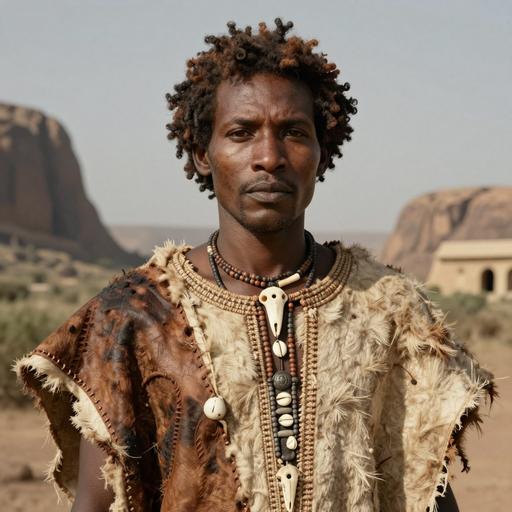
部门背景
mtDNA 谱系分支 L0D1B2B1 的历史背景
Origins and Evolution
L0D1B2B1 is a terminal subclade nested under L0d, one of the deepest branches of the human mitochondrial phylogeny. L0 lineages show their greatest diversity in southern African forager populations (commonly referred to as Khoe‑San), consistent with a long regional history. Given its placement within L0D1B2B and the broader pattern of L0d diversification, L0D1B2B1 most likely arose in southern Africa during the Late Pleistocene (around 15 kya as an approximate coalescence time). The lineage's present-day rarity reflects a history of long-term population structure, small effective population sizes in foraging groups, and subsequent dilution by demographic events such as the Bantu expansions and later historic admixture.
Subclades (if applicable)
L0D1B2B1 is an intermediate/terminal clade in the mitochondrial tree derived from L0D1B2B. As currently sampled it appears to be a relatively narrow subbranch with few (or no widely documented) deep downstream subdivisions; this pattern is consistent with a lineage that either remained restricted to small forager populations or experienced strong genetic drift. Additional targeted sampling and higher-resolution mitogenome sequencing in southern Africa and neighboring regions could reveal further internal structure or confirm its status as a terminal lineage.
Geographical Distribution
The highest frequency and diversity of L0D1B2B1 are observed in southern African Khoe‑San populations (for example, Ju|'hoan, !Kung, Nama and related groups). Low-to-moderate frequencies are observed in some neighboring Bantu-speaking populations and, more rarely, in parts of East and Central Africa; these occurrences are most parsimoniously explained by historic and prehistoric admixture and gene flow. Occasional low-frequency occurrences in North Africa, the Near East, and the African diaspora (Americas) reflect more recent movements and the transatlantic slave trade rather than the region of origin.
Historical and Cultural Significance
Because L0D1B2B1 sits within L0d, a clade strongly associated with Khoe‑San foragers, it contributes to our understanding of deep maternal ancestry in southern Africa and the demographic history of hunter‑gatherer groups during the Late Pleistocene and Holocene. The lineage helps trace contacts between forager groups and incoming agriculturalists (Bantu expansions) and later historic admixture events. In population-genetic terms, the haplogroup is informative about isolation, drift, and episodic gene flow in low-density forager populations.
Conclusion
L0D1B2B1 is a scientifically informative but rare maternal lineage that highlights the antiquity of southern African maternal diversity and the demographic processes that shaped modern African populations. Continued mitogenome sequencing across under-sampled southern African communities and neighboring regions will refine age estimates, reveal any hidden substructure, and clarify the pathways by which this lineage spread at low frequency beyond its core Khoe‑San distribution.
关键点
- Origins and Evolution
- Subclades (if applicable)
- Geographical Distribution
- Historical and Cultural Significance
- Conclusion