部门背景
mtDNA 谱系分支 L4B2A1 的历史背景
Origins and Evolution
mtDNA haplogroup L4B2A1 is a subclade of L4B2A (here referenced as L4B2AA in some phylogenies) and therefore sits within the broader African L4 branch. Haplogroup L4 itself is an ancient African maternal lineage, and its subclades show deep diversification in eastern and northeastern Africa. L4B2A1 likely arose as a local derivative within East Africa during the Holocene (several thousand years ago), although precise age estimates are uncertain due to limited sampling and resolution of sequences assigned to this fine-scale clade.
Because L4B2A1 is an intermediate/terminal lineage in the L4 phylogeny, it helps connect parent and child lineages and can be informative about localized maternal population structure and demographic events (for example, low-level expansions or persistence of small, regionally restricted maternal lineages).
Subclades (if applicable)
As a narrow subclade, L4B2A1 may itself contain downstream variants identifiable only through full mitochondrial genome sequencing. At present, available public phylogenies and population surveys indicate L4B2A1 is a terminal or near-terminal branch; further high-resolution mtDNA sequencing across East African populations is required to resolve any additional internal substructure or to identify reliably named downstream subclades.
Geographical Distribution
Available population-genetic data for broader L4 and L4B2 lineages show highest frequencies and diversity in the Horn of Africa and adjacent East African regions. By phylogenetic position and the distribution of closely related L4 subclades, L4B2A1 is most plausibly concentrated in:
- Ethiopia, Eritrea and Somalia (Horn of Africa) — expected pockets of occurrence and higher haplotype diversity reflecting local origin or long-term presence.
- Kenya and Sudan — possible occurrences linked to regional population movements and historical contact.
- Lower frequencies in neighboring parts of North-East Africa and along routes of historical gene flow into the Nile Valley and the Arabian Peninsula.
However, concrete frequency estimates for L4B2A1 are limited by sparse reporting; targeted sampling and full mitogenome analysis are necessary to map its real-world distribution and diversity.
Historical and Cultural Significance
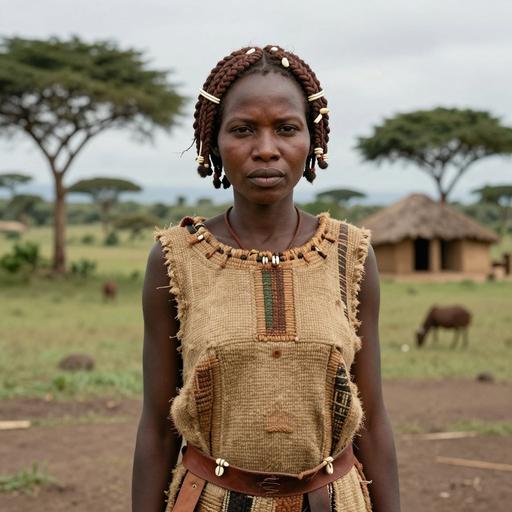
Because L4B2A1 appears to be an East African/ Horn-associated maternal lineage, it may track maternal ancestry through regional demographic processes during the Holocene such as the rise and spread of pastoralism, localized expansions of highland agriculturalists, or micro-differentiation among Nilotic, Cushitic, and Omotic-speaking groups. Any association with specific archaeological cultures (e.g., Pastoral Neolithic assemblages in eastern Africa) is currently hypothetical and should be treated cautiously: mtDNA lineages often persist through cultural transitions and do not map one-to-one onto archaeological cultures.
In genetic studies, lineages like L4B2A1 are valuable for reconstructing maternal population continuity, local female-mediated gene flow, and fine-scale demographic structure in the Horn and East Africa where L haplogroup diversity is highest.
Conclusion
L4B2A1 is a narrowly defined East African maternal lineage nested within the L4 clade. Current evidence points to a Holocene origin in the Horn/East African region and a restricted geographic distribution, but the clade remains under-characterized because of limited sampling and few published full mitogenomes assigned to it. Expanded, targeted sequencing across East African populations and clear reporting in phylogenetic resources will be needed to refine its age, spread, and any substructure.
Note: All inferences here are conservative and based on the phylogenetic position of L4B2A1 within L4 and the known distributions of related L4 subclades; empirical validation requires more comprehensive mitogenome data from East African populations.
关键点
- Origins and Evolution
- Subclades (if applicable)
- Geographical Distribution
- Historical and Cultural Significance
- Conclusion