部门背景
mtDNA 谱系分支 U4B1A4 的历史背景
Origins and Evolution
Haplogroup U4B1A4 is a downstream branch of the U4B1A subclade, itself nested within the broader European-centered mtDNA haplogroup U4. The parent U4 lineage is rooted in postglacial hunter-gatherer populations of northern and eastern Europe, with many basal U4 branches dating to the Early Holocene (~12 kya). U4B1A4 appears to have formed substantially later than the initial U4 expansion, likely during the later Neolithic to Bronze Age transition (on the order of a few thousand years ago), consistent with the formation of many fine-scale U4 subclades in regional northern Eurasian populations.
Genetically, U4B1A4 carries the diagnostic mutations of U4 and the defining mutations of the U4B1A node plus additional private mutations that mark the U4B1A4 branch. Its modest age and limited geographic spread indicate a regional origin with subsequent limited dispersal rather than a broad, early expansion.
Subclades
As a terminal or near-terminal branch (U4B1A4), this lineage currently has few or no widely recognized downstream subdivisions in public phylogenies; it is treated as a fine-scale terminal clade within U4B1A. Continued sequencing of mitogenomes from northern Eurasia may reveal additional substructure (further downstream clades) or related private branches that clarify its internal topology.
Geographical Distribution
U4B1A4 is principally a northern/eastern European lineage with spillover into adjacent northern Eurasian regions. Modern observations and ancient DNA records place it at low to moderate frequency in Scandinavia and the Baltic, parts of northwest Russia and neighboring eastern European areas, and intermittently among some Siberian and northern Eurasian indigenous populations. Lower-frequency occurrences have been reported in parts of Central Asia and the Caucasus, and very occasional incidental findings in South Asia likely reflect later long-distance gene flow or rare lineages carried by migrants.
In ancient DNA datasets U4B1A4 has been identified in a small number of archaeological samples (four in the reporting database for this subclade), often in contexts dated to the later Neolithic/Bronze Age and Iron Age in northern and northeastern Europe, consistent with a postglacial but regionally-restricted maternal continuity.
Historical and Cultural Significance
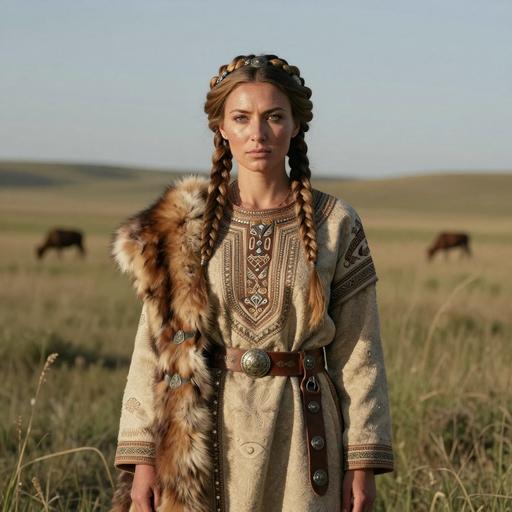
Because of its root in the U4 lineage, U4B1A4 connects to the broader story of postglacial hunter-gatherer persistence in northern Europe. While U4 as a whole is often found among Mesolithic hunter-gatherers, U4B1A4 itself seems to reflect more recent regional diversification and persistence through the Neolithic and Bronze Age. It is sometimes detected in archaeological contexts associated with northern or northeastern European cultural horizons and in populations influenced by steppe and forest-steppe interactions, but it is not a defining marker of any single major pan-regional archaeological culture.
The clade's low modern frequency, coupled with its presence in a few ancient samples, makes it useful for fine-scale regional studies of maternal continuity, migration, and local demographic history in northern Eurasia. It may also help trace maternal line continuity between Mesolithic/Neolithic hunter-gatherer substrata and later Bronze Age populations in northern Europe.
Conclusion
U4B1A4 is a geographically focused, relatively young subclade within the U4 family that illustrates localized maternal lineage diversification in northern and northeastern Europe during the later Holocene. Its limited distribution and small number of ancient occurrences make it most informative for regional population-history and ancient DNA studies rather than as a broad marker of large-scale prehistoric migrations.
关键点
- Origins and Evolution
- Subclades
- Geographical Distribution
- Historical and Cultural Significance
- Conclusion