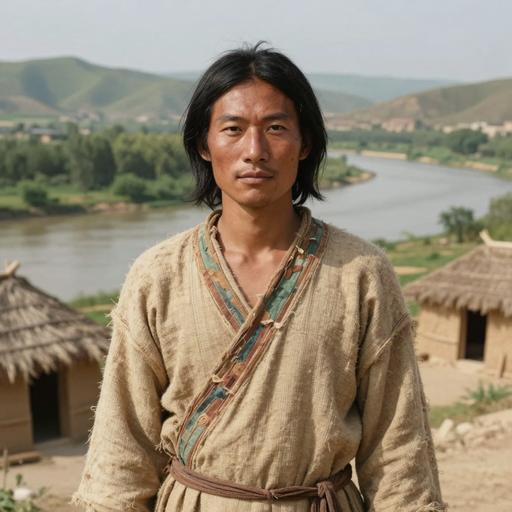
部门背景
Y-DNA 谱系分支 O1B1A2 的历史背景
Origins and Evolution
Y-DNA haplogroup O1B1A2 is a downstream subclade of O1B1A, itself part of the broader East Asian paternal clade O-M268. Because it sits at an intermediate position within a lineage that is widespread in southern East Asia and Southeast Asia, O1B1A2 is best understood as a Holocene-era derivative lineage that likely formed in or near southern China, mainland Southeast Asia, or an adjacent region where O1B1A lineages were already established.
While direct ancient-DNA resolution for O1B1A2 remains limited, the phylogenetic context of its parent clades suggests that its diversification was tied to demographic growth after the Last Glacial Maximum, especially during the transition from foraging to food-producing societies. The estimated age for this subclade is therefore placed in the early to middle Holocene, roughly around 15 thousand years ago, though the exact age may vary depending on future phylogenetic refinements and newly sampled lineages.
Subclades
As an intermediate haplogroup, O1B1A2 may itself contain multiple derived branches that are not always well represented in public datasets. In general, subclades of O-lineages in this part of the tree often show geographic structuring tied to language families and regional population history.
Key interpretive points include:
- It is nested within a major East Asian lineage rather than representing a deep basal branch.
- Its descendants likely reflect regional founder effects and population expansions within southern East Asia.
- The subclade may show uneven sampling because many O-lineage branches remain under-characterized in low-coverage or regionally limited studies.
Geographical Distribution
Haplogroup O1B1A2 is expected to be found primarily in southern China and mainland Southeast Asia, with additional presence in adjacent populations that historically experienced gene flow from those regions. Based on the distribution of the parent clade O1B1A, likely carriers include:
- Southern Han Chinese and related southern East Asian groups
- Vietnamese and other mainland Southeast Asian populations
- Tai-Kadai-speaking populations
- Austroasiatic-speaking populations
- Austronesian-speaking populations in Taiwan and Island Southeast Asia
- Some Korean and Japanese lineages at lower frequency
- Certain Tibeto-Burman-speaking populations in the broader East Asian-Himalayan interface
The lineage is not typically associated with high frequency in northern East Asia, but it may appear there through historical migration, admixture, or local founder events.
Historical and Cultural Significance
The broader O-M268/O1B1A radiation is strongly connected to the demographic history of southern East Asia, where Neolithic farming expansions, language dispersals, and later regional state formation contributed to the spread of paternal lineages. O1B1A2 likely participated in these same historical processes, especially in populations linked to the Yangtze River basin, coastal southern China, and mainland Southeast Asia.
This haplogroup may be informative in studies of:
- Neolithic population structure in southern China
- The spread of Austroasiatic, Tai-Kadai, and Austronesian-associated paternal lineages
- Regional differentiation among Sinitic, Tai-Kadai, Austroasiatic, and Austronesian populations
- Post-Neolithic expansions associated with trade, agriculture, and state-level societies
Although no single archaeological culture can be assigned to O1B1A2 with confidence, it likely reflects a lineage embedded in the broader Neolithic to Bronze Age transformation of East and Southeast Asia.
Conclusion
Y-DNA haplogroup O1B1A2 is a derived East Asian paternal lineage with its deepest roots in the broader expansion history of O-M268. Its present-day distribution likely reflects Holocene population growth and regional dispersals across southern China, mainland Southeast Asia, and neighboring areas, making it a useful marker for reconstructing the male-line history of East and Southeast Asian populations.
关键点
- Origins and Evolution
- Subclades
- Geographical Distribution
- Historical and Cultural Significance
- Conclusion