Echoes of Early Bronze Sardinia

下载的 PDF 是图像副本。如需可选中文本及更好的辅助技术支持,请使用打印功能。

Echoes of Early Bronze Sardinia

揭开一个失落的文明

正在加载考古记录……

正在收集古代记录

跳转到主内容
Echoes of Early Bronze Sardinia
文明焦点

Echoes of Early Bronze Sardinia

Cave light and bronze shadows: genetic glimpses into Sardinia, 2468–1600 BCE

2468 CE - 1600 BCE
Sardinia, Italy
滚动开始
Chapter I

剧情

了解 Echoes of Early Bronze Sardinia 文化

Archaeogenetic portrait of Sardinia's Early Bronze Age (2468–1600 BCE) from 28 samples across cave and shelter sites. Y haplogroups R and I and diverse mtDNA hint at both incoming male lineages and local maternal continuity within island funerary landscapes.

Time Period

2468–1600 BCE (Early Bronze Age)

Region

Sardinia, Italy

Common Y-DNA

R (11), I (8), R1 (1)

Common mtDNA

K (5), J (5), H (4), T (3), U (3)

Chapter II

时间线

这种文化历史上的关键时刻

2500 BCE

Early Bronze Age activity across Sardinian caves

Cave and shelter sites like Su Crucifissu Mannu and Su Stampu Erdi are used for habitation, craftwork and burial—material and genetic traces begin to reflect both local continuity and wider connections.

Chapter III

Origins & Emergence

Sardinia's Early Bronze Age unfolds in a theater of limestone cliffs, cave mouths, and sheltered coastal promontories. Archaeological data indicates habitation and mortuary use of rock shelters such as Su Crucifissu Mannu (Porto Torres), Su Stampu Erdi, Su Grutta ’e is Bittuleris and Grutta I de Longu Fresu (Seulo), Padru Jossu (Seneghe) and Riparo sotto roccia Su Asedazzu. Radiocarbon-dated contexts fall between 2468 BCE and 1600 BCE, marking a centuries-long phase of local adaptation and broader Mediterranean contact.

Material remains from these contexts—ceramics, metal objects, and personal ornaments—point to increasing metallurgical knowledge and exchange networks during the Early Bronze Age. Limited evidence suggests both persistent local traditions inherited from Neolithic and Chalcolithic communities, and new cultural influences arriving by sea or via continental corridors. Genetically, the island's assemblage preserves signatures of continuity alongside markers commonly associated with wider Bronze Age population movements.

Archaeological interpretations must remain cautious: depositional complexity in caves complicates chronology, and the current genetical sample set, while informative, is one piece of a larger puzzle. Ongoing excavation and additional ancient DNA sampling will refine narratives of how Sardinia’s communities emerged and interacted in this liminal island landscape.

  • Sites include Su Crucifissu Mannu, Su Stampu Erdi, Su Grutta ’e is Bittuleris
  • Dates span 2468–1600 BCE, Early Bronze Age contexts
  • Evidence of local continuity plus external contacts via artifacts and genetics
Chapter IV

Daily Life & Society

Life in Early Bronze Age Sardinia was shaped by rocky coasts, shepherding plains, and cave-roofed shelters that doubled as homes, workshops and tombs. Archaeological assemblages show vibrant craft traditions: pottery forms used for storage and cooking, copper-alloy objects signaling access to metalworking, and personal ornaments that index status, identity and long-distance exchange. Rock shelters such as Riparo Su Asedazzu preserve stratified debris suggesting repeated seasonal or generational use.

Cemeteries and burial deposits reveal varied funerary practices—single inhumations, multiple interments and curated skeletal deposits—indicating complex social registers and perhaps kin-based groupings. Animal remains attest to herding of sheep and goats, supplemented by wild resources. Subsistence strategies likely combined pastoralism with horticulture and marine foraging, integrating island-specific resources into daily rhythms.

Craft specialization and long-distance trade appear to have coexisted with strong local traditions, producing a society that was both rooted and outward-looking. Yet archaeological visibility is uneven: many deposits are disturbed or isolated within caves, and social organization must be inferred indirectly from material traces. The 28 genetic samples tied to these sites add a new dimension, allowing us to see not just objects but the biological ties that underpinned these communities.

  • Pastoral economy with sheep/goat herding and local cultivation
  • Burial diversity (single, multiple, curated deposits) suggests complex social structures
Chapter V

Genetic Profile

Twenty-eight ancient individuals from Sardinian cave and shelter contexts yield a genetic snapshot of Early Bronze Age islanders. The Y-chromosome distribution shows a prominence of haplogroup R (11 individuals) and haplogroup I (8 individuals), with one sample assigned more specifically to R1. Mitochondrial lineages are diverse—K (5), J (5), H (4), T (3) and U (3)—reflecting a range of maternal ancestries.

This pattern suggests a mixed genetic landscape. The presence of R-lineages, which elsewhere in Europe are often associated with Bronze Age continental expansions, hints at incoming male-mediated ancestry or contacts during the Early Bronze Age. Simultaneously, the variety of mtDNA types—some common in Neolithic and later European populations—points to substantial continuity of maternal lines on the island.
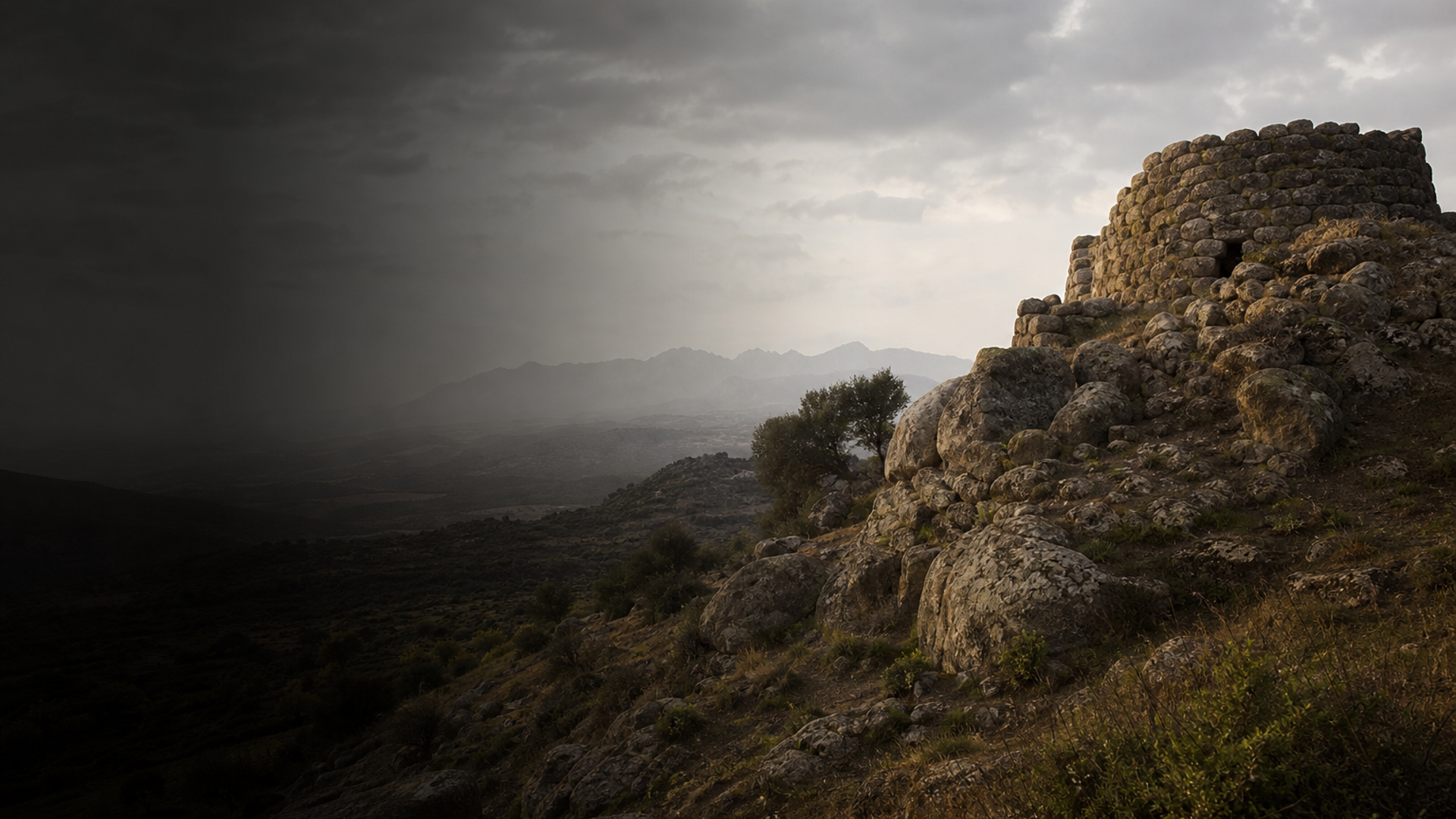

Interpreting these signals requires caution. While the sample size of 28 is meaningful, spatial clustering in caves and potential kinship within burial groups can bias frequencies; therefore, conclusions about island-wide population shifts remain provisional. Population genetic modeling that integrates these samples with contemporaneous mainland data can clarify the magnitude of external gene flow versus local persistence. For now, the genetic evidence paints a cinematic image: Sardinia as a place of enduring local roots threaded with strands of wider Bronze Age mobility.

  • Y-DNA dominated by haplogroups R and I, suggesting mixed male lineages
  • mtDNA diversity (K, J, H, T, U) indicates maternal continuity and admixture
Chapter VI

Legacy & Modern Connections

The Early Bronze Age is a formative chapter in Sardinia’s deep past, leaving demographic echoes detectable in later millennia. Modern Sardinian populations show a degree of genetic continuity with ancient islanders, but also layers of subsequent contact and change. Archaeological continuity in settlement patterns, craft traditions and funerary forms further links Bronze Age people to later cultural horizons on the island.

Genetically, the admixture of local maternal lineages with some incoming paternal signatures contributes to the island’s distinctive genetic profile seen in both ancient and modern datasets. However, the story is not simple continuity: migrations, trade and cultural transformations in the Bronze and Iron Ages reshaped ancestry over time. Continued sampling from more sites and integration with mainland sequences will sharpen our understanding of how these Early Bronze Age communities contributed to the living heritage of Sardinia.

  • Ancient DNA shows threads of continuity with modern Sardinians, amid later admixture
  • Further sampling needed to resolve the island-wide impact of Early Bronze Age gene flow
AI 电源

AI 助手

就 Echoes of Early Bronze Sardinia 文化提问

AI 助手 由DNAGENICS公司制作

解锁此特性
Ask questions about the Echoes of Early Bronze Sardinia culture. Our AI assistant can explain genetic findings, historical context, archaeological evidence, and modern connections.
AI 样本分析

Echoes of Early Bronze Sardinia 文化是人类历史中值得了解的一章……

遗传分析揭示了与早期种群的联系,同时显示了独特的适应和文化创新的证据。 古代DNA样本提供了对迁徙模式、社会结构以及古代种群之间的生物关系的深刻见解。

这是人工智能分析的预览。 解锁全AI 助手, 以探索关于:

  • 遗传组成和祖先
  • 移徙模式和起源
  • 日常生活和文化习俗
  • 现代遗传遗产

探索更古老的文化

揭开古代世界文明的故事

使用优惠码 可减免 35% • 11月12日 到期




