Huatuyan Cave: Ming-era Lives in Guangxi

下载的 PDF 是图像副本。如需可选中文本及更好的辅助技术支持,请使用打印功能。

Huatuyan Cave: Ming-era Lives in Guangxi

揭开一个失落的文明

正在加载考古记录……

正在收集古代记录

跳转到主内容
Huatuyan Cave: Ming-era Lives in Guangxi
文明焦点

Huatuyan Cave: Ming-era Lives in Guangxi

Small cave community in Hechi County (1400–1700 CE) connecting archaeology with maternal lineages

1400 CE - 1700 CE
Guangxi, Southern China (Hechi, Nandan County)
滚动开始
Chapter I

剧情

了解 Huatuyan Cave: Ming-era Lives in Guangxi 文化

Archaeological and ancient DNA data from Huatuyan Cave (Nandan, Guangxi) illuminate a small Ming-period community. Limited samples (n=8) show diverse maternal haplogroups typical of southern China. Evidence is preliminary but suggests local continuity with southern coastal and inland populations.

Time Period

1400–1700 CE (Ming era)

Region

Guangxi, Southern China (Hechi, Nandan County)

Common Y-DNA

Not reported / insufficient Y-chromosome data

Common mtDNA

D (2), F (1), N (1), M (1), R (1)

Chapter II

时间线

这种文化历史上的关键时刻

1400 CE

Ming-period occupation begins (approx.)

Archaeological and radiocarbon indicators place human activity at Huatuyan Cave beginning around the early 1400s CE, within the Ming dynasty context.

Chapter III

Origins & Emergence

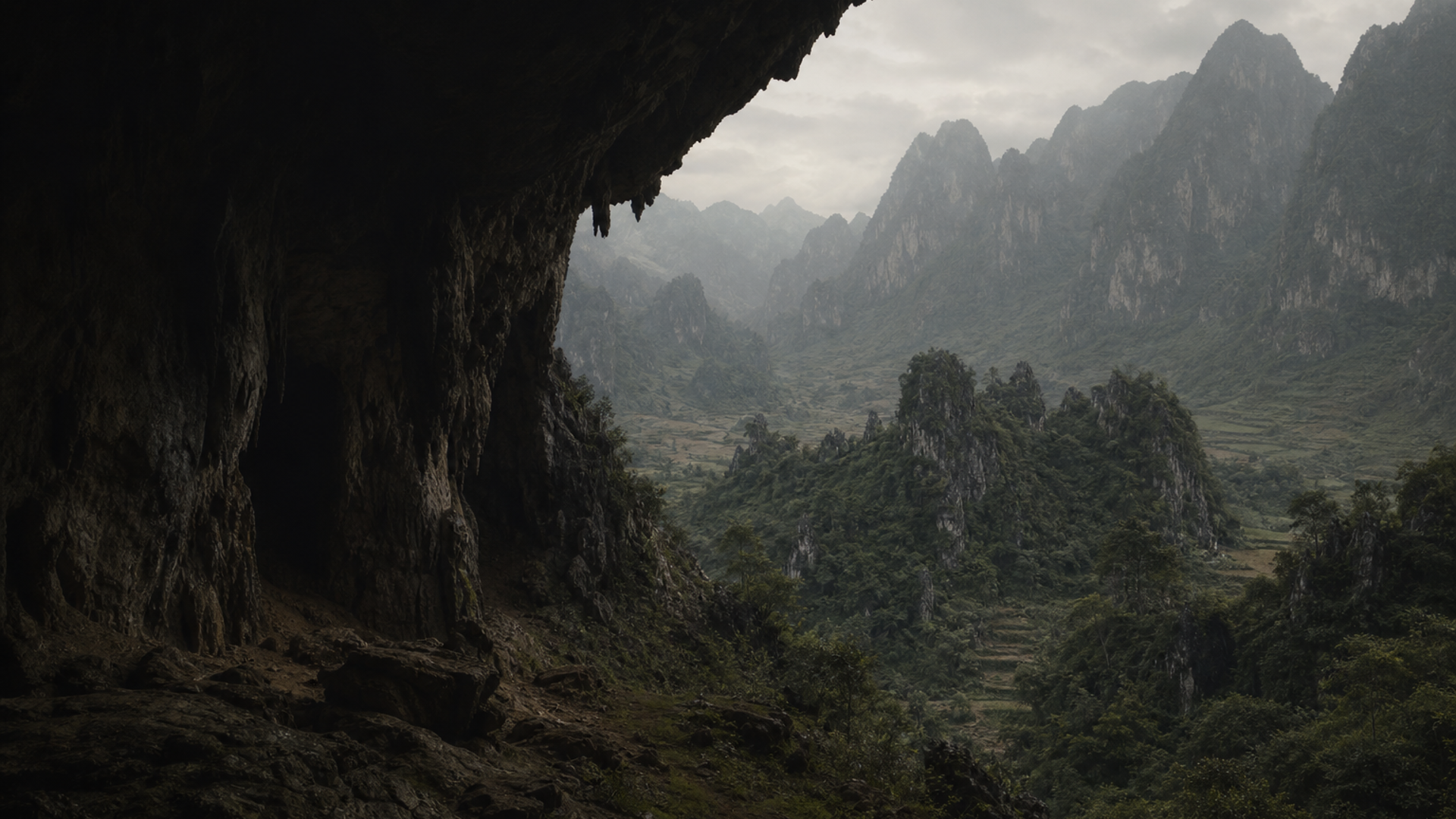
Huatuyan Cave sits on a limestone outcrop overlooking the valleys of Lihu Yaozu Town, Huatu Village in Nandan County (Hechi City, Guangxi). Archaeological data indicates episodic use of the cave across the late medieval period, concentrated within the Ming dynasty centuries (roughly 1400–1700 CE). Excavations yielded discrete hearth features, small assemblages of ceramic fragments and faunal remains, and human skeletal material in disturbed depositional contexts consistent with a small, possibly seasonally occupied settlement or communal burial area.

The cinematic layers of soot-stained walls and broken sherds speak to everyday continuity rather than elite construction—people living at the forest's edge, adapting to a karst landscape. Limited evidence suggests links with broader Ming-era material culture in southern China, but local practices likely persisted, creating a hybrid of regional traditions and household-level adaptations. Spatially, the site is one among many small cave and rock-shelter occupations documented in Guangxi, reflecting a pattern of localized habitation rather than a major population center.

Archaeological interpretation remains cautious: stratigraphic disturbance, small assemblage size, and sparse contextual information limit firm conclusions about chronology and social organization. The story that emerges is provisional—a fragmentary portrait of a small Ming-era community embedded in Guangxi's rugged landscape.

  • Site: Huatuyan Cave, Huatu Village, Lihu Yaozu Town, Nandan County, Hechi City
  • Date range: 1400–1700 CE, within the Ming dynasty period
  • Occupation scale: small cave occupation or community use; evidence is limited and locally focused
Chapter IV

Daily Life & Society

Archaeological traces at Huatuyan evoke intimate, everyday scenes: small hearths offering warmth and the routine of cooking; ceramic fragments hinting at pots used for stews and grain processing; and faunal bone fragments that suggest hunting, trapping, or small-scale animal husbandry. The cave's sheltered position would have offered protection from seasonal rains and a vantage over terraced fields and forest resources below.

Social organization likely revolved around kin networks and household groups rather than centralized authority. Material culture recovered is modest, suggesting a community making pragmatic use of locally available resources. The archaeological record does not preserve clear indicators of elaborate ritual paraphernalia, though funerary deposits and skeletal remains point to established mortuary practices in the locale. Ethnographic parallels in southern China underline how households in marginal landscapes blended agriculture, foraging, and craft production—patterns that could plausibly reflect life at Huatuyan, but direct parallels should be drawn cautiously given limited data.

  • Economy: mixed subsistence — local agriculture, forest resources, small hunting
  • Social scale: household/kin-based community; no evidence for elite settlement at site
Chapter V

Genetic Profile

Ancient DNA analysis from Huatuyan Cave includes eight sampled individuals dated to the 1400–1700 CE range. This is a small dataset: because the sample count is under 10, conclusions must be regarded as preliminary. Maternal lineages (mtDNA) were resolved for several individuals and show haplogroups commonly associated with East and Southeast Asia: D (2 individuals), F (1), N (1), M (1), and R (1). These maternal haplogroups are widely distributed in southern China and parts of mainland Southeast Asia and are consistent with continuity of regional maternal ancestry during the late medieval period.

Y-chromosome (paternal) haplogroup information is not reported or was insufficiently preserved for confident assignment in the available samples, limiting insights into paternal lineages and patrilineal structure. Some samples exhibited low coverage or degraded DNA, which explains why not all eight individuals yielded full mitochondrial or nuclear profiles.

Genetic affinities inferred from available genomic markers tentatively suggest alignment with contemporary and ancient southern Chinese populations rather than large-scale influx from distant regions during the sampled interval. However, low sample counts, potential kinship among sampled individuals, and limited geographic scope mean that these genetic patterns should be treated as a preliminary window into local population history rather than definitive evidence of population continuity or migration.

  • Sample count: 8 individuals — small dataset; interpretations are preliminary
  • mtDNA diversity: D (2), F (1), N (1), M (1), R (1); Y-DNA data insufficient or not reported
Chapter VI

Legacy & Modern Connections

Huatuyan Cave's genetic and archaeological traces offer a fragile but evocative thread connecting the Ming-era people of Guangxi to the present-day genetic landscape of southern China. The maternal lineages observed are consistent with haplogroups still common in Guangxi and neighboring provinces, hinting at long-term regional continuity in maternal ancestry. At the same time, the diversity of mtDNA types within a small assemblage underscores the complex social networks—marriage patterns, mobility, and local assimilation—that shaped population structure in late medieval times.

Archaeology and aDNA together emphasize nuance: continuity in some genetic lineages does not preclude cultural change, and small-scale communities like those at Huatuyan played a role in the broader mosaic of Ming-era society. Future work with larger sample sizes, better-preserved Y-chromosome data, and comparative regional sampling will refine these connections and test hypotheses about demographic change, migration, and kinship in southern China.

  • mtDNA affinities suggest potential continuity with modern southern Chinese populations
  • Further sampling and better Y-chromosome data are needed to clarify paternal lineages and migration
AI 电源

AI 助手

就 Huatuyan Cave: Ming-era Lives in Guangxi 文化提问

AI 助手 由DNAGENICS公司制作

解锁此特性
Ask questions about the Huatuyan Cave: Ming-era Lives in Guangxi culture. Our AI assistant can explain genetic findings, historical context, archaeological evidence, and modern connections.
AI 样本分析

Huatuyan Cave: Ming-era Lives in Guangxi 文化是人类历史中值得了解的一章……

遗传分析揭示了与早期种群的联系,同时显示了独特的适应和文化创新的证据。 古代DNA样本提供了对迁徙模式、社会结构以及古代种群之间的生物关系的深刻见解。

这是人工智能分析的预览。 解锁全AI 助手, 以探索关于:

  • 遗传组成和祖先
  • 移徙模式和起源
  • 日常生活和文化习俗
  • 现代遗传遗产

探索更古老的文化

揭开古代世界文明的故事

使用优惠码 可减免 35% • 11月12日 到期




