Lambayeque of El Brujo

下载的 PDF 是图像副本。如需可选中文本及更好的辅助技术支持,请使用打印功能。

Lambayeque of El Brujo

揭开一个失落的文明

正在加载考古记录……

正在收集古代记录

跳转到主内容
Lambayeque of El Brujo
文明焦点

Lambayeque of El Brujo

Coastal powerhouses of northern Peru — archaeology and DNA from 750–1300 CE

750 CE - 1300 CE
El Brujo, Lambayeque coast, Peru
滚动开始
Chapter I

剧情

了解 Lambayeque of El Brujo 文化

Archaeological evidence from El Brujo (Lambayeque region) dated 750–1300 CE shows coastal complex societies with monumental adobe architecture. Ancient DNA (3 samples) yields primarily Y‑haplogroup Q and Native American mtDNA lineages, but small sample size makes conclusions preliminary.

Time Period

750–1300 CE (Middle Horizon → Late Intermediate)

Region

El Brujo, Lambayeque coast, Peru

Common Y-DNA

Q (2 of 3 samples)

Common mtDNA

C1c (1), A2 (1), C1b (1)

Chapter II

时间线

这种文化历史上的关键时刻

750 CE

Emergence of Lambayeque‑associated contexts at El Brujo

Local archaeological strata show growing monumentality and complex burials, marking regional reorganization after Middle Horizon influences.

Chapter III

Origins & Emergence

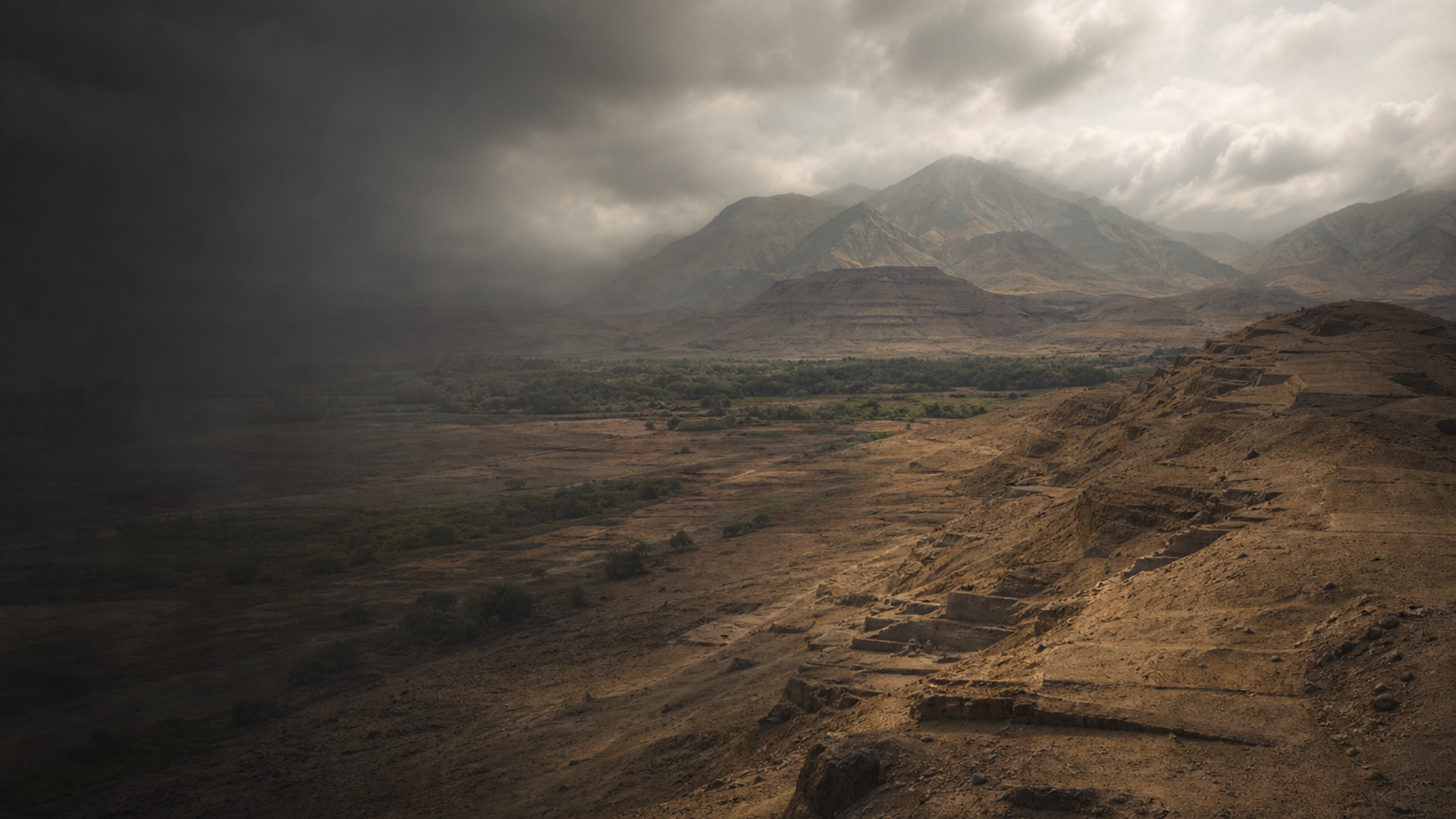
Along the arid northern coast of Peru, the cultural horizon broadly labeled “Lambayeque” (often associated with the Sicán tradition) emerges in the centuries after the Middle Horizon. Archaeological strata at El Brujo — a multi‑huaca complex in the Lambayeque valley — preserve adobe pyramids, painted friezes, and rich burial deposits that testify to growing social complexity between roughly 750 and 1300 CE. Environmental reconstructions and irrigation features indicate intensified agriculture and control of coastal wetlands that supported population aggregation and craft specialization.

Archaeological data indicates continuity with earlier coastland traditions in ceramic style and monumentality, yet regional reorganization after the Middle Horizon created new local polities and elites. Limited evidence suggests ritualized display of wealth and maritime resource exploitation played roles in elite identity. Mortuary contexts and grave goods point to ranked social structures, but settlement evidence is still incomplete: many Lambayeque-era coastal sites remain only partially excavated.

Because the genomic sample set from this cultural label is small, inferences about origins and population movement must be tentative. Genetic signals consistent with long‑standing Andean and coastal lineages support the archaeological picture of local development with possible links to broader Andean networks.

  • El Brujo complex in northern Peru preserves Lambayeque-era adobe pyramids and murals
  • Dates span c. 750–1300 CE, a transition from Middle Horizon influence to Late Intermediate regionalism
  • Evidence points to irrigation agriculture, craft specialization, and emerging elite control
Chapter IV

Daily Life & Society

Life along the Lambayeque coast would have been shaped by a dramatic, cinematic juxtaposition of oceans, deserts, and irrigated green strips of fields. Communities clustered around canal-fed agriculture where maize, beans, squash, and cotton were staples; cotton supported textile production, and marine resources supplemented diets. Archaeological excavation at El Brujo documents craft workshops, ceramic production areas, and storage facilities that indicate organized production beyond household subsistence.

Monumental mounds (huacas) dominated the visual landscape and served as centers for ritual performance, elite burial, and possibly redistribution. Burials exhibit variability — from modest interments to richly furnished tombs — suggesting social differentiation. Iconography on ceramics and murals depicts animals, maritime scenes, and abstract motifs that likely signaled lineage, office, or religious affiliation. Funerary offerings and metal objects point to long‑distance exchange and skilled metallurgy in Lambayeque contexts.

However, direct evidence for household organization, daily diets at individual sites, and the extent of regional trade corridors remains uneven. Continued excavation and integration with isotopic and genetic studies will refine reconstructions of daily life.

  • Irrigated agriculture and marine resources underpinned coastal livelihoods
  • Huacas functioned as ritual, political, and economic centers with evidence of craft workshops
Chapter V

Genetic Profile

Three ancient individuals from El Brujo dated between 750 and 1300 CE provide a preliminary window into the Lambayeque genetic landscape. Two of the three male-associated samples carry Y‑chromosome haplogroup Q, a lineage widely observed among Indigenous populations of the Americas and consistent with deep paternal continuity on the continent. Maternal lineages in the set include mtDNA haplogroups C1c, A2, and C1b — clades common across Andean and coastal populations.

These results align with archaeological expectations for long‑standing local ancestry rather than large‑scale recent population replacement. Nevertheless, the sample count is very small (<10), so patterns of kinship, social selection of burial individuals, and regional heterogeneity cannot be robustly established. For example, elite burials may be non‑representative of population averages; genetic signals from three individuals cannot resolve subtle admixture events or demographic shifts.

Future work integrating larger ancient DNA datasets from neighboring Lambayeque, Moche, and highland sites, together with isotopic mobility studies and radiocarbon dating, will be essential to test hypotheses about coastal–highland interaction, patrilineal descent, and the genetic footprint of Late Intermediate Period political change. Presently, the DNA evidence supports continuity with broader Native American paternal and maternal lineages while cautioning that conclusions are provisional.

  • Y haplogroup Q dominant in the small sample set (2 of 3), consistent with Native American paternal lineages
  • mtDNA diversity (C1c, A2, C1b) matches common Andean/coastal maternal lineages; sample size limits firm conclusions
Chapter VI

Legacy & Modern Connections

Material and genetic traces of the Lambayeque world persist in the cultural memory and genomes of contemporary northern Peruvian populations. Many modern communities along the Lambayeque and La Libertad coasts maintain agricultural practices and textile motifs that echo ancient traditions. The genetic markers identified in these three ancient individuals — haplogroup Q and Native American mtDNA clades — are also observed in living Indigenous and mestizo populations, emphasizing continuity across centuries.

Archaeological conservation at El Brujo and related sites provides tangible links between past and present, but researchers stress that cultural continuity is complex and mediated by migration, colonial disruption, and social change. Given the limited number of ancient genomes available, claims about direct ancestry to specific modern groups must be made cautiously and in collaboration with descendant communities. Ongoing collaborative research that combines archaeology, aDNA, and community knowledge offers the most reliable pathway to understanding how the Lambayeque past shapes contemporary identities.

  • Genetic continuity with common Native American lineages suggests long-term ancestry ties
  • Archaeological motifs, agricultural systems, and craft traditions have echoes in regional cultural practices
AI 电源

AI 助手

就 Lambayeque of El Brujo 文化提问

AI 助手 由DNAGENICS公司制作

解锁此特性
Ask questions about the Lambayeque of El Brujo culture. Our AI assistant can explain genetic findings, historical context, archaeological evidence, and modern connections.
AI 样本分析

Lambayeque of El Brujo 文化是人类历史中值得了解的一章……

遗传分析揭示了与早期种群的联系,同时显示了独特的适应和文化创新的证据。 古代DNA样本提供了对迁徙模式、社会结构以及古代种群之间的生物关系的深刻见解。

这是人工智能分析的预览。 解锁全AI 助手, 以探索关于:

  • 遗传组成和祖先
  • 移徙模式和起源
  • 日常生活和文化习俗
  • 现代遗传遗产

探索更古老的文化

揭开古代世界文明的故事

使用优惠码 可减免 35% • 11月12日 到期




