Nuragic Early Bronze Sardinians

下载的 PDF 是图像副本。如需可选中文本及更好的辅助技术支持,请使用打印功能。

Nuragic Early Bronze Sardinians

揭开一个失落的文明

正在加载考古记录……

正在收集古代记录

跳转到主内容
Nuragic Early Bronze Sardinians
文明焦点

Nuragic Early Bronze Sardinians

Three Sardinian individuals (2297–2038 BCE) linking island life to shifting Bronze Age genomes

2297 CE - 2038 BCE
Sardinia, Italy
滚动开始
Chapter I

剧情

了解 Nuragic Early Bronze Sardinians 文化

Archaeological and genetic glimpses from three Early Bronze Age individuals in Sardinia (2297–2038 BCE) connect Nuragic material culture with signals of local continuity and Neolithic farmer ancestry. Small sample size makes conclusions preliminary.

Time Period

2297–2038 BCE

Region

Sardinia, Italy

Common Y-DNA

I (observed)

Common mtDNA

J (2), T (1)

Chapter II

时间线

这种文化历史上的关键时刻

2200 BCE

Early Nuragic Emergence

Communities on Sardinia develop early Nuragic practices—megalithic architecture, pastoral economies, and emergent metallurgy—at sites like Su Crucifissu Mannu.

Chapter III

Origins & Emergence

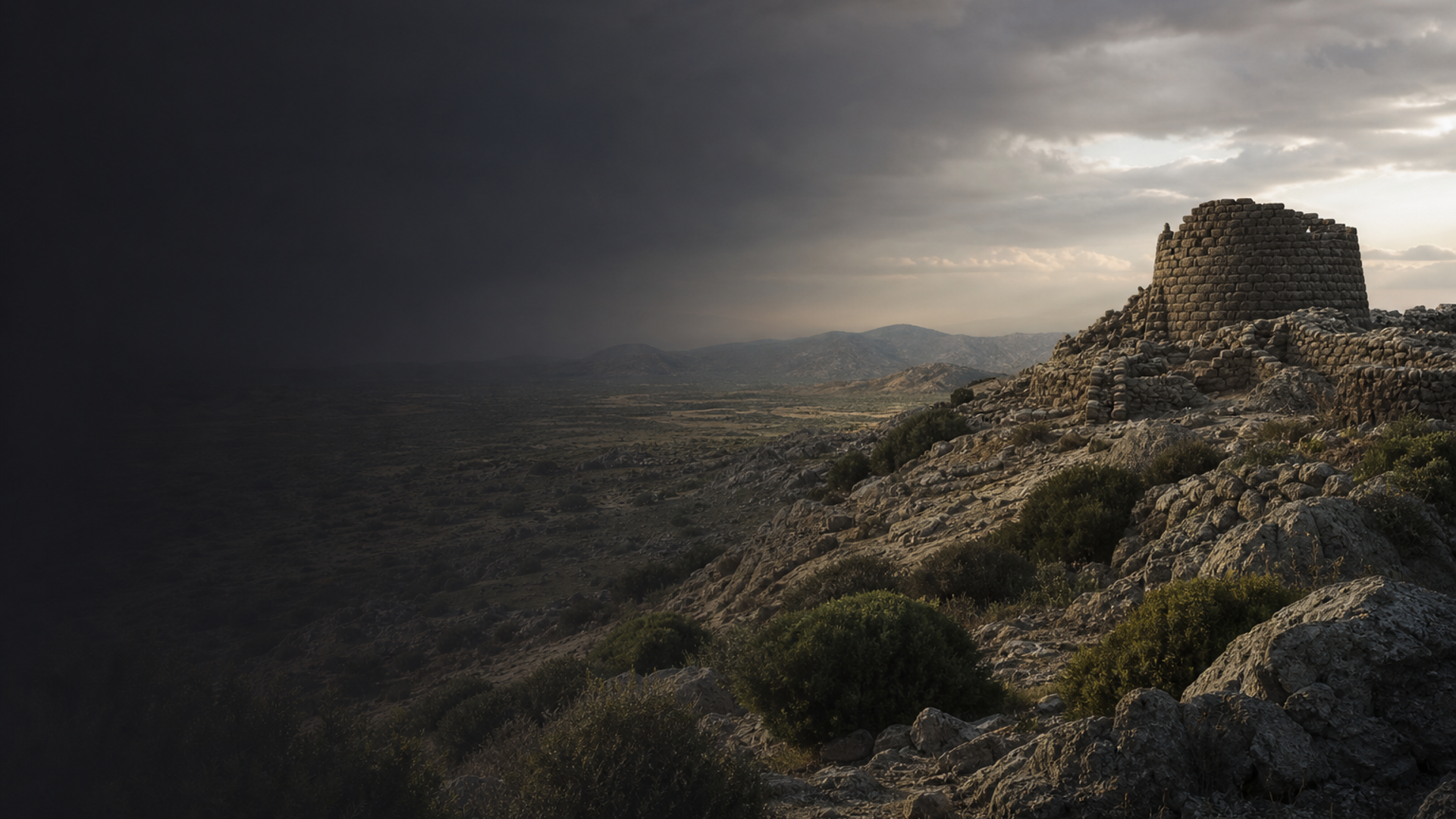
The three sampled individuals come from Early Bronze Age contexts on northern Sardinia — Usini (SS. S’Iscia ‘e sas Piras) and Porto Torres (Su Crucifissu Mannu, including tomb t.16). Archaeological data indicates these burials fall within the formative phases of the Nuragic cultural horizon (circa 2300–2000 BCE), a time when island communities elaborated new social landscapes: megalithic monuments grew in scale, pastoral economies intensified, and metalworking spread.

Cinematic in their stillness, these skeletons are anchors in a sea of changing material life. Limited evidence suggests a blend of long-standing island traditions and contacts with broader Mediterranean exchange networks. The presence of domesticates, animal pens, and early bronze artifacts in regional assemblages implies a mixed economy of herding, local cultivation, and increasing craft specialization. Archaeological traces of community tombs and fortified nuraghi begin to appear in this period, pointing to emerging social differentiation and communal investments in stone architecture.

Because only three genomes are available from these precise Early Bronze Age sites, archaeological interpretation must remain cautious. The genetic signals we observe are best treated as preliminary glimpses: they illuminate continuity with Neolithic populations and the persistence of island-specific lineages, but cannot yet capture the full demographic complexity of the entire Nuragic emergence.

  • Sites: Usini (S’Iscia ‘e sas Piras) and Porto Torres (Su Crucifissu Mannu)
  • Context: Early Bronze Age / early Nuragic horizon (c. 2297–2038 BCE)
  • Caution: Conclusions are preliminary given small sample size (n=3)
Chapter IV

Daily Life & Society

Archaeology paints daily life in cinematic strokes: sheepskin cloaks drying on low stone walls, smoke threading from hearths, and small bronze tools catching Mediterranean light. At Early Bronze Age Nuragic sites like Su Crucifissu Mannu, material remains suggest communities organized around livestock, seasonal pasturing, and localized craft production. Pottery styles, grinding stones, and animal bones together indicate diets of cereal staples and meat or dairy from sheep and goats.

Socially, the seeds of Nuragic complexity were being sown. Communal constructions and burial practices imply collective identities and remembered ancestors, while variation in grave goods hints at status differences. Trade connections are inferred from exotic raw materials and metallurgical techniques reaching the island, suggesting Sardinians were not isolated but participants in wider Mediterranean circuits.

Yet the archaeological record also emphasizes continuity: settlement patterns show enduring use of coastal and inland niches, and burial choices reflect long-term ritual habits. These material threads, when read alongside ancient DNA, help reconstruct how communities balanced local resilience with external influences during the first centuries of the Bronze Age.

  • Economy: Mixed pastoralism with local cultivation and emerging metallurgy
  • Society: Communal monuments and varied burial practices suggest growing social differentiation
Chapter V

Genetic Profile

The three genomes from Sardinia (2297–2038 BCE) provide a sparse but revealing genetic snapshot. Y-chromosome data shows haplogroup I in one male individual — a lineage often associated in Europe with Mesolithic and later local male ancestry. Mitochondrial DNA is dominated by haplogroup J (two individuals) and T (one individual), haplogroups frequently linked to Neolithic farmer dispersals from the Near East and Anatolia into Europe.
Taken together, the uniparental markers hint at a mosaic heritage: maternal lineages reflecting the Neolithic farming legacy, and at least some paternal continuity tied to long-standing European lineages. This pattern is consistent with broader ancient DNA trends in Sardinia that emphasize strong island continuity from Neolithic populations, with limited influxes of new ancestry compared with mainland Europe. However, with only three samples, these inferences are provisional. Small sample counts can miss rare lineages and overemphasize the frequencies observed in the dataset.

Archaeogenetic interpretation must therefore remain cautious: archaeological indicators of increased trade and metallurgy during the Early Bronze Age may have involved cultural transmission as much as population movement. Future sampling across Sardinia and adjacent islands will be required to resolve whether observed genetic signals reflect localized continuity, episodic migration, or a complex admixture of both.

  • Y-DNA: Haplogroup I observed (1/3)
  • mtDNA: Haplogroups J (2) and T (1), suggesting Neolithic maternal ancestry
Chapter VI

Legacy & Modern Connections

The echoes of Early Bronze Age Sardinians resonate in the island's deep genetic and cultural continuity. Modern Sardinians retain a distinct genetic signature compared with many mainland populations, and the mtDNA and Y-DNA markers seen in these Early Bronze Age individuals align with a picture of long-term island persistence rooted in the Neolithic with later local developments.

Archaeologically, the Nuragic era would later crystallize into a unique landscape of stone towers and communal monuments, but its roots are visible in these early Bronze Age lives. For present-day Sardinians and researchers, these genomes are powerful touchstones: cinematic snapshots that invite a patient, layered reconstruction of population history. Given the very small sample size (n=3), these connections are suggestive rather than definitive; they point to continuity but also to the need for broader sampling to trace lines from these Early Bronze Age individuals to later Nuragic and modern communities.

  • Modern link: Genetic continuity suggests strong island persistence from Neolithic into Bronze Age
  • Research need: Expanded sampling across Sardinia required to confirm early patterns
AI 电源

AI 助手

就 Nuragic Early Bronze Sardinians 文化提问

AI 助手 由DNAGENICS公司制作

解锁此特性
Ask questions about the Nuragic Early Bronze Sardinians culture. Our AI assistant can explain genetic findings, historical context, archaeological evidence, and modern connections.
AI 样本分析

Nuragic Early Bronze Sardinians 文化是人类历史中值得了解的一章……

遗传分析揭示了与早期种群的联系,同时显示了独特的适应和文化创新的证据。 古代DNA样本提供了对迁徙模式、社会结构以及古代种群之间的生物关系的深刻见解。

这是人工智能分析的预览。 解锁全AI 助手, 以探索关于:

  • 遗传组成和祖先
  • 移徙模式和起源
  • 日常生活和文化习俗
  • 现代遗传遗产

探索更古老的文化

揭开古代世界文明的故事

使用优惠码 可减免 35% • 11月12日 到期




