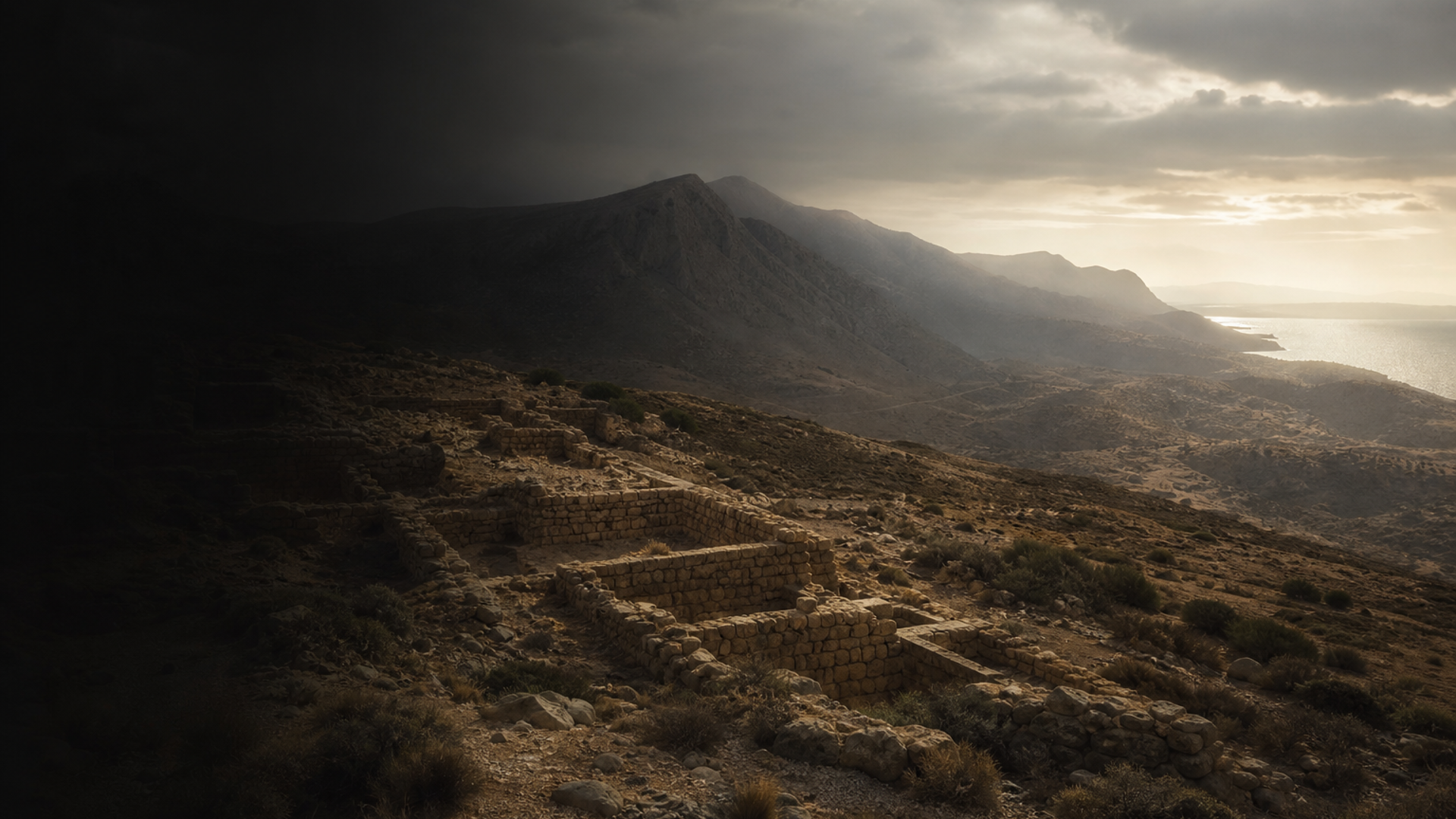
Odigitria Minoans (Crete)

下载的 PDF 是图像副本。如需可选中文本及更好的辅助技术支持,请使用打印功能。

Odigitria Minoans (Crete)

揭开一个失落的文明

正在加载考古记录……

正在收集古代记录

跳转到主内容
Odigitria Minoans (Crete)
文明焦点

Odigitria Minoans (Crete)

Five Bronze Age individuals from Moni Odigitria connect material culture with early DNA

2210 CE - 1680 BCE
Crete, Greece (Heraklion, Moni Odigitria)
滚动开始
Chapter I

剧情

了解 Odigitria Minoans (Crete) 文化

Genome data from five individuals (2210–1680 BCE) recovered at Moni Odigitria, Heraklion, Crete illuminate Minoan lifeways. Archaeology indicates continuity with Neolithic Aegean traditions; limited genetic evidence hints at Anatolian-farmer ancestry and diverse maternal lineages. Conclusions are preliminary.

Time Period

c. 2210–1680 BCE

Region

Crete, Greece (Heraklion, Moni Odigitria)

Common Y-DNA

G (observed, 1/5)

Common mtDNA

J, I5, HV, U, K (each observed once)

Chapter II

时间线

这种文化历史上的关键时刻

1700 BCE

Neopalatial Flourishing

Around 1700 BCE Minoan palatial culture expanded across Crete, marked by intense craft production, maritime exchange, and architectural renewal—context for many Odigitria samples.

Chapter III

Origins & Emergence

The assemblage from Moni Odigitria sits at the heart of Crete’s Bronze Age drama. Archaeological layers and associated artifacts dated between roughly 2210 and 1680 BCE place these individuals within the long arc of Minoan cultural florescence: a world of coastal trade, palace economies, and elaborated ritual spaces. Excavations at Moni Odigitria (Heraklion) have recovered pottery styles, architectural fragments, and burial treatments that continue regional Neolithic traditions while embracing early Bronze Age innovations.

Archaeological data indicate continuity from earlier Neolithic farming communities in the Aegean alongside visible influences from Anatolia and the broader eastern Mediterranean. Material culture—ceramic forms, decorative motifs, and imported objects—suggests Crete was a nexus of interaction rather than an isolated island. Limited evidence from only five dated individuals restricts our ability to generalize, but the combination of context and chronology supports a scenario where local populations absorbed external influences without complete population replacement.

The cinematic sweep of the island—sunlit harbors, terraced fields, and labyrinthine settlements—belies a complex genetic and cultural palimpsest. While archaeological evidence anchors these people in place and time, their biological ancestry must be read alongside the caveats inherent to small sample sizes.

  • Samples dated c. 2210–1680 BCE from Moni Odigitria, Heraklion
  • Material culture shows Neolithic continuity with eastern Mediterranean influences
  • Small sample size means origin interpretations are provisional
Chapter IV

Daily Life & Society

Life for inhabitants of Bronze Age Crete unfolded between sea and stone: fishing coves, olive groves, and densely organized settlements where craft specialization and exchange were visible in the archaeological record. At Moni Odigitria, funerary contexts and associated grave goods—pottery, beads, and sometimes copper items—evoke households embedded in networks of trade and ritual. Archaeological evidence indicates people lived in multiroom houses, practiced mixed farming, and participated in island-wide exchange of goods and ideas.

Iconography and architectural fragments recovered across Crete imply a society with organized craft production and ceremonial arenas; fresco fragments and painted pottery suggest symbolic landscapes and maritime motifs were socially salient. Stable isotope studies from comparable Minoan sites (where available) typically point to diets of cereals, pulses, seafood, and domesticated animals, reflecting a Mediterranean subsistence base enriched by marine resources. Social differentiation appears in burial variability—some individuals interred with richer assemblages—though Moni Odigitria’s record is modest in size.

As with genetic data, archaeological interpretations must account for sampling bias: the domestic, ritual, and mortuary records we see are shaped by preservation and past excavation priorities. Yet even sparse remains conjure a vivid image of responsive, mobile communities who navigated local tradition and long-distance connections.

  • Mixed farming, fishing, and craft production indicated by artifacts
  • Burial goods and house structures suggest household-based social networks
Chapter V

Genetic Profile

Five genome samples from Moni Odigitria provide a narrow but informative window into Minoan biological ancestry. Among the Y-DNA and mtDNA results recorded, one male carries haplogroup G, while maternal lineages are diverse: J, I5, HV, U, and K (each observed once). This pattern—limited paternal diversity and varied maternal haplogroups—is consistent with localized population structure and exogamous marriage practices, though with only five individuals such inferences remain tentative.

Archaeological and broader ancient-DNA studies of the Aegean have often pointed to a strong contribution from Anatolian-Neolithic farmer ancestry in Minoan populations, with additional inputs from eastern Mediterranean and Caucasus-related sources at varying levels. The Moni Odigitria sequences fit this broad expectation: genetic signals align with a population profile primarily rooted in earlier Neolithic farmers of the region rather than wholesale replacement by steppe-derived groups. However, because the sample count is low (<10), these findings should be treated as preliminary and hypothesis-generating rather than definitive.

Future sampling across multiple Cretan contexts, paired with isotopic and proteomic studies, will better resolve questions of mobility, kinship, and sex-biased gene flow. For now, the Odigitria genomes reveal a tapestry of maternal diversity woven onto a background of deep Anatolian-Aegean ancestry, resonant with the island’s archaeological story of continuity and connection.

  • Observed Y-DNA: G (1); mtDNA: J, I5, HV, U, K (each 1)
  • Genetic signal consistent with Anatolian-Neolithic farmer ancestry; conclusions provisional
Chapter VI

Legacy & Modern Connections

The Odigitria individuals remind us that modern Cretan and Aegean populations are shaped by millennia of layered interactions. Archaeological continuity across Neolithic and Bronze Age layers suggests cultural persistence, while genetic data hint at long-term demographic stability punctuated by episodic exchanges. Limited but diverse maternal lineages echo a pattern of mobility—women moving between communities or islands—overlaying a broadly local genetic substrate.

For contemporary residents and visitors, the island’s material remains and emerging genetic portrait combine to tell a story of resilience and connectivity: craftspeople, farmers, and traders who navigated a Mediterranean of currents and ideas. Given the small number of samples, however, any direct line to modern populations should be drawn cautiously. Expanding the dataset will refine how Minoan genomes contributed to later Aegean and Mediterranean gene pools, and will clarify which elements of daily life and identity persisted through subsequent centuries.

  • Suggests long-term demographic continuity in Crete with episodic external influences
  • Modern genetic links are plausible but require larger ancient DNA datasets to confirm
AI 电源

AI 助手

就 Odigitria Minoans (Crete) 文化提问

AI 助手 由DNAGENICS公司制作

解锁此特性
Ask questions about the Odigitria Minoans (Crete) culture. Our AI assistant can explain genetic findings, historical context, archaeological evidence, and modern connections.
AI 样本分析

Odigitria Minoans (Crete) 文化是人类历史中值得了解的一章……

遗传分析揭示了与早期种群的联系,同时显示了独特的适应和文化创新的证据。 古代DNA样本提供了对迁徙模式、社会结构以及古代种群之间的生物关系的深刻见解。

这是人工智能分析的预览。 解锁全AI 助手, 以探索关于:

  • 遗传组成和祖先
  • 移徙模式和起源
  • 日常生活和文化习俗
  • 现代遗传遗产

探索更古老的文化

揭开古代世界文明的故事

使用优惠码 可减免 35% • 11月12日 到期