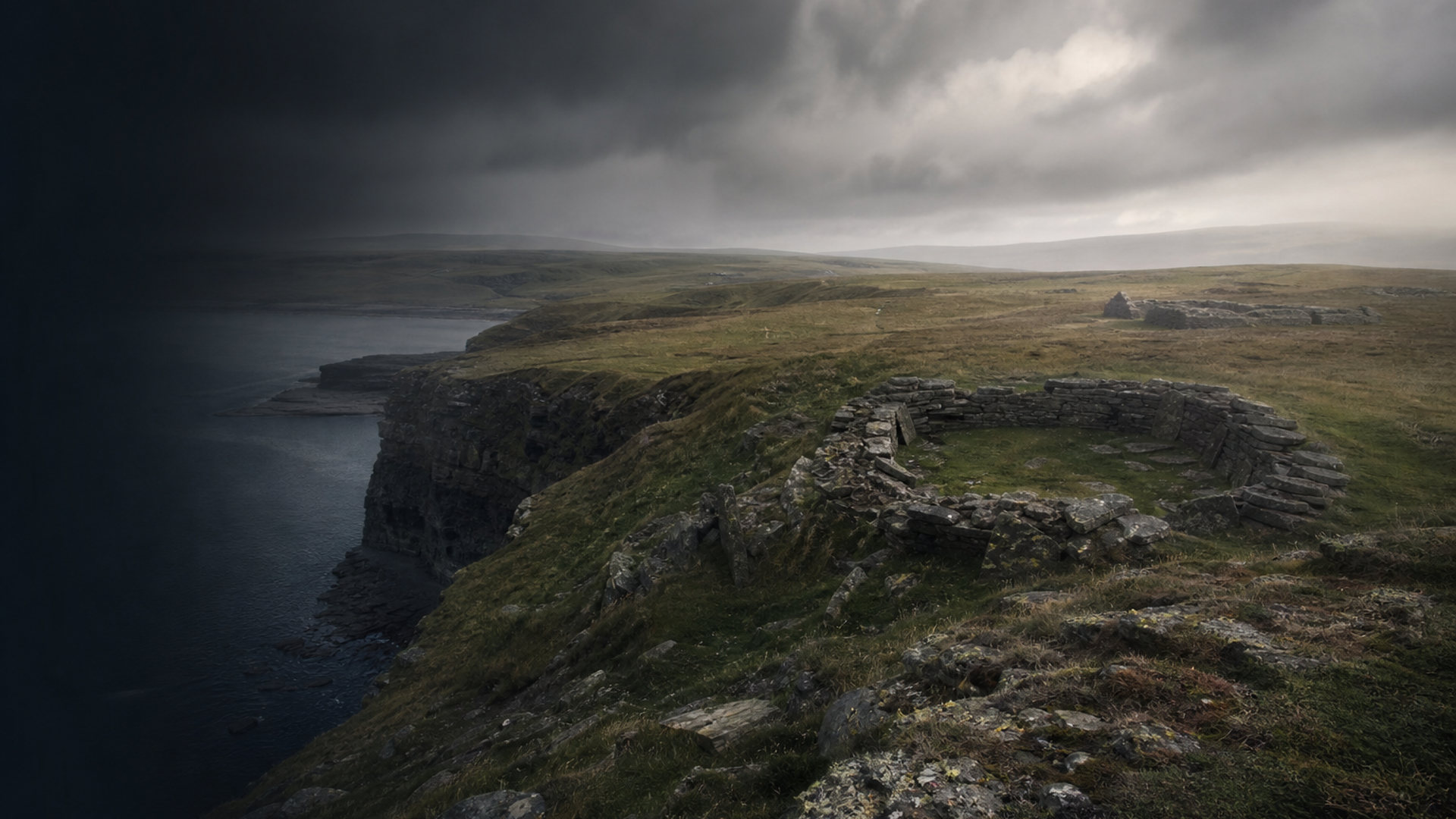
Orkney: Middle Bronze Age Echoes

下载的 PDF 是图像副本。如需可选中文本及更好的辅助技术支持,请使用打印功能。

Orkney: Middle Bronze Age Echoes

揭开一个失落的文明

正在加载考古记录……

正在收集古代记录

跳转到主内容
Orkney: Middle Bronze Age Echoes
文明焦点

Orkney: Middle Bronze Age Echoes

Island burials and maternal lineages from Links of Noltland (Westray, Orkney)

1743 CE - 1300 BCE
Orkney (Westray), United Kingdom
滚动开始
Chapter I

剧情

了解 Orkney: Middle Bronze Age Echoes 文化

Archaeological and genetic glimpses from 22 Middle Bronze Age individuals (1743–1300 BCE) excavated at Links of Noltland, Westray, revealing maternal lineages and island lifeways amid uncertain paternal signals.

Time Period

1743–1300 BCE

Region

Orkney (Westray), United Kingdom

Common Y-DNA

Limited or inconsistent Y-DNA data (insufficient coverage)

Common mtDNA

T, H39, K, H, U (see counts)

Chapter II

时间线

这种文化历史上的关键时刻

2500 BCE

Earlier Neolithic foundations

Neolithic settlement and ritual landscapes established precedents that influenced Bronze Age Orcadian lifeways.

Chapter III

Origins & Emergence

The Middle Bronze Age horizons at Links of Noltland on Westray (Orkney) sit within a long human story on the northern edge of Britain. Archaeological data indicates activity at the site between roughly 1743 and 1300 BCE, a period when island communities negotiated wind, sea and scarce arable land. Material traces from Orkney in this era are often fragmentary: cist burials, concentrations of domestic midden, and occasional metalwork and ceramics that suggest long-distance connections across the North Atlantic and the Scottish mainland.

Archaeology points to continuity with earlier Neolithic and Bronze Age practices in the Northern Isles, but also to local adaptations—settlement clustering, coastal resource intensification, and funerary placements that pay close attention to shoreline topography. Limited evidence suggests that some of these communities maintained strong maritime networks, exchanging raw materials and ideas.

Genetic data from 22 individuals provides a new dimension to origins: maternal lineages common at Links of Noltland echo patterns seen elsewhere in Bronze Age Britain, hinting at a mix of local continuity and incoming influences. However, preservation and sample coverage impose limits—interpretations about population movements should remain cautious and framed as probabilistic rather than definitive.

  • Site: Links of Noltland, Westray, Orkney (1743–1300 BCE)
  • Archaeological record: burials, settlement traces, scarce metalwork
  • Interpretation: local continuity with maritime connections
Chapter IV

Daily Life & Society

Life on Bronze Age Westray can be imagined as an interplay of wind, sea and stone. Archaeological remains suggest households organized around small stone-built structures and defended by the toughness of island weather. Diets likely combined pastoralism—sheep and cattle—with marine resources: shellfish, sea fish and seabirds are common in Northern Isles middens. Domestic debris and cist burials point to tightly knit kin groups with funerary practices oriented to local topography.

Craft and exchange were part of daily existence. Bronze items are relatively rare in Orkney compared with southern Britain, but when present they signal participation in wider exchange networks. Pottery styles and tool types show both regional distinctiveness and shared forms across the Scottish archipelago. Socially, communities may have been organized around extended family units with status differences expressed through burial placement and the occasional inclusion of exotic goods.

Seasonality would have structured labour: peat cutting, livestock grazing on machair (coastal grassland), and fishing seasons. The landscape itself—low, open and exposed—shaped a culture accustomed to mobility and resilience. Archaeological evidence indicates pragmatic adaptation rather than monumental centralization in this Middle Bronze Age phase.

  • Economy: mixed pastoralism and marine exploitation
  • Material culture: modest bronze use, local pottery traditions
Chapter V

Genetic Profile

Ancient DNA recovered from 22 individuals at Links of Noltland offers a window into maternal ancestry in Middle Bronze Age Orkney. Mitochondrial haplogroups observed include T (5 individuals), H39 (4), K (3), H (3), and U (2); the remaining samples carry other or unassigned maternal lineages. These counts indicate a diversity of maternal lines, with haplogroups common across Bronze Age Britain and Atlantic Europe.

The prevalence of T and sublineages of H suggests maternal continuity with broader British and northwestern European populations, while K and U reflect deeper Paleolithic and Neolithic maternal ancestries that persisted into the Bronze Age. The presence of H39—an H subclade observed in northern contexts—may reflect regional continuity, though subclade distributions remain incompletely understood.

Crucially, reliable Y-chromosome (paternal) signals for this assemblage are limited or inconsistently reported, so inferences about male-mediated migration or patrilineal continuity are constrained. With a sample size of 22, maternal patterns are moderately robust, but caution remains necessary: population structure, kinship within the burial sample, and preservation biases can skew frequency estimates. Future sampling and higher-coverage genome-wide data will better resolve admixture sources, affinities to mainland Scotland, Scandinavia, and earlier Neolithic inhabitants, and the balance between local continuity and incoming gene flow.

  • mtDNA counts: T (5), H39 (4), K (3), H (3), U (2) — moderate diversity
  • Y-DNA: insufficient or inconsistent coverage; paternal patterns unclear
Chapter VI

Legacy & Modern Connections

The genetic and archaeological imprint of Middle Bronze Age Orkney contributes to the long tapestry of Orcadian ancestry. Maternal haplogroups found at Links of Noltland resonate with lineages still present in modern northern Britain, suggesting elements of continuity along female lines. Culturally, practices adapted to island life—resource mixing, seasonal mobility, and small-scale exchange—helped shape resilient community identities that would underlie later Orcadian traditions.

However, linking ancient individuals directly to modern populations requires caution. Centuries of migration, Viking-era movements, and more recent demographic shifts have layered additional ancestry over Bronze Age foundations. The current dataset of 22 individuals provides a meaningful but partial snapshot: it highlights continuity and connection without resolving the full story of Orkney’s genetic history. Continued excavation and genome-wide studies will refine how these Bronze Age islanders contributed to the genetic mosaic of the North Atlantic.

  • Maternal continuity visible but partial; modern ancestry layered by later migrations
  • Dataset valuable but not definitive—more sampling needed for full picture
AI 电源

AI 助手

就 Orkney: Middle Bronze Age Echoes 文化提问

AI 助手 由DNAGENICS公司制作

解锁此特性
Ask questions about the Orkney: Middle Bronze Age Echoes culture. Our AI assistant can explain genetic findings, historical context, archaeological evidence, and modern connections.
AI 样本分析

Orkney: Middle Bronze Age Echoes 文化是人类历史中值得了解的一章……

遗传分析揭示了与早期种群的联系,同时显示了独特的适应和文化创新的证据。 古代DNA样本提供了对迁徙模式、社会结构以及古代种群之间的生物关系的深刻见解。

这是人工智能分析的预览。 解锁全AI 助手, 以探索关于:

  • 遗传组成和祖先
  • 移徙模式和起源
  • 日常生活和文化习俗
  • 现代遗传遗产

探索更古老的文化

揭开古代世界文明的故事

使用优惠码 可减免 35% • 11月12日 到期