Tuv Late‑Medieval Steppe Echoes

下载的 PDF 是图像副本。如需可选中文本及更好的辅助技术支持,请使用打印功能。

Tuv Late‑Medieval Steppe Echoes

揭开一个失落的文明

正在加载考古记录……

正在收集古代记录

跳转到主内容
Tuv Late‑Medieval Steppe Echoes
文明焦点

Tuv Late‑Medieval Steppe Echoes

Bones and genomes from Argali Mountain whisper of mobile life on the Mongolian plateau.

1000 CE - 1500 CE
Tuv Province, Mongolia
滚动开始
Chapter I

剧情

了解 Tuv Late‑Medieval Steppe Echoes 文化

Archaeogenetic and archaeological data (4 samples, 1000–1500 CE) from Tuv Province, Mongolia link Late Medieval steppe lifeways with a mixed East–West paternal signal. Limited samples make conclusions preliminary, but mtDNA points to broadly East Asian maternal ancestry.

Time Period

1000–1500 CE

Region

Tuv Province, Mongolia

Common Y-DNA

C (2), R (1)

Common mtDNA

G, M, C, D

Chapter II

时间线

这种文化历史上的关键时刻

1200 CE

Late Medieval occupation in Tuv

Samples from Argali Mountain and Bunkhantyn Gatsaa date within the 1000–1500 CE window, indicating Late Medieval burial and occupation activity in Tuv Province.

Chapter III

Origins & Emergence

The Tuv Late Medieval samples come from highland and valley contexts in Tuv Province—Argali Mountain and Bunkhantyn Gatsaa—and span roughly 1000–1500 CE, a period of political flux on the Mongolian plateau following the height of the Mongol Empire. Archaeological data indicates cemetery and transient camp use across the region; topography and ethnographic analogy suggest seasonal mobility between summer pastures and sheltered winter sites.

Limited evidence suggests these communities were formed through a long history of steppe interaction. The material landscape of the Late Medieval steppe is a palimpsest of older Bronze Age, Turkic, and Mongol-era layers; disentangling those threads requires integrated stratigraphy, artifact typology, and radiocarbon dating at each site. With only four genomic samples available from Argali Mountain and Bunkhantyn Gatsaa, any model of origin must remain provisional. Genetic signals hint at continuity with broader East Asian maternal lineages alongside occasional West Eurasian paternal contributions, consistent with the steppe’s role as a conduit for people and culture.

This is a portrait in outline: evocative, partial, and awaiting more data. High-resolution sampling across Tuv and neighboring regions will be needed to test whether these Late Medieval groups reflect local continuity, recent migration, or complex admixture.

  • Samples from Argali Mountain and Bunkhantyn Gatsaa, Tuv Province (1000–1500 CE)
  • Region shows archaeological layering from earlier Bronze Age to Mongol-era occupation
  • Small sample size (n=4) makes origin models preliminary
Chapter IV

Daily Life & Society

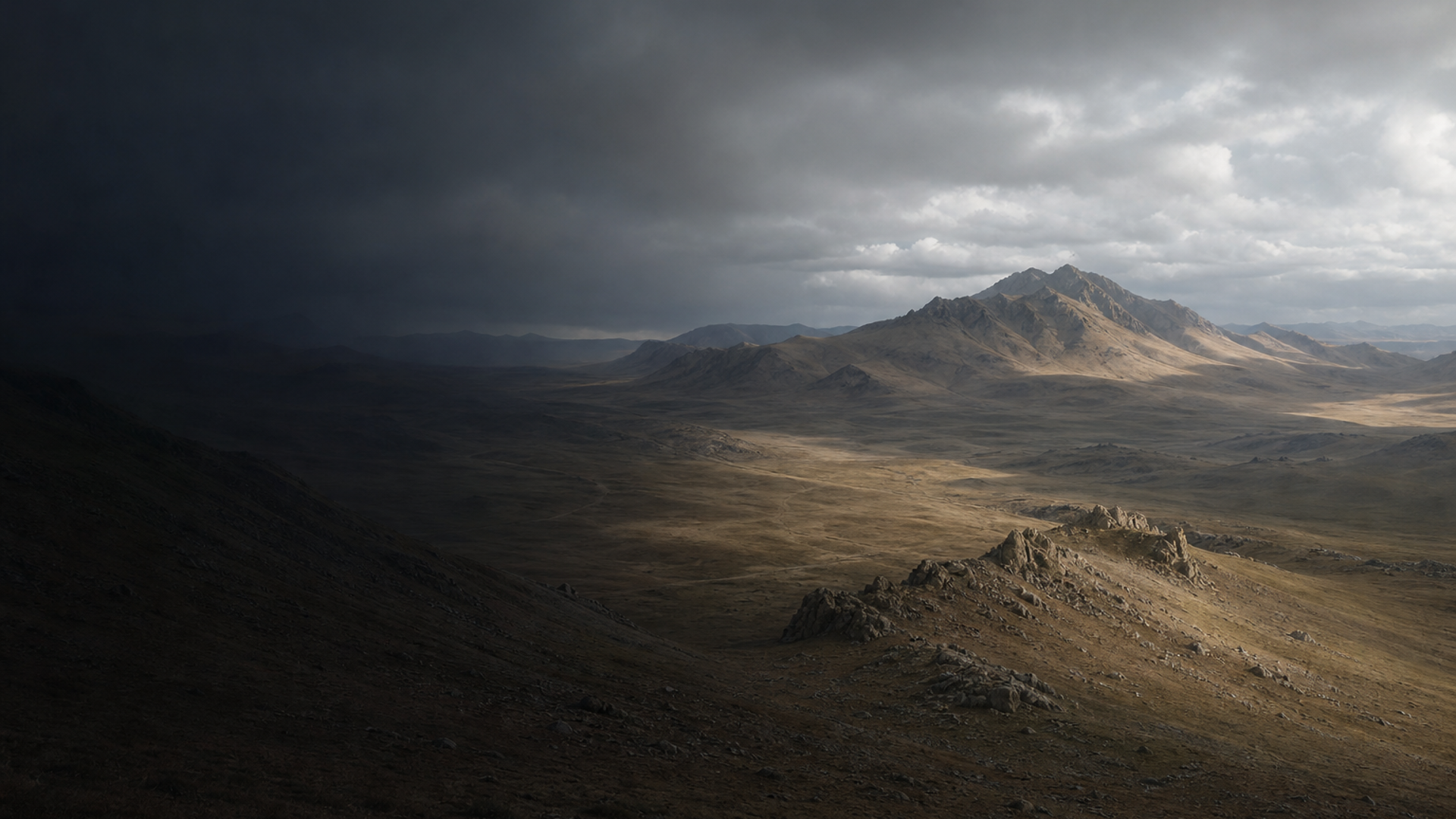
Archaeological data indicates a mobile, pastoral horizon across the Late Medieval Tuv landscape. The cinematic sweep of the steppe—ridges, river valleys, and sheltered hollows—shaped a seasonal rhythm of movement: summer pastures on higher ground, wintering in lee of mountains. Faunal remains from comparable regional sites point to sheep, goats, horses, and cattle as central resources, while portable material culture (tools, personal ornaments) accentuates mobility rather than permanent settlement.

Burial contexts in Tuv often preserve fragile clues: body orientation, grave assemblages, and spatial clustering can reflect kin groups, social status, or ritual practice. At Argali Mountain and Bunkhantyn Gatsaa the archaeological footprint is modest; limited excavations and survey data make specific reconstructions tentative. Ethnographic analogy to later Mongolian pastoral lifeways—yurt use, mounted herding, seasonal camps—provides a useful interpretive frame but must be applied cautiously.

Material traces and genomes together suggest communities adapted to the high‑steppe environment, practicing animal husbandry, mobility, and participation in wide-ranging exchange networks that could carry people, goods, and genes across Eurasia.

  • Pastoral, seasonally mobile lifeways inferred from landscape and regional faunal patterns
  • Burial evidence modest; interpretations rely on limited excavation and ethnographic analogy
Chapter V

Genetic Profile

The genetic dataset from the Mongolia_Tuv_LateMedieval grouping comprises four individuals dated to 1000–1500 CE from Tuv Province. Y‑chromosome results include two individuals with haplogroup C and one with haplogroup R; mitochondrial haplogroups observed are G, M, C, and D. These markers paint a picture consistent with broad East Asian maternal ancestry and a predominantly East Eurasian paternal background, but with at least one lineage (R) that is often associated with West Eurasian or Eurasian steppe-wide paternal connections.

C haplogroups are common across northern and eastern Asia and often linked to long‑standing regional male lines. The presence of R in a single individual suggests male‑mediated gene flow from populations carrying West Eurasian‑associated Y lineages—a pattern attested elsewhere on the steppe where trade, migration, and military movements facilitated admixture. Maternal haplogroups G, M, C, and D are widespread in East Asia and reflect continuity with regional maternal pools.

Crucially, the sample count is very small (<10). Any population‑level inference is preliminary: autosomal ancestry proportions, fine‑scale admixture dates, and demographic models require many more genomes. Still, the combination of East Asian mtDNA and mixed Y‑DNA hints at sex‑biased or episodic incoming male lineages superimposed on local maternal continuity, a recurring theme in steppe genetic histories.

  • Y‑DNA: C predominant (2/3), R present (1/3) — suggests mixed paternal inputs
  • mtDNA: G, M, C, D — broadly East Asian maternal ancestry; sample size (n=4) limits certainty
Chapter VI

Legacy & Modern Connections

The genomic and archaeological echoes from Late Medieval Tuv speak to continuities that may reach into modern populations of central Mongolia. Many contemporary Mongolian and neighboring Siberian groups carry mtDNA lineages like C, D, and G and Y lineages including C, indicating long‑term persistence of key genetic lineages on the steppe. The single R Y‑chromosome in this small sample hints at the steppe’s long history as a corridor for men and technologies moving between West and East Eurasia.

However, limited sampling from Argali Mountain and Bunkhantyn Gatsaa means direct claims of genetic continuity with specific modern communities are tentative. Expanded ancient and present‑day sampling, combined with radiocarbon chronologies and archaeological context, is essential to test models of local survival versus replacement or admixture. Still, the picture that emerges—of resilient maternal lineages, episodic paternal influxes, and a culture shaped by mobility—resonates with the broader human story of the Eurasian steppe.

  • Modern Mongolian populations share many maternal haplogroups seen in these samples, suggesting possible continuity
  • Single West‑associated Y lineage suggests episodic male‑mediated gene flow across the steppe
AI 电源

AI 助手

就 Tuv Late‑Medieval Steppe Echoes 文化提问

AI 助手 由DNAGENICS公司制作

解锁此特性
Ask questions about the Tuv Late‑Medieval Steppe Echoes culture. Our AI assistant can explain genetic findings, historical context, archaeological evidence, and modern connections.
AI 样本分析

Tuv Late‑Medieval Steppe Echoes 文化是人类历史中值得了解的一章……

遗传分析揭示了与早期种群的联系,同时显示了独特的适应和文化创新的证据。 古代DNA样本提供了对迁徙模式、社会结构以及古代种群之间的生物关系的深刻见解。

这是人工智能分析的预览。 解锁全AI 助手, 以探索关于:

  • 遗传组成和祖先
  • 移徙模式和起源
  • 日常生活和文化习俗
  • 现代遗传遗产

探索更古老的文化

揭开古代世界文明的故事

使用优惠码 可减免 35% • 11月12日 到期