Menu
Store
Blog
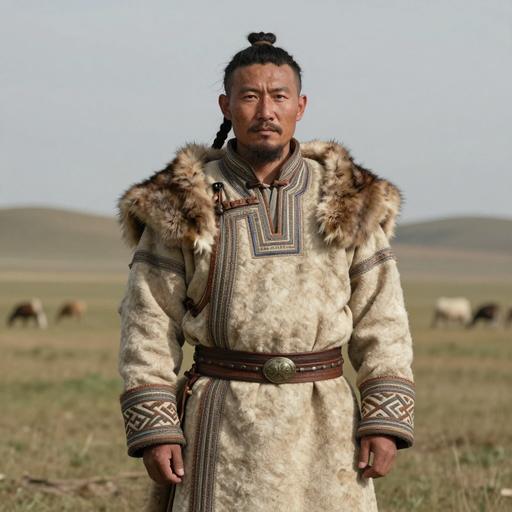
Portrait reconstruction of I13175
Ancient Individual

A man buried in Mongolia in the Iron Age era

I13175
408 CE - 537 CE
Male
Iron Age Mongolia
Mongolia
Scroll to begin
Chapter I

Identity

The biological and cultural markers that define this ancient individual

Sample ID

I13175

Date Range

408 CE - 537 CE

Biological Sex

Male

mtDNA Haplogroup

D4b1a2a

Y-DNA Haplogroup

R1b2b-BY14575

Cultural Period

Iron Age Mongolia

Chapter II

Place

Where this individual was discovered

Country Mongolia
Locality Khovd. Bulgan sum. Uliastai deed denj II kurgan 1 burial 1 (secondary)
Coordinates 45.3900, 90.7980
Chapter III

Time

When this individual lived in the broader context of human history

I13175 408 CE - 537 CE
Chapter IV

Story

The narrative of this ancient life

Iron Age Mongolia, particularly in the context of the nomadic steppe cultures such as the Xianbei, represents a fascinating period rich in cultural dynamics, social organization, and economic practices. The era is characterized by the transition from the Bronze Age to the Iron Age, where the steppes of Mongolia became a vibrant crossroads of cultural and technological exchange.

Geographic and Environmental Context

The landscape of Iron Age Mongolia was dominated by vast open steppes, rugged mountains, and expansive deserts. These terrains dictated the nomadic lifestyle; the Mongolian steppes provided ample pasture for livestock while the harsh climate necessitated a mobile way of life. The environment significantly influenced the cultural and economic organization of its inhabitants, who adopted a pastoral nomadic lifestyle centered around animal husbandry.

The Xianbei and Other Nomadic Cultures

The Xianbei were among the prominent nomadic groups during this period, emerging as a significant power in the 1st century CE. They were an early Mongolic people known for their equestrian skills and military prowess. The Xianbei were part of a broader cultural milieu that included various Turkic and Mongolic tribes, each with its distinct yet related traditions and lifestyles.

  1. Organization and Society:

    • The Xianbei and their contemporaries were organized into tribal confederations. These societies were highly stratified, with a clear hierarchy that was crucial for maintaining order and coordination among nomadic groups.
    • Leadership was typically vested in a chieftain or a khagan (khan), who commanded both military and political power. Leadership was often hereditary but required the ability to command respect and demonstrate martial skill.
    • Kinship and clan structures were vital, as they provided the primary framework for social organization and identity.
  2. Economy and Subsistence Practices:

    • Pastoralism was the cornerstone of the economy. The nomadic tribes raised horses, sheep, goats, cattle, and camels, which were essential for transportation, trade, and subsistence.
    • The Iron Age saw advancements in metalwork, including the introduction of iron tools and weapons, which enhanced both agricultural practices and military capabilities.
    • The Xianbei engaged in trade networks that extended across Asia, trading furs, livestock, and crafted goods for silk, grains, and metal implements. These interactions facilitated cultural exchange and connectivity with other civilizations, such as the Chinese Han dynasty.

Cultural and Technological Developments

The Iron Age tribes of Mongolia exhibited distinctive cultural developments:

  • Art and Craftsmanship: Xianbei artisans produced intricate metalwork and decorative items, reflecting a synthesis of local styles with influences acquired through trade and conquest. Jewelry, weaponry, and horse gear often featured elaborate designs that indicated wealth and status.

  • Military Innovations:

    • The Xianbei were renowned for their exceptional cavalry, which became the backbone of their military might. They utilized composite bows and developed advanced riding techniques.
    • Iron weaponry, such as swords, lances, and arrowheads, gave them a strategic advantage in warfare.
  • Spirituality and Rituals:

    • Shamanistic beliefs were prevalent, with shamans acting as mediators between the spiritual and physical worlds. These religious specialists performed rituals that were crucial for ensuring prosperity, health, and victory in battle.
    • Burial practices were an essential cultural aspect, with elaborate kurgans (burial mounds) indicating the importance placed on ancestry and the afterlife.

Interactions and Legacy

The Xianbei, through their military conquests and alliances, played a crucial role in shaping the political landscape of East Asia. They were instrumental in the decline of the Xiongnu Confederation and established their own tribal states, influencing the regions that would become parts of modern-day Mongolia, China, and Siberia.

The legacy of the Xianbei and other Iron Age nomadic cultures of Mongolia is evident in the later formations of more organized states and empires in the region, including the rise of the Mongol Empire under Genghis Khan. The cultural and military innovations of this era laid the groundwork for the sophisticated equestrian and nomadic cultures that dominated the steppes for centuries.

In summary, Iron Age Mongolia was a period of profound cultural and technological innovation among the nomadic peoples of the steppe, exemplified by groups like the Xianbei. Their adaptation to the harsh environment, their complex social structures, and their influential role in regional politics make them a pivotal subject of study in understanding the history and culture of Central Asia.

Chapter V

Genetics

The genetic ancestry of this ancient individual

Ancient Genetic Admixture

This analysis compares the DNA profile of I13175 with ancient reference populations, showing the genetic composition in terms of prehistoric ancestral groups.

Ancient Asians 84.6%
Western Steppe Pastoralists 6.7%
European Hunter-Gatherers 3.2%
Ancient Native Americans 2.9%
Ancient Oceanians 2.6%

Modern Genetic Admixture

This analysis compares the DNA profile with present-day reference populations, showing what percentage of genetic makeup resembles modern populations from different regions.

Asia 100.0%
Central Asian, Northern Indian & Pakistani 56.0%
Central Asian 56.0%
Chinese & Southeast Asian 42.4%
Tibetan 42.4%
Northern Asian 1.6%
Mongolian 1.6%

Closest Modern Populations

These are the modern populations showing the closest statistical alignment to A man buried in Mongolia in the Iron Age era, ranked by genetic distance. Lower distance values indicate closer statistical similarity.

1
Khamnegan
3.9148
2
Mongol
5.9615
3
Buryat
6.1078
4
Oroqen
6.4302
5
Ulchi
7.1409
6
Kalmyk
7.5128
7
Nanai
7.5809
8
Tuvinian
7.7677
9
Nivkh
7.9464
10
Mogush
8.0685
Chapter VI

Context

Other ancient individuals connected to this sample

Sources

References

Scientific publications and genetic data

Scientific Publication

Genomic insights into the formation of human populations in East Asia

Authors Wang CC, Yeh HY, Popov AN
Abstract

The deep population history of East Asia remains poorly understood owing to a lack of ancient DNA data and sparse sampling of present-day people1,2. Here we report genome-wide data from 166 East Asian individuals dating to between 6000 BC and AD 1000 and 46 present-day groups. Hunter-gatherers from Japan, the Amur River Basin, and people of Neolithic and Iron Age Taiwan and the Tibetan Plateau are linked by a deeply splitting lineage that probably reflects a coastal migration during the Late Pleistocene epoch. We also follow expansions during the subsequent Holocene epoch from four regions. First, hunter-gatherers from Mongolia and the Amur River Basin have ancestry shared by individuals who speak Mongolic and Tungusic languages, but do not carry ancestry characteristic of farmers from the West Liao River region (around 3000 BC), which contradicts theories that the expansion of these farmers spread the Mongolic and Tungusic proto-languages. Second, farmers from the Yellow River Basin (around 3000 BC) probably spread Sino-Tibetan languages, as their ancestry dispersed both to Tibet-where it forms approximately 84% of the gene pool in some groups-and to the Central Plain, where it has contributed around 59-84% to modern Han Chinese groups. Third, people from Taiwan from around 1300 BC to AD 800 derived approximately 75% of their ancestry from a lineage that is widespread in modern individuals who speak Austronesian, Tai-Kadai and Austroasiatic languages, and that we hypothesize derives from farmers of the Yangtze River Valley. Ancient people from Taiwan also derived about 25% of their ancestry from a northern lineage that is related to, but different from, farmers of the Yellow River Basin, which suggests an additional north-to-south expansion. Fourth, ancestry from Yamnaya Steppe pastoralists arrived in western Mongolia after around 3000 BC but was displaced by previously established lineages even while it persisted in western China, as would be expected if this ancestry was associated with the spread of proto-Tocharian Indo-European languages. Two later gene flows affected western Mongolia: migrants after around 2000 BC with Yamnaya and European farmer ancestry, and episodic influences of later groups with ancestry from Turan.

G25 Coordinates

The G25 coordinates for sample I13175 can be used for detailed admixture analysis in our G25 Studio tool.

I13175,0.04193832,-0.38314868,0.0772318,-0.02773666,-0.05813234,-0.03561874,0.00954556,0.01169698,0.00474302,0.00963234,-0.0096133,0.00015386,0.00135944,-0.00083454,-0.010729,-0.01003248,-0.00718546,0.0074126,0.01574062,0.0091821,0.01561336,-0.01982588,-0.00112022,0.00548192,0.01092588
Analyze in G25 Studio
Use code for 40% off Expires Feb 26