Menu
Store
Blog
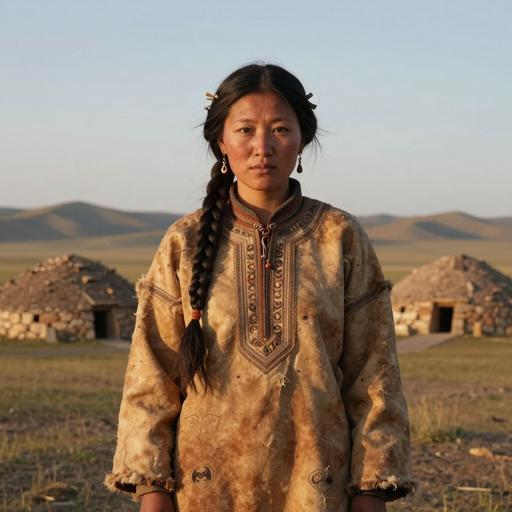
Portrait reconstruction of I13959
Ancient Individual

A woman buried in Mongolia in the Middle Late Bronze Age era

I13959
1446 BCE - 1305 BCE
Female
Late Bronze Age Mongun-Taiga 1, Mongolia
Mongolia
Scroll to begin
Chapter I

Identity

The biological and cultural markers that define this ancient individual

Sample ID

I13959

Date Range

1446 BCE - 1305 BCE

Biological Sex

Female

mtDNA Haplogroup

Not available

Cultural Period

Late Bronze Age Mongun-Taiga 1, Mongolia

Chapter II

Place

Where this individual was discovered

Country Mongolia
Locality Khovd. Munkhkhairkhan sum. Ulaan tolgoi. barrow 3
Coordinates 47.0690, 91.8300
Chapter III

Time

When this individual lived in the broader context of human history

I13959 1446 BCE - 1305 BCE
Chapter IV

Story

The narrative of this ancient life

The Late Bronze Age Mongun-Taiga 1 culture, located in present-day Mongolia on the Eurasian Steppe, is a fascinating yet understudied period that reflects the complex societal and environmental dynamics of the region. This era, approximately dating from the 14th to the 9th century BCE, serves as a critical juncture in the prehistoric development of the steppe cultures, often recognized for their strategic adaptations to the expansive and challenging landscapes.

Geographic and Environmental Context

Mongun-Taiga, lying at the intersection of Mongolia, Russia, and Kazakhstan, is characterized by its rugged terrain, high altitudes, and varied climate. The ecology includes expansive grasslands, harsh mountainous regions, and riverine systems, which have historically necessitated a semi-nomadic lifestyle. The area's environment is both a challenge and a resource, offering materials and routes for movement that contributed to the cultural development during the Late Bronze Age.

Societal Structure and Economy

The societal structure of the Mongun-Taiga 1 culture was likely organized around extended kinship networks, which were the primary social units capable of effectively managing the demands of both herding and agricultural activities. The presence of pastoral nomadism was a defining attribute, with communities primarily engaged in animal husbandry, focusing on sheep, goats, cattle, and horses. The introduction and integration of horse domestication played a transformative role, facilitating not only pastoral activities but also communication and military tactics.

In addition to pastoralism, these societies may have practiced limited agriculture, taking advantage of fertile niches in the landscape to cultivate grains like barley and wheat. These practices would have contributed to a diverse diet and a form of economic stability that supported growing populations and more complex societal structures.

Material Culture and Technology

The Mongun-Taiga 1 culture is marked by advancements in metallurgy and craftsmanship. Artifacts from this period include sophisticated bronze tools and weapons, such as daggers, axes, and ornaments, indicating a high level of skill in metalworking. The use of bronze not only revolutionized tools and weapons but also signified social prestige and power, likely playing a role in the hierarchical structuring of society.

Ceramic production also flourished during this time, with pottery often decorated with intricate patterns that were possibly indicative of cultural or clan identity. The styles and designs found on ceramics can provide insights into trade and cultural interactions with neighboring regions.

Burial Practices and Religion

The burial practices of the Mongun-Taiga 1 culture are a key source of archaeological evidence. Kurgans, or burial mounds, are prominent archaeological features that offer insights into the religious beliefs and social organization of the time. These structures often contained grave goods, such as pottery, weapons, and ornaments, suggesting beliefs in an afterlife where such items would be necessary.

The elaborate nature of these burials indicates a belief system that valued ancestral lineage and possibly revered warrior or chieftain figures. The assemblage of grave goods, along with the strategic placement of kurgans in the landscape, underscores the cultural importance of land, memory, and status.

Interactions and Legacy

The Late Bronze Age communities of the Mongun-Taiga region had notable interactions with neighboring cultures, facilitated by their strategic position on the Eurasian Steppe. This period saw increasing mobility and exchange, which would lay the groundwork for the later historic episodes of steppe empires.

The legacy of the Mongun-Taiga 1 culture is evident in the continuation and evolution of steppe traditions, including the emphasis on horseback riding, pastoral nomadism, and the development of complex confederations and networks that later emerged in the Iron Age. Understanding this era provides valuable insights into the adaptation strategies that have historically defined the resilience and ingenuity of steppe communities.

This cultural snapshot of the Mongun-Taiga 1 period in the Late Bronze Age highlights a sophisticated society adept at navigating the challenges of their environment while contributing to the broader cultural tapestry of the Eurasian Steppe.

Chapter V

Genetics

The genetic ancestry of this ancient individual

Ancient Genetic Admixture

This analysis compares the DNA profile of I13959 with ancient reference populations, showing the genetic composition in terms of prehistoric ancestral groups.

Ancient Asians 63.9%
Western Steppe Pastoralists 22.1%
Ancient Native Americans 9.1%
Ancient Oceanians 5.0%

Modern Genetic Admixture

This analysis compares the DNA profile with present-day reference populations, showing what percentage of genetic makeup resembles modern populations from different regions.

Asia 77.6%
Northern Asian 65.8%
Siberian 52.6%
Mongolian 13.3%
Japanese & Korean 11.8%
Japanese 11.8%
America 16.4%
America 16.4%
Native American 16.4%
Europe 6.0%
Northwestern European 6.0%
English 6.0%

Closest Modern Populations

These are the modern populations showing the closest statistical alignment to A woman buried in Mongolia in the Middle Late Bronze Age era, ranked by genetic distance. Lower distance values indicate closer statistical similarity.

1
Khakass Kachins
7.6059
2
Mogush
7.6369
3
Teleut O
7.7029
4
Altaian
7.8770
5
Altaian Kizhi
7.9172
6
Tuvinian
8.3710
7
Mongol Xinjiang
8.4493
8
Kazakh China
8.9424
9
Kalmyk
9.0637
10
Buryat O
9.2226
Chapter VI

Context

Other ancient individuals connected to this sample

Sources

References

Scientific publications and genetic data

Scientific Publication

Genomic insights into the formation of human populations in East Asia

Authors Wang CC, Yeh HY, Popov AN
Abstract

The deep population history of East Asia remains poorly understood owing to a lack of ancient DNA data and sparse sampling of present-day people1,2. Here we report genome-wide data from 166 East Asian individuals dating to between 6000 BC and AD 1000 and 46 present-day groups. Hunter-gatherers from Japan, the Amur River Basin, and people of Neolithic and Iron Age Taiwan and the Tibetan Plateau are linked by a deeply splitting lineage that probably reflects a coastal migration during the Late Pleistocene epoch. We also follow expansions during the subsequent Holocene epoch from four regions. First, hunter-gatherers from Mongolia and the Amur River Basin have ancestry shared by individuals who speak Mongolic and Tungusic languages, but do not carry ancestry characteristic of farmers from the West Liao River region (around 3000 BC), which contradicts theories that the expansion of these farmers spread the Mongolic and Tungusic proto-languages. Second, farmers from the Yellow River Basin (around 3000 BC) probably spread Sino-Tibetan languages, as their ancestry dispersed both to Tibet-where it forms approximately 84% of the gene pool in some groups-and to the Central Plain, where it has contributed around 59-84% to modern Han Chinese groups. Third, people from Taiwan from around 1300 BC to AD 800 derived approximately 75% of their ancestry from a lineage that is widespread in modern individuals who speak Austronesian, Tai-Kadai and Austroasiatic languages, and that we hypothesize derives from farmers of the Yangtze River Valley. Ancient people from Taiwan also derived about 25% of their ancestry from a northern lineage that is related to, but different from, farmers of the Yellow River Basin, which suggests an additional north-to-south expansion. Fourth, ancestry from Yamnaya Steppe pastoralists arrived in western Mongolia after around 3000 BC but was displaced by previously established lineages even while it persisted in western China, as would be expected if this ancestry was associated with the spread of proto-Tocharian Indo-European languages. Two later gene flows affected western Mongolia: migrants after around 2000 BC with Yamnaya and European farmer ancestry, and episodic influences of later groups with ancestry from Turan.

G25 Coordinates

The G25 coordinates for sample I13959 can be used for detailed admixture analysis in our G25 Studio tool.

I13959,0.05122304,-0.30049006,0.06136662,0.0063455,-0.08170158,-0.03119434,0.00241728,0.00584556,0.01534304,0.0131066,0.01099724,0.00431046,-0.0058814,0.00405528,-0.00559148,-0.01307804,-0.00627002,0.01104678,0.01607626,0.00613824,0.0214125,-0.02082594,0.001276,0.0042445,0.0090274
Analyze in G25 Studio
Use code for 40% off Expires Feb 26