Menu
Store
Blog
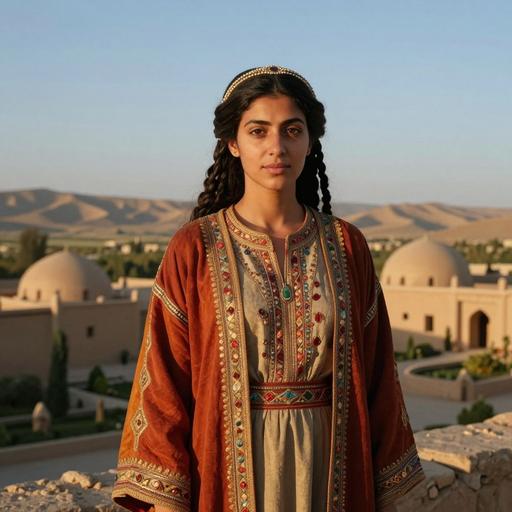
Portrait reconstruction of I1955
Ancient Individual

A woman buried in Iran in the Middle Ages era

I1955
1480 CE - 1640 CE
Female
Historical Iran
Iran
Scroll to begin
Chapter I

Identity

The biological and cultural markers that define this ancient individual

Sample ID

I1955

Date Range

1480 CE - 1640 CE

Biological Sex

Female

mtDNA Haplogroup

U1a1

Cultural Period

Historical Iran

Chapter II

Place

Where this individual was discovered

Country Iran
Locality Ganj Dareh
Coordinates 34.4500, 48.1160
Chapter III

Time

When this individual lived in the broader context of human history

I1955 1480 CE - 1640 CE
Chapter IV

Story

The narrative of this ancient life

The historical era of Iran, specifically during the Persian Civilization, is often considered one of the most influential and remarkable periods in ancient history. This era spans several centuries, with the height of Persian civilization occurring under the Achaemenid Empire, which was founded by Cyrus the Great in the 6th century BCE. The Persian civilization, however, extends beyond the Achaemenid dynasty, encompassing several subsequent empires and cultural transformations, each contributing to the rich tapestry of Iran’s historical legacy.

Achaemenid Era (circa 550-330 BCE)

Founding of the Empire: Cyrus the Great is often credited with laying the foundations for the Achaemenid Empire, which at its zenith stretched from the Balkans and Eastern Europe in the west to the Indus Valley in the east. His empire was characterized by a pioneering model of centralized administration and governance, yet it allowed a degree of autonomy among its numerous territories.

Cultural Syncretism: The Achaemenid period is noted for its cultural diversity and tolerance. Under Cyrus, and later Darius the Great, the empire adopted a policy of respect for the local customs, religions, and laws of its diverse subject peoples. The famous Cyrus Cylinder has often been cited as an early charter of human rights, emphasizing this ethos.

Infrastructure and the Royal Road: Darius I took particular interest in developing infrastructure, notably through the construction of the Royal Road, which facilitated rapid communication across the empire. The road network and postal system were vastly advanced for their time, fostering trade and integrating the vast empire economically.

Art and Architecture: The Achaemenid era heralded distinctive art and architectural styles, with the royal city of Persepolis standing as a testament to their grandeur. The art blended various influences from across the empire, featuring monumental sculptures and elaborate carvings that demonstrated the empire’s wealth and reverence for their divine rulers.

Parthian and Sassanian Era (247 BCE - 651 CE)

Parthian Empire: Following the fall of the Achaemenid Empire, the Parthians emerged as a significant power, best known for their unique cavalry and military tactics. They acted as a cultural bridge between the East and the West during their time and were instrumental in trade along the Silk Road.

Sassanian Dynasty: The Sassanian dynasty, which succeeded the Parthians, marked a renaissance of Persian culture and a return to Zoroastrian orthodoxy as the state religion. They fostered advancements in architecture, art, and science. The Sassanian administration structured the empire in a more centralized fashion, with a focus on reviving old Persian traditions and military strategies.

Societal and Cultural Aspects

Religion and Philosophy: Zoroastrianism was the dominant religion, influencing subsequent religious beliefs and philosophies, including Judaism, Christianity, and Islam. The religion promoted the dichotomy between good and evil, and concepts such as free will and final judgment became cornerstones of later religious thought.

Language and Literature: The Old Persian language evolved over these eras. With the development of the Persian script, literature flourished, with royal inscriptions and religious texts enduring as significant cultural documents. The subsequent proliferation of the Persian language during these periods served as a unifying cultural force across various empires.

Contributions to Science and Learning: The Persian empires were conversant with the scientific knowledge of their time, and they were particularly renowned in astronomy, mathematics, and medicine. The Sassanian era is often credited with creating academies and libraries that acted as seedbeds for later Islamic scholarship.

Legacy

The legacy of Persian civilization is vast and enduring, influencing not only the immediate neighboring regions but also contributing profoundly to the cultural and political landscapes of the ancient and medieval world. From administrative models to cultural practices, the Persian civilization set benchmarks in governance, tolerance, and cultural plurality, echoing throughout history and leaving an indelible mark on subsequent civilizations. Understanding this era reflects on the sophisticated interplay between power dynamics, cultural integration, and philosophical advancements that defined one of history's most remarkable civilizations.

Chapter V

Genetics

The genetic ancestry of this ancient individual

Ancient Genetic Admixture

This analysis compares the DNA profile of I1955 with ancient reference populations, showing the genetic composition in terms of prehistoric ancestral groups.

Neolithic Farmers 72.6%
European Hunter-Gatherers 10.4%
Western Steppe Pastoralists 9.4%
Ancient Asians 7.7%

Modern Genetic Admixture

This analysis compares the DNA profile with present-day reference populations, showing what percentage of genetic makeup resembles modern populations from different regions.

Asia 87.6%
Northern West Asian 52.1%
Caucasian 24.4%
Mesopotamian 21.7%
Anatolian 5.3%
Cypriot 0.7%
Arab, Egyptian & Levantine 20.1%
Levantine 19.6%
Central Asian, Northern Indian & Pakistani 15.4%
Pakistan 12.7%
Indian 2.7%
Europe 12.4%
Southern European 12.4%
Balkan 6.3%
Italian 6.1%

Closest Modern Populations

These are the modern populations showing the closest statistical alignment to A woman buried in Iran in the Middle Ages era, ranked by genetic distance. Lower distance values indicate closer statistical similarity.

1
Iranian Zoroastrian
1.6236
2
Iranian Lor Khorramabad
1.6314
3
Kurd USSR
1.7637
4
Iranian Persian Fars
1.7787
5
Talysh Azerbaijan
1.7968
6
Iranian Cosmopolitan Tehran
1.8247
7
Ezid
1.8755
8
Kurd Iraq
1.8930
9
Iranian Lor Bakhtiari
1.9915
10
Iranian Persian Yazd
2.0328
Chapter VI

Context

Other ancient individuals connected to this sample

Sources

References

Scientific publications and genetic data

Scientific Publication

Genomic insights into the origin of farming in the ancient Near East

Authors Lazaridis I, Nadel D, Rollefson G
Abstract

We report genome-wide ancient DNA from 44 ancient Near Easterners ranging in time between ~12,000 and 1,400 bc, from Natufian hunter-gatherers to Bronze Age farmers. We show that the earliest populations of the Near East derived around half their ancestry from a 'Basal Eurasian' lineage that had little if any Neanderthal admixture and that separated from other non-African lineages before their separation from each other. The first farmers of the southern Levant (Israel and Jordan) and Zagros Mountains (Iran) were strongly genetically differentiated, and each descended from local hunter-gatherers. By the time of the Bronze Age, these two populations and Anatolian-related farmers had mixed with each other and with the hunter-gatherers of Europe to greatly reduce genetic differentiation. The impact of the Near Eastern farmers extended beyond the Near East: farmers related to those of Anatolia spread westward into Europe; farmers related to those of the Levant spread southward into East Africa; farmers related to those of Iran spread northward into the Eurasian steppe; and people related to both the early farmers of Iran and to the pastoralists of the Eurasian steppe spread eastward into South Asia.

G25 Coordinates

The G25 coordinates for sample I1955 can be used for detailed admixture analysis in our G25 Studio tool.

I1955,0.09275204,0.1105899,-0.0671799,-0.02933884,-0.0479564,-0.00205474,0.00817064,-0.00616846,-0.02792884,-0.01492868,0.00026396,-0.00047484,-0.00277418,-0.00368078,0.00565666,0.01107282,-0.0042573,-0.00079466,0.00237196,-0.00871326,0.0007419,-0.00277798,0.00083888,-0.00088434,0.00522649
Analyze in G25 Studio
Use code for 40% off Expires Feb 27