Menu
Store
Blog
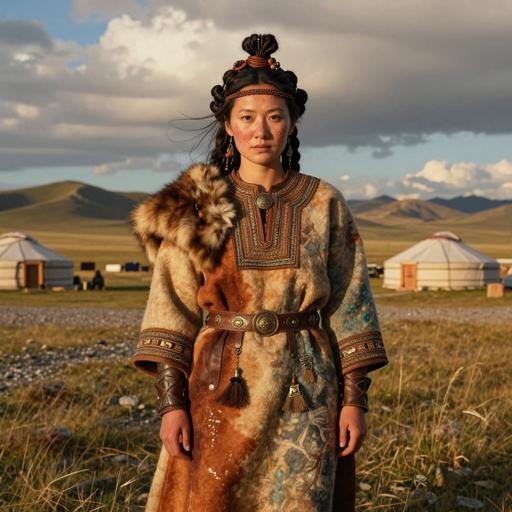
Portrait reconstruction of I6263
Ancient Individual

A woman buried in Mongolia in the Early Iron Age era

I6263
358 BCE - 170 BCE
Female
Early Iron Age Pazyryk Culture 6, Mongolia
Mongolia
Scroll to begin
Chapter I

Identity

The biological and cultural markers that define this ancient individual

Sample ID

I6263

Date Range

358 BCE - 170 BCE

Biological Sex

Female

mtDNA Haplogroup

H5a1

Cultural Period

Early Iron Age Pazyryk Culture 6, Mongolia

Chapter II

Place

Where this individual was discovered

Country Mongolia
Locality Bayan Ulgii aimag. Tsengel sum. Tsagaan-Uul. Khuvsgol
Coordinates 48.6800, 88.3800
Chapter III

Time

When this individual lived in the broader context of human history

I6263 358 BCE - 170 BCE
Chapter IV

Story

The narrative of this ancient life

The Pazyryk Culture, a fascinating facet of the Early Iron Age, is an integral component of the larger tapestry of nomadic steppe cultures that flourished across the Eurasian Steppe, particularly in Mongolia, southern Siberia, and parts of Kazakhstan. This culture is named after the Pazyryk burial site located in the Altai Mountains of Siberia, where archaeologists uncovered remarkably well-preserved artifacts from burial mounds, or kurgans, giving deep insights into the lives of these ancient nomadic people.

Geographic Context and Environment

The Pazyryk Culture thrived around the 6th to 3rd centuries BCE, amidst the harsh but resource-abundant landscapes of the Altai Mountains. This region of Mongolia and southern Siberia presented diverse ecosystems, including mountains, grasslands, and forests, influencing the nomadic lifestyle of the Pazyryk people. The terrain and climate dictated a pastoralist way of life, demanding mobility and resilience from these communities as they herded livestock and engaged in seasonal migrations.

Social and Political Structure

The Pazyryk society was predominantly composed of nomadic tribes. Their social structure was likely hierarchal, with evidence pointing towards the existence of social elites, as suggested by the elaborate and richly furnished burial mounds. These kurgans indicate that leaders or important figures were bestowed with considerable honor in death, reflecting their status in life. The presence of chieftains and warrior classes may have played a central role in maintaining order and leadership within these mobile social groups.

Economy and Lifestyle

As a nomadic steppe culture, the Pazyryk culture relied heavily on horse-based pastoralism. Horses were central not only as a mode of transportation but played a crucial role in their economy and warfare. The Pazyryk people raised and tended livestock such as sheep, goats, and cattle, which provided meat, milk, wool, and hides. Trade also formed a key component of their economy, as evidenced by artifacts and textiles found in Pazyryk burials, indicating contact with distant cultures, including those in China, Persia, and the Mediterranean.

Art and Craftsmanship

The Pazyryk Culture is particularly noted for its sophisticated art and craftsmanship. Among the most famous discoveries are the well-preserved textiles, felt appliqués, and saddle covers, which are adorned with intricate motifs depicting animals, mythical beasts, and complex geometric patterns. These artifacts suggest a high level of artistic skill and perhaps indicate the symbolic or totemic significance of these designs. Their art also reveals hybrid influences, showcasing both indigenous styles and motifs drawn from the wider Eurasian artistic milieu, including Scythian art.

Burial Customs and Religious Beliefs

Burial mounds, or kurgans, serve as the most studied aspect of the Pazyryk Culture, reflecting both religious beliefs and social practices. These kurgans are remarkable for their construction in frozen ground, preserving organic materials such as wood, textiles, and even tattooed human skin. The practice of elaborate burial ceremonies suggests a belief in the afterlife, with graves containing everyday items, weapons, horse sacrifices, and elaborate garment to accompany the dead in the next world. Tattooed remains discovered in these burials hint at both aesthetic practices and possible spiritual or magical beliefs linked to shamanistic traditions.

Influence and Legacy

The Pazyryk Culture contributed significantly to the understanding of early nomadic societies of the Eurasian steppes. Their advanced horsemanship, complex societal structures, and rich artistic traditions underscore their influence on neighboring cultures and future nomadic empires. They played a significant role in the cross-cultural exchanges that defined the Silk Road's early history. The preserved artifacts from their burial sites provide an invaluable glimpse into the interconnectedness and cultural dynamism of the ancient world, demonstrating the Pazyryk's role in the broader historical and cultural dialogues of Eurasia.

In conclusion, the Pazyryk Culture encapsulates the adaptability and creativity of nomadic societies in the face of challenging environments. Their legacy is marked by their contributions to art, their complex social structures, and their role in the broader narrative of Eurasian history.

Chapter V

Genetics

The genetic ancestry of this ancient individual

Ancient Genetic Admixture

This analysis compares the DNA profile of I6263 with ancient reference populations, showing the genetic composition in terms of prehistoric ancestral groups.

Ancient Asians 32.0%
Western Steppe Pastoralists 30.9%
European Hunter-Gatherers 16.6%
Neolithic Farmers 14.6%
Ancient Native Americans 6.0%

Modern Genetic Admixture

This analysis compares the DNA profile with present-day reference populations, showing what percentage of genetic makeup resembles modern populations from different regions.

Europe 48.8%
Eastern European 33.1%
Northwestern European 15.8%
English 13.4%
Finnish 2.4%
Asia 44.4%
Central Asian, Northern Indian & Pakistani 21.1%
Central Asian 12.7%
Indian 4.9%
Pakistan 3.4%
Northern Asian 14.1%
Siberian 13.4%
Mongolian 0.7%
Northern West Asian 6.7%
Caucasian 6.7%
Chinese & Southeast Asian 2.6%
Tibetan 1.6%
Chinese 1.0%
America 6.5%
America 6.5%
Native American 6.5%

Closest Modern Populations

These are the modern populations showing the closest statistical alignment to A woman buried in Mongolia in the Early Iron Age era, ranked by genetic distance. Lower distance values indicate closer statistical similarity.

1
Tatar Lipka
6.2070
2
Bashkir
6.5030
3
Besermyan
6.6379
4
Udmurt
6.8316
5
Tatar Crimean Steppe
7.1681
6
Tatar Kazan
7.8937
7
Khanty O1
7.9322
8
Saami
8.5305
9
Chuvash
9.5897
10
Turkmen
9.7855
Chapter VI

Context

Other ancient individuals connected to this sample

Sources

References

Scientific publications and genetic data

Scientific Publication

Genomic insights into the formation of human populations in East Asia

Authors Wang CC, Yeh HY, Popov AN
Abstract

The deep population history of East Asia remains poorly understood owing to a lack of ancient DNA data and sparse sampling of present-day people1,2. Here we report genome-wide data from 166 East Asian individuals dating to between 6000 BC and AD 1000 and 46 present-day groups. Hunter-gatherers from Japan, the Amur River Basin, and people of Neolithic and Iron Age Taiwan and the Tibetan Plateau are linked by a deeply splitting lineage that probably reflects a coastal migration during the Late Pleistocene epoch. We also follow expansions during the subsequent Holocene epoch from four regions. First, hunter-gatherers from Mongolia and the Amur River Basin have ancestry shared by individuals who speak Mongolic and Tungusic languages, but do not carry ancestry characteristic of farmers from the West Liao River region (around 3000 BC), which contradicts theories that the expansion of these farmers spread the Mongolic and Tungusic proto-languages. Second, farmers from the Yellow River Basin (around 3000 BC) probably spread Sino-Tibetan languages, as their ancestry dispersed both to Tibet-where it forms approximately 84% of the gene pool in some groups-and to the Central Plain, where it has contributed around 59-84% to modern Han Chinese groups. Third, people from Taiwan from around 1300 BC to AD 800 derived approximately 75% of their ancestry from a lineage that is widespread in modern individuals who speak Austronesian, Tai-Kadai and Austroasiatic languages, and that we hypothesize derives from farmers of the Yangtze River Valley. Ancient people from Taiwan also derived about 25% of their ancestry from a northern lineage that is related to, but different from, farmers of the Yellow River Basin, which suggests an additional north-to-south expansion. Fourth, ancestry from Yamnaya Steppe pastoralists arrived in western Mongolia after around 3000 BC but was displaced by previously established lineages even while it persisted in western China, as would be expected if this ancestry was associated with the spread of proto-Tocharian Indo-European languages. Two later gene flows affected western Mongolia: migrants after around 2000 BC with Yamnaya and European farmer ancestry, and episodic influences of later groups with ancestry from Turan.

G25 Coordinates

The G25 coordinates for sample I6263 can be used for detailed admixture analysis in our G25 Studio tool.

I6263,0.0992876,-0.05289132,0.0612239,0.05160806,-0.02784656,0.00534464,-0.00830016,-0.00768686,-0.00635616,-0.0214149,-0.00373268,-0.00278418,0.00749866,-0.00900034,0.0070763,0.00286572,-0.00939492,0.00026202,0.00323686,0.00482588,-0.01103142,0.002476,5.756E-05,0.00536158,0.00163152
Analyze in G25 Studio
Use code for 40% off Expires Feb 26