Menu
Store
Blog
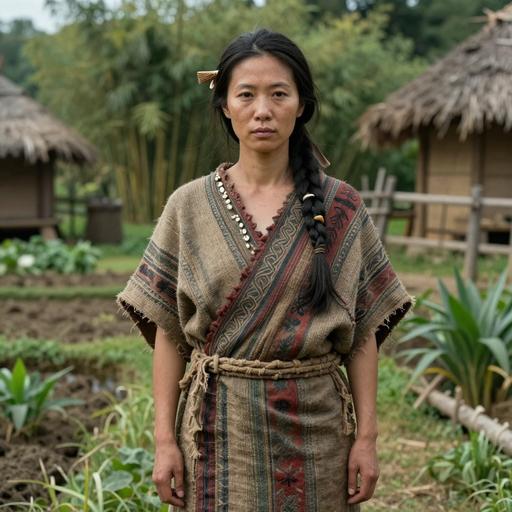
Portrait reconstruction of NAG019
Ancient Individual

A woman buried in Japan in the Iron Age era

NAG019
796 BCE - 560 BCE
Female
Nagabaka 2800BP
Japan
Scroll to begin
Chapter I

Identity

The biological and cultural markers that define this ancient individual

Sample ID

NAG019

Date Range

796 BCE - 560 BCE

Biological Sex

Female

mtDNA Haplogroup

Not available

Cultural Period

Nagabaka 2800BP

Chapter II

Place

Where this individual was discovered

Country Japan
Locality Nagabaka
Chapter III

Time

When this individual lived in the broader context of human history

NAG019 796 BCE - 560 BCE
Chapter IV

Story

The narrative of this ancient life

The Jomon period, spanning from approximately 14,000 BCE to 300 BCE, was a time of significant cultural development in prehistoric Japan. The Nagabaka site, dating to around 800 BCE, falls within the later stages of the Jomon era, specifically around 2800 Before Present (BP). This period is characterized by advanced pottery, sedentary lifestyles, and a rich cultural tapestry that warrants a detailed exploration.

Nagabaka 2800 BP - Context

Geography and Environment

The Nagabaka site is located on the island of Honshu, Japan, an area known for its varied and rich ecosystems. During this time, Japan experienced a relatively stable climate after the Jomon transgression—a period of rising sea levels following the last Ice Age. This era's temperate climate fostered dense forests and abundant marine life, contributing to the Jomon people’s subsistence strategies.

Society and Lifestyle

The Jomon people were predominantly hunter-gatherers, with a lifestyle gradually transitioning to one with increased elements of sedentism due to abundant natural resources. By 800 BCE, semi-permanent and permanent settlements were common. The Nagabaka community would have lived in pit-dwellings (tateana jukyo), which were partially underground structures that provided insulation against the elements. Villages might consist of these dwellings arranged in circular patterns, possibly indicating social structures or stratification.

Economy and Diet

The economy of the Jomon people was based on a blend of hunting, gathering, and fishing. The Nagabaka people would have exploited the rich forestry for nuts (such as acorns and chestnuts), fruits, and game like deer and boar. The coastal proximity provided ample opportunities for fishing, with shellfish and seaweed being significant dietary components. Evidence of early cultivation practices, such as the planting of taro or other root crops, suggests an incipient form of horticulture.

Cultural Practices

Pottery

One of the most distinguishable aspects of Jomon culture is its pottery, renowned for cord-marking, which gives the era its name (\Jomon" translates to "cord-marked"). By 800 BCE, Jomon pottery from Nagabaka likely featured intricate designs and sophisticated shapes, reflecting technological advances and aesthetic values. These pots were not merely utilitarian but also held a ceremonial significance, often used in rituals or as burial offerings.

Art and Tools

The Nagabaka Jomon people crafted various tools and artifacts, from stone and bone tools for daily subsistence activities to ornaments such as beads and pendants. These items indicate both practical skills and artistic endeavors, with many objects showcasing symbolic and possibly religious motifs. Dogu, clay figurines believed to have ritualistic purposes, were prevalent, embodying various stylized human forms and potentially serving roles in fertility or shamanistic rites.

Religion and Spirituality

Jomon spirituality was likely animistic, with a deep reverence for nature. The people of Nagabaka may have engaged in rituals tied to natural cycles and phenomena, relying on shamans or spiritual leaders to mediate between the physical and spiritual realms. Sites often include stone circles or alignments that suggest ceremonial activities, pointing to a complex belief system.

Interaction and Exchange

Despite Japan’s insular geography, there were instances of interaction between different Jomon communities and even with cultures from mainland Asia. Exchange of goods such as obsidian, which traveled great distances, indicates a network of trade and cultural exchange.

Legacy

The Jomon culture, including the Nagabaka community of 800 BCE, left an enduring legacy in Japanese prehistory, influencing subsequent cultures such as the Yayoi. The era’s focus on communal living, respect for nature, and artistic expression set the foundation for many cultural attributes seen in later Japanese history.

In conclusion, the Nagabaka site of 800 BCE offers a snapshot of Jomon life that is characterized by complex societal structures, advanced craftsmanship, and rich spiritual life. This community’s legacy is preserved in the archaeological record, offering valuable insights into one of the myriad cultures that have shaped Japan’s historical and cultural landscape."

Chapter V

Genetics

The genetic ancestry of this ancient individual

Ancient Genetic Admixture

This analysis compares the DNA profile of NAG019 with ancient reference populations, showing the genetic composition in terms of prehistoric ancestral groups.

Ancient Asians 82.9%
Neolithic Farmers 8.3%
Ancient Oceanians 5.4%
Western Steppe Pastoralists 3.5%

Modern Genetic Admixture

This analysis compares the DNA profile with present-day reference populations, showing what percentage of genetic makeup resembles modern populations from different regions.

Asia 94.5%
Japanese & Korean 90.2%
Japanese 90.2%
Central Asian, Northern Indian & Pakistani 4.3%
Indian 4.3%
Africa 2.9%
North African 2.9%
North African 2.9%
Europe 2.3%
Southern European 2.3%
Iberian 1.4%
Sardinian 0.9%

Closest Modern Populations

These are the modern populations showing the closest statistical alignment to A woman buried in Japan in the Iron Age era, ranked by genetic distance. Lower distance values indicate closer statistical similarity.

1
Nepali Tamang Simigaon
4.2333
2
Tamang
4.3057
3
Magar
4.3591
4
Gurung
5.7504
5
Yuku
6.7080
6
Nepali Tamang Tashinam
6.8452
7
Dongxiang
7.2789
8
Nepali Indo Aryan O2
7.3760
9
Salar
7.4342
10
Tibetan Gangcha
7.6464
Chapter VI

Context

Other ancient individuals connected to this sample

Sources

References

Scientific publications and genetic data

Scientific Publication

Triangulation supports agricultural spread of the Transeurasian languages

Authors Robbeets M, Bouckaert R, Conte M
Abstract

The origin and early dispersal of speakers of Transeurasian languages-that is, Japanese, Korean, Tungusic, Mongolic and Turkic-is among the most disputed issues of Eurasian population history1-3. A key problem is the relationship between linguistic dispersals, agricultural expansions and population movements4,5. Here we address this question by 'triangulating' genetics, archaeology and linguistics in a unified perspective. We report wide-ranging datasets from these disciplines, including a comprehensive Transeurasian agropastoral and basic vocabulary; an archaeological database of 255 Neolithic-Bronze Age sites from Northeast Asia; and a collection of ancient genomes from Korea, the Ryukyu islands and early cereal farmers in Japan, complementing previously published genomes from East Asia. Challenging the traditional 'pastoralist hypothesis'6-8, we show that the common ancestry and primary dispersals of Transeurasian languages can be traced back to the first farmers moving across Northeast Asia from the Early Neolithic onwards, but that this shared heritage has been masked by extensive cultural interaction since the Bronze Age. As well as marking considerable progress in the three individual disciplines, by combining their converging evidence we show that the early spread of Transeurasian speakers was driven by agriculture.

G25 Coordinates

The G25 coordinates for sample NAG019 can be used for detailed admixture analysis in our G25 Studio tool.

NAG019,0.01766464,-0.3506835,-0.01343108,-0.00180848,-0.00240934,-0.00798748,0.00353326,0.00228412,0.011903,0.01281874,-0.05259838,-0.00422632,0.00604132,0.0009238,-0.00742152,-0.00597516,0.0035849,-0.00097674,-0.00235422,0.00142968,0.00274376,0.0132228,0.00405566,0.00392104,0.02333142
Analyze in G25 Studio
Use code for 40% off Expires Feb 27