Menu
Store
Blog
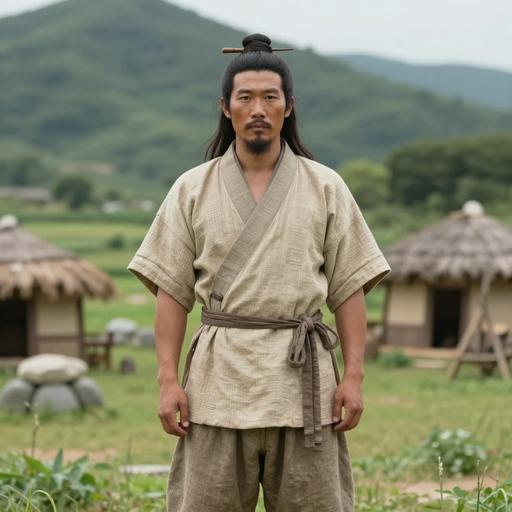
Portrait reconstruction of DAJ001
Ancient Individual

A man buried in South Korea in the Iron Age era

DAJ001
768 BCE - 542 BCE
Male
Iron Age Korea
South Korea
Scroll to begin
Chapter I

Identity

The biological and cultural markers that define this ancient individual

Sample ID

DAJ001

Date Range

768 BCE - 542 BCE

Biological Sex

Male

mtDNA Haplogroup

Not available

Y-DNA Haplogroup

Not available

Cultural Period

Iron Age Korea

Chapter II

Place

Where this individual was discovered

Country South Korea
Locality Taejungni
Chapter III

Time

When this individual lived in the broader context of human history

DAJ001 768 BCE - 542 BCE
Chapter IV

Story

The narrative of this ancient life

The Iron Age in Korea, which roughly spanned from the 4th century BCE to the 4th century CE, was a transformative period characterized by significant cultural, technological, and political developments. During this time, various tribal states emerged, eventually coalescing into the Three Kingdoms of Korea: Goguryeo, Baekje, and Silla. These developments coincided with and were influenced by exchanges with neighboring China and the broader East Asian region, leading to profound cultural and technological impacts.

Technological and Economic Developments

Iron Use and Metallurgy:

  • The introduction and widespread use of iron tools and weapons was a defining feature of the Iron Age in Korea. Iron tools were more durable and effective than their bronze counterparts, revolutionizing agricultural practices, increasing productivity, and subsequently supporting population growth.
  • Advanced iron smelting techniques were developed, and iron-making became a specialized industry. Iron tools included plows, sickles, axes, and other implements that dramatically improved agricultural efficiency.

Agriculture:

  • With the enhancement of agricultural tools, rice and millet farming became more productive, forming the staple diet of Korean societies.
  • The ability to cultivate more land led to the establishment of permanent settlements and contributed to urban development.

Cultural and Social Aspects

Social Structure and Tribal Confederations:

  • The Iron Age saw the formation of various tribal confederations, the most notable being the Samhan: Mahan, Jinhan, and Byeonhan. These confederations were organized into hundreds of small polities, each with its own leaders and social structures.
  • Social hierarchies became more pronounced, with chieftains or kings ruling over tribal communities. These leaders often derived their power from controlling trade and surplus resources, as well as from martial prowess.

Religion and Belief Systems:

  • Shamanistic practices were prevalent, with a strong emphasis on nature worship and ancestor veneration. Shamans played a vital role in mediating between the spiritual and physical worlds.
  • Over time, the influence of Chinese religions like Confucianism, Daoism, and later Buddhism began to permeate Korean society, although indigenous beliefs remained strong.

Art and Artifacts:

  • Artifacts from this era include a variety of pottery, iron weapons, and agricultural tools. Bronze mirrors and ornaments have also been discovered, indicating both local craftsmanship and trade connections.
  • Burial practices included stone cists, dolmens, and earthen pit tombs, often accompanied by grave goods, reflecting beliefs in an afterlife and the social status of the deceased.

Political and Military Context

Emergence of Early States:

  • The increased organization and centralization led to the formation of early states like Goguryeo in the north and the various Han states in the south.
  • The political landscape was characterized by frequent conflicts and alliances among tribal states, driven by the desire to control more land and resources.

Military Aspects:

  • With iron providing superior weaponry, military capabilities expanded significantly. This included the development of iron swords, spears, and armor, facilitating more effective warfare.
  • Defense strategies evolved with the construction of fortresses and fortified cities, particularly in strategic locations such as river valleys and mountain passes.

Interaction with Neighboring Cultures

Trade and Diplomacy:

  • Korea's Iron Age cultures engaged in extensive trade with neighboring regions, including China and Japan. The trade networks facilitated the exchange of goods such as silk, ceramics, and metals, as well as cultural and technological innovations.
  • Diplomatic relations were established with Chinese dynasties like the Han and later the Wei, Jin, and others, influencing Korean political and cultural developments.

Cultural Exchange:

  • The flow of ideas and technologies from China, including Chinese script, which eventually led to the creation of Korea's own writing systems, significantly impacted Korean society.
  • Korean craftsmen and scribes adopted Chinese artistic styles, techniques, and materials, which were adapted and integrated into local traditions.

In summary, the Iron Age in Korea was a period of profound transformation that laid the foundations for the development of the Korean civilization. It was marked by advancements in technology and agriculture, the emergence of significant social and political structures, and increased cultural exchange and influence with neighboring regions, particularly China. This era set the stage for the ensuing formation of the Three Kingdoms and Korea's further historical evolution.

Chapter V

Genetics

The genetic ancestry of this ancient individual

Ancient Genetic Admixture

This analysis compares the DNA profile of DAJ001 with ancient reference populations, showing the genetic composition in terms of prehistoric ancestral groups.

Ancient Asians 67.7%
European Hunter-Gatherers 13.4%
Western Steppe Pastoralists 9.5%
Neolithic Farmers 6.7%
Ancient Oceanians 2.7%

Modern Genetic Admixture

This analysis compares the DNA profile with present-day reference populations, showing what percentage of genetic makeup resembles modern populations from different regions.

Asia 65.8%
Japanese & Korean 49.1%
Japanese 49.1%
Northern Asian 10.6%
Mongolian 8.3%
Siberian 2.3%
Chinese & Southeast Asian 6.1%
Chinese 6.1%
Europe 28.7%
Northwestern European 27.4%
English 20.8%
Northwestern European 6.6%
Southern European 1.3%
Sardinian 1.3%
Africa 5.5%
North African 2.6%
North African 2.6%
West African 2.2%
Nigerian 2.2%
African Hunter-Gatherer 0.8%

Closest Modern Populations

These are the modern populations showing the closest statistical alignment to A man buried in South Korea in the Iron Age era, ranked by genetic distance. Lower distance values indicate closer statistical similarity.

1
Kirghiz China
8.9431
2
Kazakh Xinjiang
9.1553
3
Kirghiz
9.1986
4
Kirghiz Tajikistan Pamir
9.3341
5
Kazakh
9.3662
6
Kazakh China
9.5745
7
Buryat O
10.7163
8
Karakalpak
10.9139
9
Hazara
11.2991
10
Uygur
11.3543
Chapter VI

Context

Other ancient individuals connected to this sample

Sources

References

Scientific publications and genetic data

Scientific Publication

Triangulation supports agricultural spread of the Transeurasian languages

Authors Robbeets M, Bouckaert R, Conte M
Abstract

The origin and early dispersal of speakers of Transeurasian languages-that is, Japanese, Korean, Tungusic, Mongolic and Turkic-is among the most disputed issues of Eurasian population history1-3. A key problem is the relationship between linguistic dispersals, agricultural expansions and population movements4,5. Here we address this question by 'triangulating' genetics, archaeology and linguistics in a unified perspective. We report wide-ranging datasets from these disciplines, including a comprehensive Transeurasian agropastoral and basic vocabulary; an archaeological database of 255 Neolithic-Bronze Age sites from Northeast Asia; and a collection of ancient genomes from Korea, the Ryukyu islands and early cereal farmers in Japan, complementing previously published genomes from East Asia. Challenging the traditional 'pastoralist hypothesis'6-8, we show that the common ancestry and primary dispersals of Transeurasian languages can be traced back to the first farmers moving across Northeast Asia from the Early Neolithic onwards, but that this shared heritage has been masked by extensive cultural interaction since the Bronze Age. As well as marking considerable progress in the three individual disciplines, by combining their converging evidence we show that the early spread of Transeurasian speakers was driven by agriculture.

G25 Coordinates

The G25 coordinates for sample DAJ001 can be used for detailed admixture analysis in our G25 Studio tool.

DAJ001,0.04701914,-0.24686414,0.03263114,-0.01576522,0.03112068,0.0127283,-0.00350512,-0.00256642,-0.00210558,0.00266544,-0.04278892,-0.0021398,0.00757618,-0.0092454,-0.00233376,-0.00179954,-0.00332958,5.26E-06,0.00263372,-0.0022091,0.01272498,-0.00722656,0.00220194,0.00622748,-0.01732574
Analyze in G25 Studio
Use code for 40% off Expires Feb 27