Menu
Store
Blog
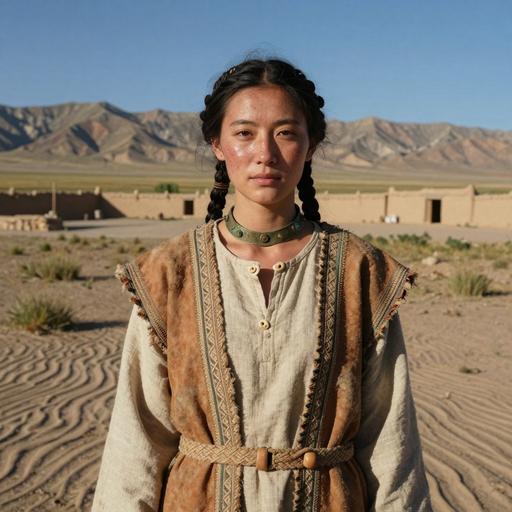
Portrait reconstruction of SSGM16
Ancient Individual

A woman buried in China in the Bronze Age era

SSGM16
2864 BCE - 2500 BCE
Female
Xinjiang Bronze Age
China
Scroll to begin
Chapter I

Identity

The biological and cultural markers that define this ancient individual

Sample ID

SSGM16

Date Range

2864 BCE - 2500 BCE

Biological Sex

Female

mtDNA Haplogroup

H2b

Cultural Period

Xinjiang Bronze Age

Chapter II

Place

Where this individual was discovered

Country China
Locality Xinjiang. Songshugou
Coordinates 46.8213, 85.9201
Chapter III

Time

When this individual lived in the broader context of human history

SSGM16 2864 BCE - 2500 BCE
Chapter IV

Story

The narrative of this ancient life

The Xinjiang Bronze Age represents a fascinating period in ancient Chinese civilization, marked by a unique cultural and technological landscape in the northwestern region of present-day China. This era, roughly dating from the 2nd millennium BCE to the 1st millennium BCE, showcases the interactions between different cultures across Eurasia and highlights the region's role as a crossroads of trade and cultural exchange.

Geographical and Environmental Context

The Xinjiang region, encompassing vast deserts, high mountains, and fertile oases, provided a challenging yet resource-rich environment for ancient peoples. Its position along the Silk Road facilitated interactions between nomadic pastoralists, settled agriculturalists, and traders, creating a melting pot of cultures. This geographical positioning was crucial for the diffusion of Bronze Age technologies and cultural practices.

Cultural and Technological Development

Metallurgy and Craftsmanship

Bronze metallurgy is a defining feature of this period, with the emergence of sophisticated techniques in metalworking. Artifacts such as weapons, tools, ornaments, and ritual vessels underscore the advanced metallurgical skills of the region's inhabitants. The use of bronze signified a considerable advancement over previous stone tools and contributed to improvements in agriculture, warfare, and cultural practices.

Settlements and Architecture

Archaeological evidence reveals the presence of both nomadic and settled communities, with semi-permanent structures in oasis towns and temporary encampments in grazing areas. The architecture of the period often consisted of mud-brick constructions and yurts, reflecting adaptations to the varied climate and lifestyle of the inhabitants. Some settlements show evidence of fortifications and large communal buildings, indicating a degree of social organization and defense needs.

Economy and Substinance

The economy during the Xinjiang Bronze Age was diverse, comprising agriculture, herding, hunting, and trade. The arid landscape necessitated innovative irrigation techniques, facilitating the cultivation of wheat, millet, and barley in oasis areas. Pastoralism played a significant role, with sheep, goats, and horses being key components of the subsistence strategy. The domestication and use of the horse were particularly significant for transportation and trade.

Cultural Interactions and Exchange

Xinjiang's location as a nexus of various trade routes allowed for significant cultural interactions with other regions. The influence of the Central Asian steppe cultures, Indo-European migrations, and contact with early Chinese civilizations contributed to a rich tapestry of influences. This is evident in the artistic styles, burial practices, and religious motifs found in archaeological sites.

Burial Practices and Beliefs

Burial sites from this era reflect a complex spiritual life, with grave goods indicating belief in an afterlife and emphasizing social status. The presence of chariots and horses in some high-status burials suggests the importance of mobility and possibly hint at Indo-European influences. These burial practices also reveal insights into the social hierarchy and the role of the elite in the Bronze Age society.

Linguistic and Ethnic Diversity

The Xinjiang Bronze Age was characterized by linguistic and ethnic diversity. Evidence suggests that the region was home to a variety of languages, possibly including early forms of Indo-European languages. This linguistic diversity points to the broader movements and exchanges of peoples across the region.

Legacy and Historical Impact

The Xinjiang Bronze Age set the foundations for the region's later historical developments and its integration into various Chinese dynasties. Its legacy is visible in the continuation of certain technological, cultural, and economic practices into later periods. Moreover, it underscores the importance of Xinjiang as a cultural and technological bridge between the East and West.

In conclusion, the Xinjiang Bronze Age reflects a dynamic and complex period in ancient Chinese civilization, showcasing technological innovations, cultural exchanges, and adaptations to a challenging environment. The region's archaeological record provides invaluable insights into the processes that shaped the development of early complex societies in this pivotal part of the world.

Chapter V

Genetics

The genetic ancestry of this ancient individual

Ancient Genetic Admixture

This analysis compares the DNA profile of SSGM16 with ancient reference populations, showing the genetic composition in terms of prehistoric ancestral groups.

Western Steppe Pastoralists 48.4%
European Hunter-Gatherers 20.6%
Ancient Asians 15.1%
Neolithic Farmers 11.4%
Ancient Native Americans 4.5%

Modern Genetic Admixture

This analysis compares the DNA profile with present-day reference populations, showing what percentage of genetic makeup resembles modern populations from different regions.

Europe 63.4%
Eastern European 49.0%
Northwestern European 14.4%
Finnish 10.5%
English 2.1%
Scandinavian 1.9%
Asia 29.7%
Central Asian, Northern Indian & Pakistani 25.8%
Pakistan 20.9%
Indian 4.9%
Northern West Asian 3.9%
Caucasian 3.9%
America 6.8%
America 6.8%
Native American 6.8%

Closest Modern Populations

These are the modern populations showing the closest statistical alignment to A woman buried in China in the Bronze Age era, ranked by genetic distance. Lower distance values indicate closer statistical similarity.

1
Tatar Kazan
4.5292
2
Tatar Mishar
5.4658
3
Besermyan
5.5609
4
Komi A
6.3437
5
Udmurt
7.2698
6
Russian Leshukonsky
7.7208
7
Tatar Lipka
7.8419
8
Chuvash
8.0014
9
Saami Kola
8.5412
10
Russian Pinezhsky
9.1923
Chapter VI

Context

Other ancient individuals connected to this sample

Sources

References

Scientific publications and genetic data

Scientific Publication

The genomic origins of the Bronze Age Tarim Basin mummies

Authors Zhang F, Ning C, Scott A
Abstract

The identity of the earliest inhabitants of Xinjiang, in the heart of Inner Asia, and the languages that they spoke have long been debated and remain contentious1. Here we present genomic data from 5 individuals dating to around 3000-2800 BC from the Dzungarian Basin and 13 individuals dating to around 2100-1700 BC from the Tarim Basin, representing the earliest yet discovered human remains from North and South Xinjiang, respectively. We find that the Early Bronze Age Dzungarian individuals exhibit a predominantly Afanasievo ancestry with an additional local contribution, and the Early-Middle Bronze Age Tarim individuals contain only a local ancestry. The Tarim individuals from the site of Xiaohe further exhibit strong evidence of milk proteins in their dental calculus, indicating a reliance on dairy pastoralism at the site since its founding. Our results do not support previous hypotheses for the origin of the Tarim mummies, who were argued to be Proto-Tocharian-speaking pastoralists descended from the Afanasievo1,2 or to have originated among the Bactria-Margiana Archaeological Complex3 or Inner Asian Mountain Corridor cultures4. Instead, although Tocharian may have been plausibly introduced to the Dzungarian Basin by Afanasievo migrants during the Early Bronze Age, we find that the earliest Tarim Basin cultures appear to have arisen from a genetically isolated local population that adopted neighbouring pastoralist and agriculturalist practices, which allowed them to settle and thrive along the shifting riverine oases of the Taklamakan Desert.

G25 Coordinates

The G25 coordinates for sample SSGM16 can be used for detailed admixture analysis in our G25 Studio tool.

SSGM16,0.10809798,0.02508914,0.04203646,0.06089266,-0.0179211,0.01558314,-0.00427954,-0.00471624,-0.01062606,-0.02627436,0.00628158,-0.00593316,0.00729966,-0.00928908,-0.00381346,-0.00958622,-0.01445452,-0.0021666,-0.01009974,-0.01271564,-0.00303276,0.00529322,-0.01355366,0.00513818,-0.00465432
Analyze in G25 Studio
Use code for 40% off Expires Mar 01