Menu
Store
Blog
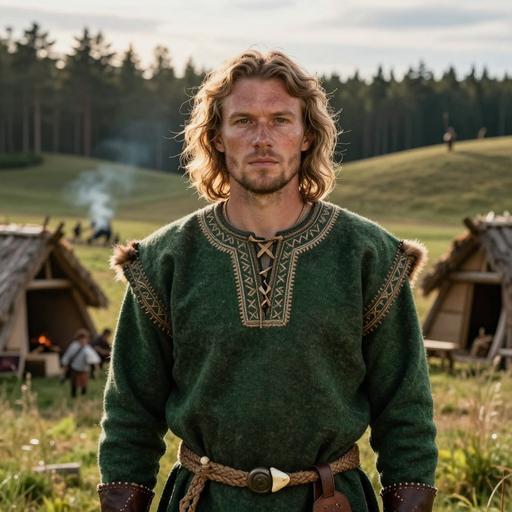
Portrait reconstruction of FRA202
Ancient Individual

A man buried in Sweden in the Bronze Age era

FRA202
2467 BCE - 2307 BCE
Male
Swedish Frälsegården Steppe-Influenced Culture
Sweden
Scroll to begin
Chapter I

Identity

The biological and cultural markers that define this ancient individual

Sample ID

FRA202

Date Range

2467 BCE - 2307 BCE

Biological Sex

Male

mtDNA Haplogroup

I2

Y-DNA Haplogroup

Not available

Cultural Period

Swedish Frälsegården Steppe-Influenced Culture

Chapter II

Place

Where this individual was discovered

Country Sweden
Locality Frälsegården
Coordinates 58.1644, 13.4547
Chapter III

Time

When this individual lived in the broader context of human history

FRA202 2467 BCE - 2307 BCE
Chapter IV

Story

The narrative of this ancient life

The Swedish Frälsegården Steppe-Influenced Culture of the Nordic era would be an intriguing and hypothetical blend of traditional Nordic elements and influences from the Central Asian steppes. This fusion could have emerged during a period of increased contact between the Nordic regions and the Eurasian steppes, perhaps through trade, migration, or conquest. Let's explore various aspects of such a culture, from social structure and economy to art, religion, and daily life.

Social Structure and Economy

Social Hierarchy: The term \Frälsegården" suggests a form of nobility or landowning class derived from Swedish medieval society, where "Frälse" refers to the nobility being exempt from taxes. This noble class would be at the top of the social pyramid, possibly enriched by connections to Eastern trade routes or alliances through marriage.

Beneath the nobility, a warrior class reminiscent of both Viking raiders and steppe nomads exists. These warriors are expert horsemen, incorporating cavalry tactics and horsemanship from the steppe cultures, perhaps influenced by peoples such as the Mongols or Scythians.

The lower tiers of society would consist of free farmers, artisans, and craftsmen who incorporate both Nordic and steppe technology and artistry into their work, as well as thralls or serfs who handle much of the manual labor.

Economy: The economy would be a mix of agriculture and trade. The fertile lands of Sweden provide opportunities for farming, focusing on crops like barley, oats, and rye, but influenced by steppe traditions, there would be a strong emphasis on cattle and horse breeding. Horses become a symbol of wealth and status, much like among steppe societies.

Trade is vital, with routes extending across continents. The reach from the Baltic to the Black Sea to the Silk Road intertwines the Nordic lands with the riches of Asia. Valuable goods such as silk, spices, and silver travel northward, while high-quality timber, furs, and amber move south and east.

Art and Architecture

Art: Art in this culture would reflect a synthesis of Nordic and steppe motifs. Traditional Norse art, known for its interwoven patterns and mythological themes, would blend with the geometric and naturalistic motifs found in steppe artifacts. Metalwork would be particularly notable, with jewelry and weaponry adorned with intricate designs representing animals and legendary creatures, drawing inspiration from both traditions.

Architecture: Architectural styles could see the traditional longhouses of the Nordic region combined with the yurt-like structures of the steppes, creating versatile buildings suited for harsh Scandinavian winters. The use of wood is prevalent, incorporating steppe techniques in construction that allow for buildings that are easily constructed and deconstructed.

Religion and Beliefs

Religion would be an amalgamation of Norse paganism and shamanistic elements from the steppes. Deities like Odin and Thor would continue to be venerated, but shaman-like figures would also gain importance, serving as intermediaries between the human and spiritual worlds.

Spiritual practices might feature horse sacrifices, a tradition from the steppes, along with ritual feasts and ceremonies held in conjunction with the changing seasons, a holdover from the agricultural cycle of the Nordic calendar.

Daily Life and Customs

Clothing: Clothing would be a practical blend of Nordic woolen garments and steppe leatherwork. Layered tunics and cloaks for warmth are common, often ornately decorated with embroidery depicting both mythological stories and pastoral scenes.

Food: The diet would be diverse, with a base of grains and dairy products typical of the Nordic people, enriched by meat from cattle, goats, and horses. Fermented foods and drinks, such as mead and kvass, would feature, alongside dishes influenced by steppe culinary traditions, possibly introducing elements like flatbreads or dumplings.

Festivals and Entertainment: Festivals combine Nordic celebrations like Midsommar and Yule with steppe traditions. These occasions feature horse races, wrestling, and storytelling, where skalds sing of heroes and gods modeled after both Norse sagas and steppe epics.

Conclusion

The Swedish Frälsegården Steppe-Influenced Culture of the Nordic era represents a fascinating intersection of two distinct cultural worlds. While speculative, it demonstrates the potential for cultural exchange and hybridization, resulting in a society that retains the strengths and traditions of both Nordic and steppe peoples, forging a unique place in the annals of history."

Chapter V

Context

Other ancient individuals connected to this sample

Sources

References

Scientific publications and genetic data

Scientific Publication

Repeated plague infections across six generations of Neolithic Farmers

Authors Seersholm FV, Sjögren KG, Koelman J
Abstract

In the period between 5,300 and 4,900 calibrated years before present (cal. BP), populations across large parts of Europe underwent a period of demographic decline1,2. However, the cause of this so-called Neolithic decline is still debated. Some argue for an agricultural crisis resulting in the decline3, others for the spread of an early form of plague4. Here we use population-scale ancient genomics to infer ancestry, social structure and pathogen infection in 108 Scandinavian Neolithic individuals from eight megalithic graves and a stone cist. We find that the Neolithic plague was widespread, detected in at least 17% of the sampled population and across large geographical distances. We demonstrate that the disease spread within the Neolithic community in three distinct infection events within a period of around 120 years. Variant graph-based pan-genomics shows that the Neolithic plague genomes retained ancestral genomic variation present in Yersinia pseudotuberculosis, including virulence factors associated with disease outcomes. In addition, we reconstruct four multigeneration pedigrees, the largest of which consists of 38 individuals spanning six generations, showing a patrilineal social organization. Lastly, we document direct genomic evidence for Neolithic female exogamy in a woman buried in a different megalithic tomb than her brothers. Taken together, our findings provide a detailed reconstruction of plague spread within a large patrilineal kinship group and identify multiple plague infections in a population dated to the beginning of the Neolithic decline.

Use code for 40% off Expires Feb 27