Menu
Store
Blog
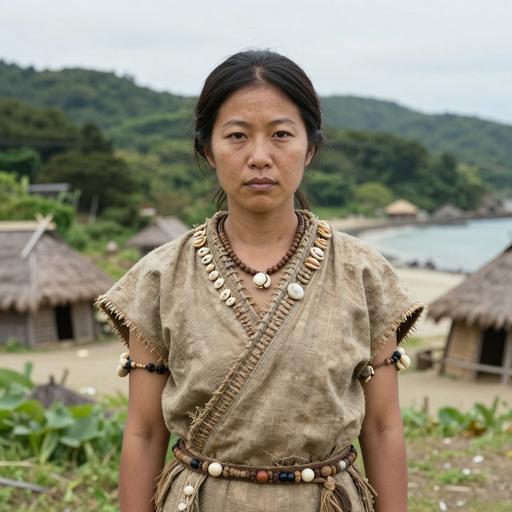
Portrait reconstruction of JpHi01
Ancient Individual

A woman buried in Japan in the Bronze Age era

JpHi01
1900 BCE - 1735 BCE
Female
The Jomon Period in Japan
Japan
Scroll to begin
Chapter I

Identity

The biological and cultural markers that define this ancient individual

Sample ID

JpHi01

Date Range

1900 BCE - 1735 BCE

Biological Sex

Female

mtDNA Haplogroup

M7a1a

Cultural Period

The Jomon Period in Japan

Chapter II

Place

Where this individual was discovered

Country Japan
Locality Shikoku. Ainan. Hijaro Shell Midden
Chapter III

Time

When this individual lived in the broader context of human history

JpHi01 1900 BCE - 1735 BCE
Chapter IV

Story

The narrative of this ancient life

The Jōmon period is a fascinating and significant era in Japanese prehistory, spanning from approximately 14,000 BCE to around 300 BCE. Named after the cord-marked patterns found on pottery from this time, the term \Jōmon" itself literally means "cord-marked" in Japanese. This period is notable for its longevity, complex societal developments, and the distinctive pottery that marks its archaeological sites.

Chronology and Subdivision:

The Jōmon period is typically divided into several phases based on changes in pottery styles and subsistence strategies:

  1. Incipient Jōmon (14,000–8,000 BCE): The beginning of the Jōmon period coincided with the end of the last Ice Age, bringing about climatic changes that allowed for more abundant resources and human habitation.
  2. Initial Jōmon (8,000–5,000 BCE): This phase saw the development of more diverse pottery styles and the establishment of permanent settlements.
  3. Early Jōmon (5,000–2,500 BCE): Marked by an increase in social complexity, this period witnessed advancements in craftsmanship and possibly the beginnings of ritualistic and religious activities.
  4. Middle Jōmon (2,500–1,500 BCE): Considered the peak of Jōmon culture, this era is characterized by elaborate pottery, increased population, and the construction of pit dwellings.
  5. Late Jōmon (1,500–1,000 BCE): Environmental changes led to shifts in settlement patterns and adaptations in subsistence practices.
  6. Final Jōmon (1,000–300 BCE): This phase was a period of transition with influences from neighboring cultures, setting the stage for the ensuing Yayoi period.

Geographic and Environmental Context:

The Jōmon culture extended across the Japanese archipelago, including the islands of Honshu, Hokkaido, Kyushu, and Shikoku. Diverse ecological zones ranging from coastal areas to forested mountains allowed for varied subsistence strategies. The end of the Pleistocene epoch brought warmer and wetter conditions, resulting in rich flora and fauna that supported hunting, gathering, and fishing economies.

Subsistence and Economy:

The people of the Jōmon period were primarily hunter-gatherers, and their diets were varied and resource-rich. They exploited coastal and riverine resources such as fish and shellfish, hunted wild animals like deer and boars, and gathered nuts, seeds, and fruits. There is evidence of plant cultivation, particularly of chestnuts and other native species, suggesting some degree of sedentism and agricultural experimentation.

Material Culture and Artifacts:

One of the most iconic aspects of Jōmon culture is its pottery. Early Jōmon pottery is among the oldest in the world, featuring simple designs. Over time, the pottery became increasingly sophisticated, with intricate cord-marked patterns, figurines, and vessels of various shapes and sizes. The elaborate pottery of the Middle Jōmon period is particularly renowned for its aesthetic complexity.

In addition to pottery, Jōmon people crafted a variety of tools and ornaments from stone, bone, wood, and antler. Stone tools included axes, knives, and projectile points, while bone was used to make fishhooks and needles. Personal adornments like beads and pendants were created from materials such as jade, amber, and clay.

Social Organization and Housing:

Jōmon society was likely organized into small, kin-based communities with rudimentary social stratification. The presence of circular pit dwellings in settlements suggests a degree of permanence, with some evidence of large communal structures that may have served as community centers or ritual spaces.

Circular and horseshoe-shaped village layouts are common, featuring communal areas and storage pits. These communal aspects indicate a society with shared resources and cooperative social structures.

Spiritual and Ritual Life:

The Jōmon people are believed to have engaged in rich spiritual and ritual life. This is suggested by the discovery of clay figurines, known as dogū, often depicting humanoid forms with exaggerated features. These are thought to have had spiritual or shamanistic significance, possibly used in fertility rites or as talismans. Additionally, jewelry and other personal adornments found in graves suggest a belief in an afterlife or spiritual world.

Conclusion:

The Jōmon period represents a complex hunter-gatherer culture that thrived in prehistoric Japan for thousands of years. Its developments in pottery, social organization, and subsistence strategies highlight human adaptability and ingenuity. The Jōmon period set the foundation for subsequent cultural transformations with the arrival of new technologies and influences during the Yayoi period. Despite its prehistoric context, the legacy of the Jōmon people remains a vibrant and integral part of Japan’s cultural heritage, symbolizing innovation, creativity, and the deep relationship between humans and their environment."

Chapter V

Context

Other ancient individuals connected to this sample

Sources

References

Scientific publications and genetic data

Scientific Publication

Ancient genomics reveals tripartite origins of Japanese populations

Authors Cooke NP, Mattiangeli V, Cassidy LM
Abstract

Prehistoric Japan underwent rapid transformations in the past 3000 years, first from foraging to wet rice farming and then to state formation. A long-standing hypothesis posits that mainland Japanese populations derive dual ancestry from indigenous Jomon hunter-gatherer-fishers and succeeding Yayoi farmers. However, the genomic impact of agricultural migration and subsequent sociocultural changes remains unclear. We report 12 ancient Japanese genomes from pre- and postfarming periods. Our analysis finds that the Jomon maintained a small effective population size of ~1000 over several millennia, with a deep divergence from continental populations dated to 20,000 to 15,000 years ago, a period that saw the insularization of Japan through rising sea levels. Rice cultivation was introduced by people with Northeast Asian ancestry. Unexpectedly, we identify a later influx of East Asian ancestry during the imperial Kofun period. These three ancestral components continue to characterize present-day populations, supporting a tripartite model of Japanese genomic origins.

Use code for 40% off Expires Mar 01