Menu
Store
Blog
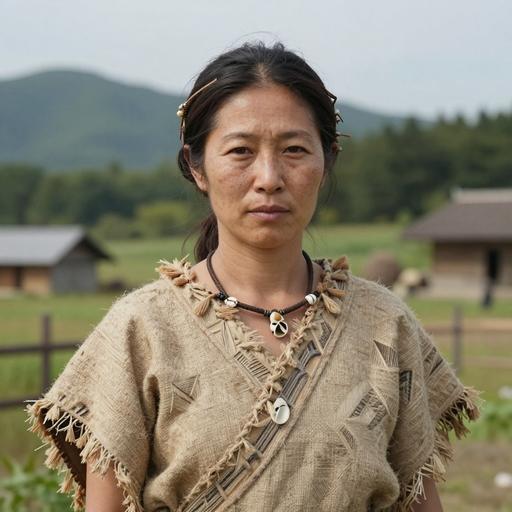
Portrait reconstruction of JpOd6
Ancient Individual

A woman buried in Japan in the Copper Age era

JpOd6
4229 BCE - 3984 BCE
Female
Early Jomon Period Japan
Japan
Scroll to begin
Chapter I

Identity

The biological and cultural markers that define this ancient individual

Sample ID

JpOd6

Date Range

4229 BCE - 3984 BCE

Biological Sex

Female

mtDNA Haplogroup

N9b3

Cultural Period

Early Jomon Period Japan

Chapter II

Place

Where this individual was discovered

Country Japan
Locality Honshu. Toyama. Kureha Hills. Odake Shell Midden
Chapter III

Time

When this individual lived in the broader context of human history

JpOd6 4229 BCE - 3984 BCE
Chapter IV

Story

The narrative of this ancient life

The Early Jomon period, which roughly dates from around 5000 to 2500 BCE, is a fascinating era in Japanese prehistory. It marks a significant phase in the long-spanning Jomon period (approximately 14,000 to 300 BCE), which is named after the distinctive \cord-marked" pottery that characterizes the culture. The Early Jomon period is crucial for understanding the transition of nomadic hunter-gatherers to more settled, complex societies in Japan, particularly on the island of Honshu, the largest island in the Japanese archipelago.

Geography and Environment

During this period, Japan's climate was relatively warmer than today, contributing to an abundance of natural resources. Honshu, along with the other main islands, was covered in dense forests of evergreen and deciduous trees that supported a variety of wildlife. This abundance allowed the Jomon people to practice a semi-sedentary lifestyle, sustained by hunting, gathering, and fishing.

Society and Settlement

The Early Jomon period saw the development of more permanent settlements compared to the preceding Incipient Jomon period. Villages were often located along coastlines, rivers, or lakes, benefiting from rich marine and freshwater resources. Archaeological evidence shows that these settlements could consist of circular pit dwellings, reflective of both family-based and communal activities. The appearance of social structures and differentiation within the society is suggested by the varied sizes and functions of the house structures, as well as the distribution of burial practices.

Subsistence and Economy

The Jomon people relied heavily on a broad-spectrum subsistence strategy. Their diet included acorns, chestnuts, and other nuts that required processing to remove toxins, as well as a wide variety of fruits, seeds, fish, shellfish, and game such as deer and boar. This rich food resource base led to an increase in population density and allowed for the formation of more stable communities. Complex techniques for storing food, such as stone-lined pits, have also been uncovered, indicating the Jomon’s understanding of preservation and seasonal cycles.

Pottery and Material Culture

One of the most distinguishing features of the Jomon culture is its pottery, which during the Early Jomon period, became more sophisticated and varied in form. The pottery, typically created using coiling and firing techniques, often bore intricate cord-marked designs, from which the period gets its name. This pottery wasn’t just utilitarian but also held ceremonial significance, evidenced by the increasing complexity and regional variations in design. Besides pottery, the Jomon people were skilled in crafting tools and decorative items from bone, stone, and shell, including arrowheads, needles, and beads.

Spiritual and Artistic Life

The Early Jomon period is also notable for its spiritual and artistic expressions. The construction of stone circles, though their exact purposes remain speculative, suggests some form of ritual or communal gathering. Figurines and masks, often featuring elaborate designs, indicate a rich tradition of spiritual or totemic practices. These artifacts point to a complex spiritual life that likely revolved around nature, fertility, and communal identity.

Conclusion

The Early Jomon period represents a significant epoch in Japanese prehistory due to its advances in social organization, economic complexity, and cultural expression. It lays a foundation for subsequent developments in the Jomon period and provides invaluable insights into how early societies adapted to and thrived in the diverse and resource-rich environments of prehistoric Japan. The achievements of this period, particularly in pottery and subsistence strategies, highlight the ingenuity and adaptability of the Jomon people, marking them as one of the most innovative and enduring cultures of the prehistoric world."

Chapter V

Genetics

The genetic ancestry of this ancient individual

Ancient Genetic Admixture

This analysis compares the DNA profile of JpOd6 with ancient reference populations, showing the genetic composition in terms of prehistoric ancestral groups.

Ancient Asians 85.0%
Neolithic Farmers 8.8%
Ancient Oceanians 6.2%

Modern Genetic Admixture

This analysis compares the DNA profile with present-day reference populations, showing what percentage of genetic makeup resembles modern populations from different regions.

Asia 92.5%
Japanese & Korean 87.3%
Japanese 87.3%
Central Asian, Northern Indian & Pakistani 5.3%
Indian 5.3%
Oceania 4.9%
Melanesian 4.9%
Papuan 4.9%
Africa 2.6%
North African 1.2%
North African 1.2%
African Hunter-Gatherer 1.1%

Closest Modern Populations

These are the modern populations showing the closest statistical alignment to A woman buried in Japan in the Copper Age era, ranked by genetic distance. Lower distance values indicate closer statistical similarity.

1
Tamang
4.0400
2
Nepali Tamang Simigaon
4.1040
3
Magar
4.1678
4
Gurung
5.1329
5
Yuku
6.0195
6
Nepali Tamang Tashinam
6.2615
7
Dongxiang
6.4007
8
Salar
6.5283
9
Tibetan Xunhua
6.8700
10
Baoan
6.9394
Chapter VI

Context

Other ancient individuals connected to this sample

Sources

References

Scientific publications and genetic data

Scientific Publication

Ancient genomics reveals tripartite origins of Japanese populations

Authors Cooke NP, Mattiangeli V, Cassidy LM
Abstract

Prehistoric Japan underwent rapid transformations in the past 3000 years, first from foraging to wet rice farming and then to state formation. A long-standing hypothesis posits that mainland Japanese populations derive dual ancestry from indigenous Jomon hunter-gatherer-fishers and succeeding Yayoi farmers. However, the genomic impact of agricultural migration and subsequent sociocultural changes remains unclear. We report 12 ancient Japanese genomes from pre- and postfarming periods. Our analysis finds that the Jomon maintained a small effective population size of ~1000 over several millennia, with a deep divergence from continental populations dated to 20,000 to 15,000 years ago, a period that saw the insularization of Japan through rising sea levels. Rice cultivation was introduced by people with Northeast Asian ancestry. Unexpectedly, we identify a later influx of East Asian ancestry during the imperial Kofun period. These three ancestral components continue to characterize present-day populations, supporting a tripartite model of Japanese genomic origins.

G25 Coordinates

The G25 coordinates for sample JpOd6 can be used for detailed admixture analysis in our G25 Studio tool.

JpOd6,0.01653998,-0.35108794,-0.0116292,-0.01019936,0.00783576,-0.006886,0.0081111,0.00698896,0.01078294,0.01309462,-0.05423258,-0.00342606,0.00494864,0.00127314,-0.00608034,-0.0051295,0.00420038,-0.00187146,-0.00444654,0.00035246,0.0014604,0.016296,0.00413942,0.00267702,0.02529529
Analyze in G25 Studio
Use code for 40% off Expires Mar 01