Menu
Store
Blog
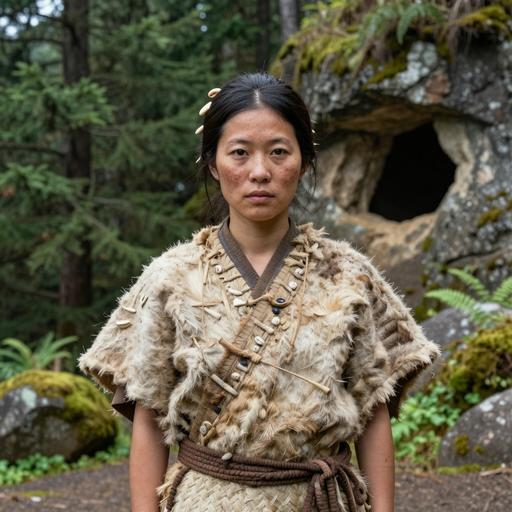
Portrait reconstruction of JpKa6904
Ancient Individual

A woman buried in Japan in the Mesolithic era

JpKa6904
7041 BCE - 6696 BCE
Female
The Initial Jomon Period in Japan
Japan
Scroll to begin
Chapter I

Identity

The biological and cultural markers that define this ancient individual

Sample ID

JpKa6904

Date Range

7041 BCE - 6696 BCE

Biological Sex

Female

mtDNA Haplogroup

N9b3

Cultural Period

The Initial Jomon Period in Japan

Chapter II

Place

Where this individual was discovered

Country Japan
Locality Shikoku. Ehime Prefecture. Kamiukena District. Kamikuroiwa Rock Shelter
Chapter III

Time

When this individual lived in the broader context of human history

JpKa6904 7041 BCE - 6696 BCE
Chapter IV

Story

The narrative of this ancient life

The Initial Jomon Period, part of the broader Jomon Era, is a fascinating and transformative epoch in prehistoric Japan, marking significant developments in culture, technology, and social organization among the foraging communities. Spanning approximately from 10,000 BCE to 5,000 BCE, this period witnessed the gradual transition from a nomadic lifestyle to more settled communities, facilitated by changes in climate and innovative advancements.

Environmental Context and Adaptation:

  1. Climate and Geography:

    • The onset of the Initial Jomon Period was marked by the end of the last Ice Age, leading to a warmer and more stable climate.
    • Rising sea levels transformed the landscape, creating a heavily forested archipelago abundant in flora and fauna, ideal for hunting, gathering, and fishing.
  2. Resource Utilization:

    • The rich biodiversity allowed for diverse subsistence strategies, with communities exploiting both land and marine resources efficiently.
    • Nut-bearing trees, such as chestnuts and acorns, became staple sources of food, alongside fish and game.

Technological and Material Culture:

  1. Pottery:

    • This period is renowned for its earthenware pottery, considered among the oldest in the world. These ceramics were primarily used for storage and cooking.
    • The pottery was characterized by its rope-patterned designs (from which \Jomon," meaning "cord-marked," derives).
  2. Stone Tools and Weaponry:

    • The development of stone tools was an essential aspect, with tools like arrowheads, knives, and axes indicating advanced craftsmanship.
    • These tools facilitated the capture and processing of a wider range of resources.
  3. Housing and Settlements:

    • While still semi-nomadic, there was a shift towards more permanent settlements, often near water sources for easier access to fish and transport.
    • Pit dwellings, with thatched roofs and central hearths, became prevalent architectural structures.

Social and Cultural Dynamics:

  1. Social Organization:

    • The Initial Jomon communities were likely egalitarian, with resources shared among community members.
    • Social organization was probably kin-based, with extended families forming the basic social units.
  2. Rituals and Spiritual Beliefs:

    • Archaeological findings suggest the presence of ritual practices, possibly linked to animistic beliefs or ancestor worship.
    • The use of clay figurines and stone altars indicates the importance of spiritual or religious life.
  3. Art and Symbolism:

    • Artistic expression was evident in the intricate designs found on pottery and ornaments, reflecting aesthetic sensibilities and possibly symbolic meanings or clan affiliations.

Impact and Legacy:

  1. Foundation for Subsequent Cultures:

    • The technological and cultural innovations of the Initial Jomon laid the groundwork for subsequent periods, as communities became increasingly complex and interconnected.
  2. Influence on Modern Japanese Culture:

    • Although the Jomon society eventually transformed with the influx of new cultures and technologies during the Yayoi period, many of their practices, particularly in pottery and craftsmanship, continued to influence Japanese culture.

In summary, the Initial Jomon Period represents a significant chapter in Japan's prehistoric era, highlighting the adaptability and creativity of early human societies. It set the stage for developments that would ultimately shape the region's subsequent cultural and historical trajectories."

Chapter V

Genetics

The genetic ancestry of this ancient individual

Ancient Genetic Admixture

This analysis compares the DNA profile of JpKa6904 with ancient reference populations, showing the genetic composition in terms of prehistoric ancestral groups.

Ancient Asians 83.3%
Ancient Oceanians 7.1%
Neolithic Farmers 5.4%
Western Steppe Pastoralists 4.3%

Modern Genetic Admixture

This analysis compares the DNA profile with present-day reference populations, showing what percentage of genetic makeup resembles modern populations from different regions.

Asia 96.9%
Japanese & Korean 87.9%
Japanese 87.9%
Central Asian, Northern Indian & Pakistani 9.0%
Indian 9.0%
Oceania 2.1%
Melanesian 2.1%
Papuan 2.1%
Africa 1.0%
African Hunter-Gatherer 1.0%

Closest Modern Populations

These are the modern populations showing the closest statistical alignment to A woman buried in Japan in the Mesolithic era, ranked by genetic distance. Lower distance values indicate closer statistical similarity.

1
Tamang
4.3489
2
Nepali Tamang Simigaon
4.4267
3
Magar
4.4932
4
Gurung
5.7756
5
Nepali Tamang Tashinam
6.8683
6
Yuku
7.0452
7
Dongxiang
7.4445
8
Nepali Indo Aryan O2
7.4905
9
Salar
7.5525
10
Tibetan Xunhua
7.7008
Chapter VI

Context

Other ancient individuals connected to this sample

Sources

References

Scientific publications and genetic data

Scientific Publication

Ancient genomics reveals tripartite origins of Japanese populations

Authors Cooke NP, Mattiangeli V, Cassidy LM
Abstract

Prehistoric Japan underwent rapid transformations in the past 3000 years, first from foraging to wet rice farming and then to state formation. A long-standing hypothesis posits that mainland Japanese populations derive dual ancestry from indigenous Jomon hunter-gatherer-fishers and succeeding Yayoi farmers. However, the genomic impact of agricultural migration and subsequent sociocultural changes remains unclear. We report 12 ancient Japanese genomes from pre- and postfarming periods. Our analysis finds that the Jomon maintained a small effective population size of ~1000 over several millennia, with a deep divergence from continental populations dated to 20,000 to 15,000 years ago, a period that saw the insularization of Japan through rising sea levels. Rice cultivation was introduced by people with Northeast Asian ancestry. Unexpectedly, we identify a later influx of East Asian ancestry during the imperial Kofun period. These three ancestral components continue to characterize present-day populations, supporting a tripartite model of Japanese genomic origins.

G25 Coordinates

The G25 coordinates for sample JpKa6904 can be used for detailed admixture analysis in our G25 Studio tool.

JpKa6904,0.0140654,-0.35005974,-0.01710218,-0.00044906,0.00525462,-0.01330924,0.00467646,0.00393928,0.01022418,0.01225716,-0.0541926,-0.00396158,0.00600928,-0.0004789,-0.00803014,-0.00511712,0.00425564,-0.0019149,-0.00257376,0.00125214,0.0025496,0.0137618,0.00458914,0.00405282,0.02471285
Analyze in G25 Studio
Use code for 40% off Expires Mar 01