Menu
Store
Blog
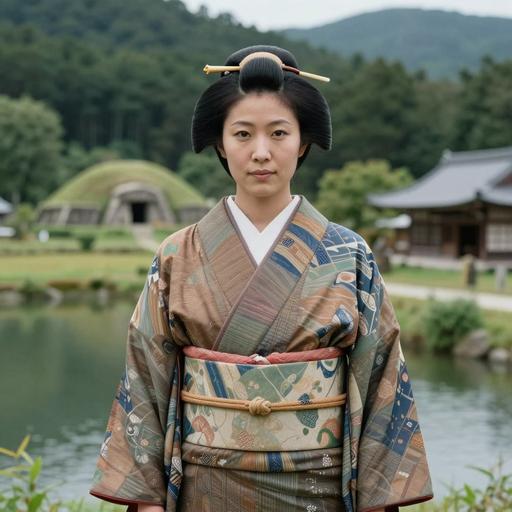
Portrait reconstruction of JpIw33
Ancient Individual

A woman buried in Japan in the Kofun Period era

JpIw33
595 CE - 655 CE
Female
Kofun Period Japan
Japan
Scroll to begin
Chapter I

Identity

The biological and cultural markers that define this ancient individual

Sample ID

JpIw33

Date Range

595 CE - 655 CE

Biological Sex

Female

mtDNA Haplogroup

M7b1a1a1

Cultural Period

Kofun Period Japan

Chapter II

Place

Where this individual was discovered

Country Japan
Locality Honshu. Ishikawa Prefecture. Kanazawa. Iwade horizontal cave tombs
Chapter III

Time

When this individual lived in the broader context of human history

JpIw33 595 CE - 655 CE
Chapter IV

Story

The narrative of this ancient life

The Kofun period, lasting from approximately the mid-3rd century to the early 7th century, is a pivotal era in Japanese history, marking significant political, social, and cultural transformations. It is named after the large tumulus mounds, called \kofun," that were constructed as burial sites for the ruling elite during this time. The period witnessed the emergence of a more centralized state structure and the establishment of key cultural practices that would persist throughout Japanese history.

Political Structure and Society

  1. Emergence of Powerful Clans:

    • The Kofun period is characterized by the dominance of powerful regional clans known as "uji," each led by a chieftain. The Yamato clan eventually emerged as the most influential, coming to dominate much of the archipelago.
    • These clans were integral to the formation of a more centralized authority, with the Yamato leaders leveraging alliances and military might to assert control over surrounding regions.
  2. Centralization and State Formation:

    • The consolidation of political power under the Yamato court laid the groundwork for a more unified Japanese state.
    • Influences from the Korean Peninsula and China, including bureaucratic and administrative techniques, played a significant role in this centralization process.
  3. Social Hierarchy:

    • Society was hierarchically structured, with a clear division between the elite ruling class and commoners.
    • The elite were distinguished by their political power, wealth, and access to prestigious goods obtained through trade and tribute.

Culture and Religion

  1. Shinto Practices:

    • Indigenous religious beliefs, which would later be codified as Shinto, were prevalent. These involved the worship of kami (spirits or gods) associated with natural phenomena, ancestors, and important clan deities.
    • Ritual practices and ceremonies were important in both political and social contexts, serving as a means to legitimize the power of the ruling elite.
  2. Burial Mounds (Kofun):

    • The kofun themselves are key cultural artifacts from this period. These earthen mounds, often shaped like keyholes, served as tombs for the elite and symbolize the hierarchical nature of Kofun society.
    • The tombs were accompanied by grave goods, including bronze mirrors, iron weapons, and clay haniwa figures, which provide insights into the material culture and beliefs of the time.
  3. Art and Artifacts:

    • Haniwa figures, made of terracotta, are among the most distinctive artifacts of this era. They served both decorative and ritual purposes, often being placed around the kofun.
    • The period also saw the production of sophisticated metalwork and pottery, indicating advanced craftsmanship and trade links with neighboring cultures.

Economic and Technological Developments

  1. Agriculture and Land Management:

    • Advances in agricultural techniques led to increased productivity, which supported population growth and the development of larger settlements.
    • Rice cultivation continued to be the backbone of the economy, with agricultural surplus allowing for the support of a warrior and artisan class.
  2. Trade and External Relations:

    • The Kofun period was marked by active trade and cultural exchanges with the Korean Peninsula and China. This led to the introduction of new technologies, such as ironworking and advanced pottery techniques.
    • External influences also extended to military practices, architecture, and the adaptation of Chinese writing, which would lay the groundwork for the development of the Japanese script.

In conclusion, the Kofun period is critical to understanding the transition of Japan from fragmented tribal societies to a more unified state with a rich cultural identity. It set the stage for the subsequent Asuka period, during which Japan would further embrace continental influences and continue its transformation into a more sophisticated and centralized state. The legacy of the Kofun period is still visible today in Japan's cultural and historical landscape, particularly through its burial mounds and the enduring influence of early clan cultures."

Chapter V

Genetics

The genetic ancestry of this ancient individual

Ancient Genetic Admixture

This analysis compares the DNA profile of JpIw33 with ancient reference populations, showing the genetic composition in terms of prehistoric ancestral groups.

Ancient Asians 100.0%

Modern Genetic Admixture

This analysis compares the DNA profile with present-day reference populations, showing what percentage of genetic makeup resembles modern populations from different regions.

Asia 98.9%
Japanese & Korean 92.1%
Japanese 92.1%
Northern Asian 3.2%
Mongolian 3.2%
Central Asian, Northern Indian & Pakistani 1.9%
Pakistan 1.5%
Chinese & Southeast Asian 1.6%
Chinese 1.6%
America 0.7%
America 0.7%
Native American 0.7%

Closest Modern Populations

These are the modern populations showing the closest statistical alignment to A woman buried in Japan in the Kofun Period era, ranked by genetic distance. Lower distance values indicate closer statistical similarity.

1
Mongola
3.1428
2
Korean Antu
3.1674
3
Korean
3.3767
4
Yugur
3.7459
5
Manchu
3.8609
6
Manchu Jinzhou
3.8756
7
Han Shanxi
3.9453
8
Xibo
4.1944
9
Han Henan
4.2974
10
Han Shandong
4.3210
Chapter VI

Context

Other ancient individuals connected to this sample

Sources

References

Scientific publications and genetic data

Scientific Publication

Ancient genomics reveals tripartite origins of Japanese populations

Authors Cooke NP, Mattiangeli V, Cassidy LM
Abstract

Prehistoric Japan underwent rapid transformations in the past 3000 years, first from foraging to wet rice farming and then to state formation. A long-standing hypothesis posits that mainland Japanese populations derive dual ancestry from indigenous Jomon hunter-gatherer-fishers and succeeding Yayoi farmers. However, the genomic impact of agricultural migration and subsequent sociocultural changes remains unclear. We report 12 ancient Japanese genomes from pre- and postfarming periods. Our analysis finds that the Jomon maintained a small effective population size of ~1000 over several millennia, with a deep divergence from continental populations dated to 20,000 to 15,000 years ago, a period that saw the insularization of Japan through rising sea levels. Rice cultivation was introduced by people with Northeast Asian ancestry. Unexpectedly, we identify a later influx of East Asian ancestry during the imperial Kofun period. These three ancestral components continue to characterize present-day populations, supporting a tripartite model of Japanese genomic origins.

G25 Coordinates

The G25 coordinates for sample JpIw33 can be used for detailed admixture analysis in our G25 Studio tool.

JpIw33,0.02241514,-0.43654228,0.0135503,-0.05197434,0.02447122,0.00646962,0.0066467,0.00611286,-7.282E-05,0.00782068,-0.06311694,-0.00699702,0.0096794,-0.00763068,-0.00930114,-0.0042859,0.00055348,0.0004507,0.00179846,-0.00165956,0.01395268,-0.00506126,0.0039178,0.0028769,-0.00919765
Analyze in G25 Studio
Use code for 40% off Expires Mar 01