Introduction
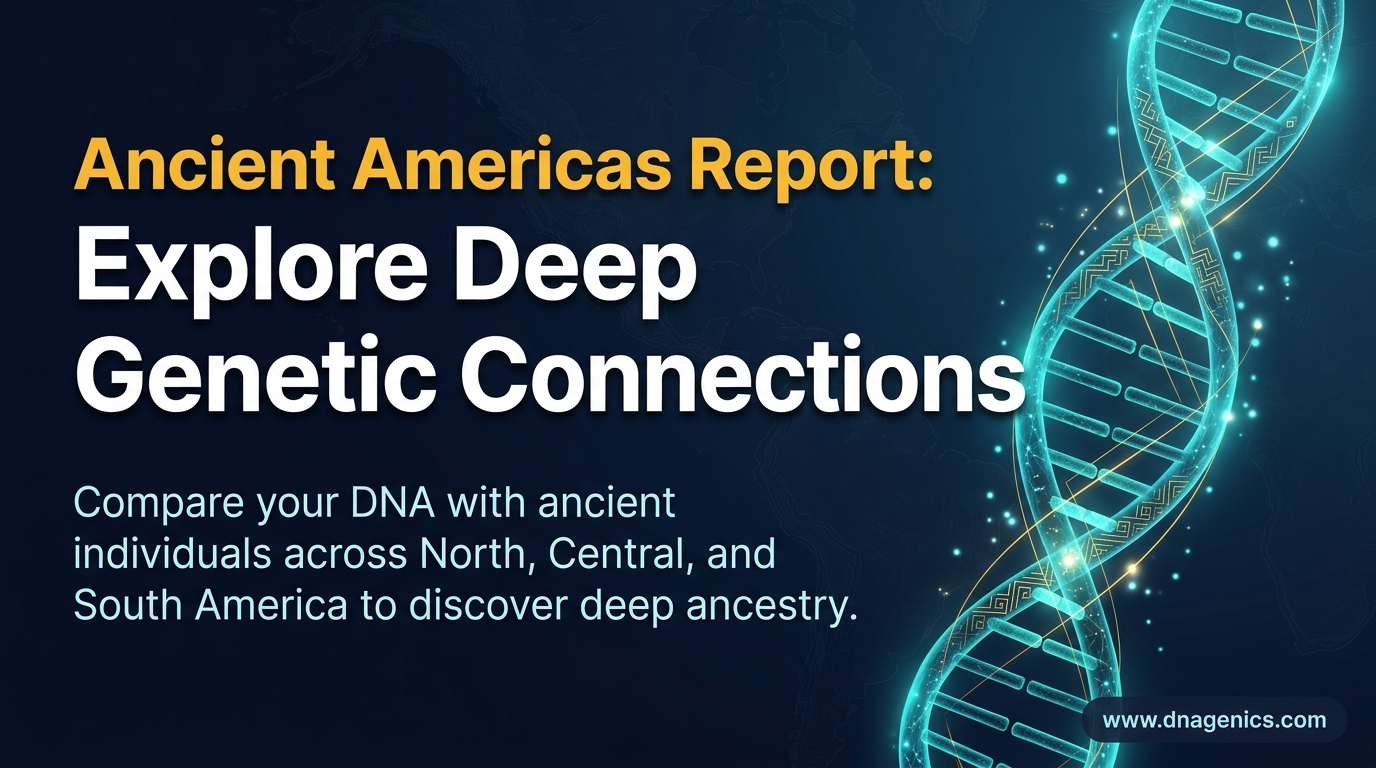
The history of the Americas is written not only in archaeology and oral tradition, but also in DNA. For people interested in deep ancestry, an Ancient Americas Report can offer a fascinating way to explore how their genetic profile compares with ancient individuals recovered from sites across North, Central, and South America. Rather than looking for a single yes or no answer, this report provides a layered view of genetic similarity, showing where your DNA may align with deep populations from the ancient Americas.
This matters because many people have questions about distant genetic connections that go far beyond recent family trees. Whether you are researching a possible Indigenous American connection, exploring Latin American heritage, or simply curious about how your DNA compares to ancient reference samples, this report gives you a structured way to interpret those signals. Produced by DNAGENICS, it is designed to be accessible for beginners while still offering enough technical detail for experienced genealogy and ancestry users.
Key Takeaways
- The Ancient Americas Report measures your DNA against ancient individuals from across the Americas, including North, Central, and South America.
- Your result is built from a composite Ancient Americas Index that combines shared DNA segment matching, admixture distance, and a best-fit population model.
- A match in this report indicates genetic similarity, not proof of a specific tribal, national, or documented genealogical identity.
- The report includes your closest ancient connections, period-level breakdowns, shared segment details, and an interactive map of matching sites.
- Evidence labels help you distinguish between Shares DNA, Shared lineage branch, Best-fit model, and Reference sample entries.
What the Ancient Americas Report Measures
The Ancient Americas Report compares your DNA against ancient individuals recovered from archaeological sites across the Americas. These ancient samples represent different cultural and historical periods, which allows the report to show how closely your genetic profile aligns with deep population structure in the region. The goal is not to assign identity, but to identify patterns of similarity that may be informative for ancestry research.
What makes this report especially useful is that it does not depend on a single calculation. Instead, it combines three complementary forms of genetic evidence into one overall score. That approach is important because deep ancestry signals are often subtle, and no single method captures the full picture on its own.
The report is especially relevant for people with Indigenous American or Latin American heritage, but it can also be informative for users worldwide. Ancient population movements and shared deep ancestry can create low-level signals in many modern DNA profiles, so even testers without known American heritage may see a valid result.
How the Composite Index Works
The main result in the report is the Ancient Americas Index, a composite score built from three methods working together. These methods are not interchangeable, and each one adds a different kind of evidence to the final result.
The first method is shared DNA segment matching. This checks whether you share identifiable DNA segments with an ancient individual, which is one of the strongest forms of evidence in the report. Shared segments suggest a more direct genetic connection than simple population similarity alone, although they still do not identify a specific ancestor.
The second method is admixture distance. This measures how closely your overall genetic profile resembles the ancient reference populations used in the analysis. In simple terms, it asks how far your DNA is from different ancient population models, using a statistical comparison rather than a direct segment match.
The third method is a best-fit population model, which tests which combination of ancient reference individuals best explains your DNA profile. This is a similarity-based model, not a claim of direct descent. It helps place your result in a broader ancestral context, especially when your signal is low or distributed across multiple periods.
By combining these methods, the report produces a more balanced and reliable interpretation than any one calculation could provide. That is particularly helpful in deep ancestry work, where signals may be faint, mixed, or uneven across different parts of the genome.
What You Get in the Report
The Ancient Americas Report includes several features that help you understand both your overall result and the evidence behind it. One of the most useful is the list of your closest genetic connections, which shows specific ancient individuals from the Americas whose DNA is most similar to yours. These entries include portraits, archaeological locations, and estimated dates, giving you historical context alongside the genetic comparison.
You also get a breakdown of genetic affinity across different cultural periods of the ancient Americas. This helps you see whether your strongest similarity appears in Paleoindian, Archaic, Mesoamerican, Andean, North American, or Caribbean and Amazonian contexts. For people interested in deeper regional patterns, this can be especially informative.
Another valuable feature is the shared DNA segment view, which shows the segments driving your result. Because shared segments are more direct evidence than broad model similarity, they can help you evaluate which connections are strongest. The report also includes an interactive map showing where your closest ancient matches were found, making the results easier to visualize geographically.
Finally, the report includes a shareable Heritage Summary and a plain-language guide that explains how to read the results and what the limitations are. That is important, because ancestry reports are most useful when they are interpreted carefully and in context.
How to Read the Evidence Labels
One of the most helpful parts of the report is the evidence labeling system. Each ancient individual is tagged according to the type of relationship it has to your results, which makes it easier to tell strong evidence from contextual information.
Shares DNA means the ancient individual shares DNA segments with you. This is a direct signal within the report and often the most meaningful type of connection listed.
Shared lineage branch means the individual shares the same maternal or paternal haplogroup branch. This can support a broader deep-ancestry interpretation, but it does not mean you descend from that exact person.
Best-fit model indicates that the individual is part of the population mix that best fits your DNA. This is a statistical similarity signal, not shared DNA.
Reference sample means the individual is shown for context only. It may help illustrate the range of ancient populations considered in the analysis, but it is not itself a match.
This labeling approach is important because period scores and individual matches do not mean the same thing. A period can score highly even when only a few individuals from that period share DNA with you, because the score also reflects population similarity in the best-fit model. The report helps separate those ideas so that users can understand what each signal actually means.
Why the Ancient Americas Context Matters
The ancient Americas cover a wide span of time and geography, from early Paleoindian populations to later regional cultures in Mesoamerica, the Andes, the North American interior, the Caribbean, and the Amazon basin. That diversity is one reason the report is so informative. It gives users a way to compare their DNA against a broad and historically meaningful set of ancient references rather than a narrow regional sample.
This broader context is valuable for genealogy researchers who suspect a connection to the Americas, as well as for deep-ancestry enthusiasts who want to place their DNA in a wider human history. It can also be a useful complement to other ancient and regional reports, especially when users are trying to build a fuller picture of their deep genetic background.
The report also fits naturally alongside maternal and paternal haplogroup analysis. Haplogroups trace one direct maternal or paternal line, while the Ancient Americas Report looks at broader genome-wide similarity. Used together, these tools can provide different but complementary clues about deep ancestry.
Practical Implications
If you receive a result from the Ancient Americas Report, the most important thing is to interpret it as genetic similarity, not proof of a specific identity or documented lineage. A positive result does not confirm Indigenous American ancestry in a legal, cultural, or genealogical sense, and a low or distant result is still a normal and valid outcome for many users. The report is most useful when treated as one piece of evidence in a broader ancestry investigation.
If your match appears weak or distant, that does not necessarily mean the report is unhelpful. It may simply mean that your ancient signal is subtle, distributed, or better explained by another deep-ancestry report. Users interested in a more complete picture may want to compare this result with other regional ancient reports and with haplogroup findings, especially if they are building a multi-layered ancestry interpretation.
Conclusion
The Ancient Americas Report offers a careful, evidence-based way to explore deep genetic connections to ancient populations across the Americas. By combining shared segment matching, admixture distance, and a best-fit population model, it provides a more nuanced view than a single calculation could. For anyone interested in ancestry, deep history, or ancient DNA, it is a useful tool for understanding where your DNA may align with the ancient Americas, while keeping the limits of interpretation clear.
References / Further Reading
- DNAGENICS, Ancient Americas Report, product information provided in source content
- Ancient DNA and ancestry interpretation concepts referenced in the report methodology, including shared DNA segment matching, admixture distance, best-fit population modeling, and haplogroup analysis