Introduction
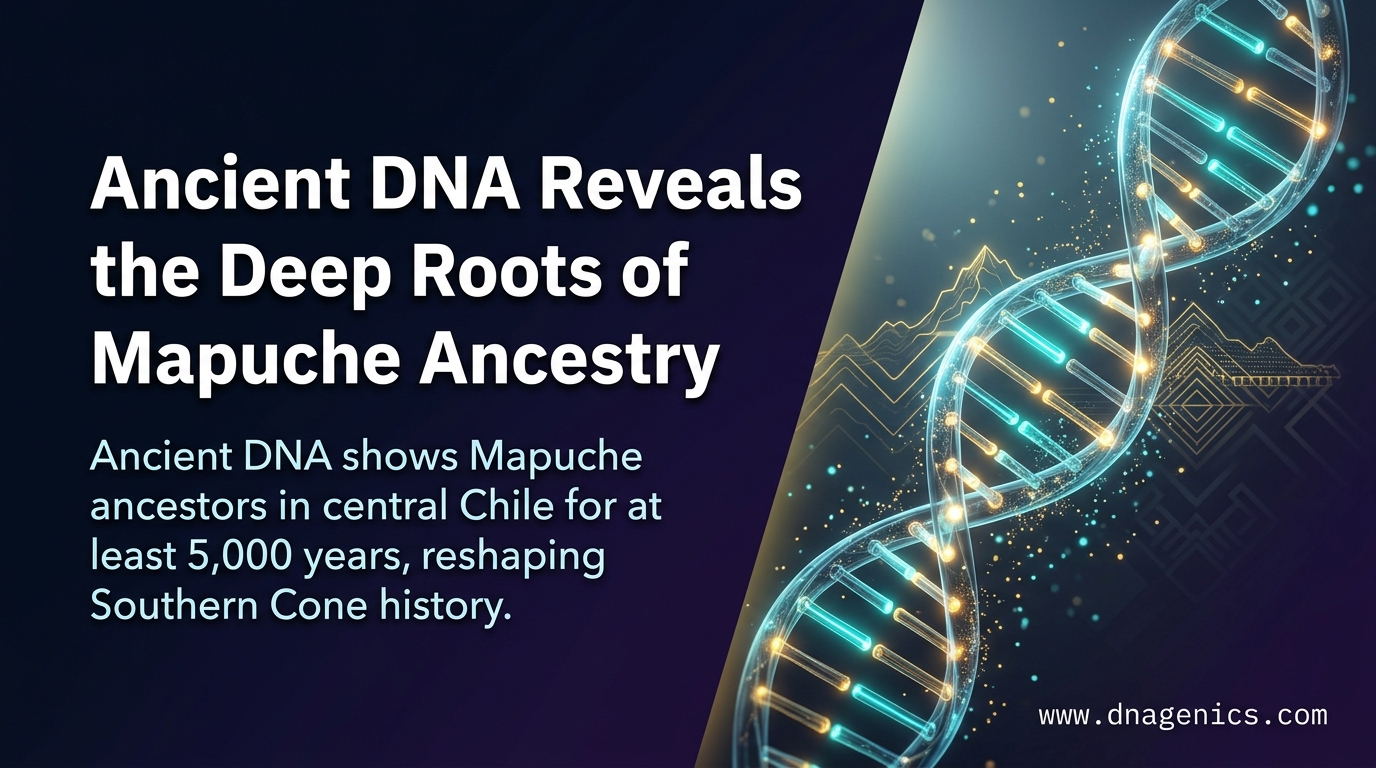
For generations, the origins of the Mapuche people were discussed through archaeology, language, and colonial history, but not through genetics. That changed when ancient DNA studies began to trace deep population history across Chile and the wider Southern Cone. The new evidence suggests that Mapuche-related ancestors were already living in central Chile thousands of years before Spanish contact, and long before the rise of the Inca in the region.
This matters because the Mapuche are one of the largest Indigenous peoples in Chile, and their past was never recorded in writing before conquest. Genetics cannot replace history, but it can fill in missing chapters. By comparing ancient genomes with present-day and historical populations, researchers are reconstructing a more detailed picture of migration, long-term continuity, and regional interaction in the Andes and beyond.
Key Discoveries / Main Points
- Mapuche-related ancestry appears to have deep roots in central Chile and Chiloé, with direct ancestors present there at least 5,000 years ago.
- The strongest ancient genetic match for modern Mapuche groups came from Conchalí, in the Santiago basin, from individuals dating to around AD 1100 and AD 1350.
- The data suggest a long period of relative isolation from the Andes, followed by later contact in the last millennium that was mostly cultural, with only limited gene flow.
- Ancient DNA also shows connections between southern Chile and the far south, including shared ancestry with Kaweskar and Yamana-related groups in some coastal populations.
- The study highlights how population genetics can recover broad ancestry patterns even when direct written records are absent.
What This Means for Your DNA
If you are interested in DNA ancestry testing, this research is a good example of how population history is read through statistical comparison, not through simple labels. A modern DNA profile cannot tell you that you are Mapuche, nor can it prove a direct tribal identity on its own. What it can do is show whether your genetic markers fit better with one reference population than another, especially when the reference panel includes ancient DNA from the region.
For people with ancestry from Chile, southern Peru, Bolivia, Argentina, or the southern edge of Patagonia, this study shows why regional context matters. Many South American populations are related through long shared histories, later migrations, and local adaptations. A result that points to indigenous ancestry from the Southern Cone may reflect deep local continuity, later admixture, or both. In other words, your DNA can reveal a broad ancestral landscape, but interpreting it correctly requires archaeological and historical context.
This also shows why ancestry reports can look different depending on the reference database used. If a company compares your DNA to modern groups only, it may miss older population structure. When ancient genomes are added, the story becomes more precise. For descendants of Indigenous communities, that means ancestry estimates can sometimes recover older regional connections that were preserved in the genome even when historical records were lost.
Historical and Archaeological Context
Archaeology shows that people were present in southern Chile very early. Sites like Monte Verde, near Puerto Montt, demonstrate human occupation in the region about 14,500 years ago, although no DNA has been recovered there. The oldest genome from Chile comes from Los Rieles, near Los Vilos, and dates to about 10,900 years ago. That individual belongs to an early lineage that was later largely replaced across much of South America, which matches a broader pattern seen in ancient genomes from the continent.
The newer Mapuche-related signal comes from later individuals in central Chile, especially Conchalí, which sits in the Santiago basin. These genomes are important because they are geographically close to the historic area where Mapudungun was spoken at contact. The pattern suggests that the ancestors of the Mapuche were already established in central Chile and Chiloé by at least 5,000 years ago, then remained there for millennia before the Spanish arrived. This supports a long regional continuity rather than a recent movement from the Andes or from farther east.
Historical contact with the Andes appears to have intensified only in the last thousand years or so. Crops such as maize, quinoa, and potatoes spread south, and a small number of Quechua and Aymara loanwords entered Mapudungun. That combination of linguistic and genetic evidence suggests cultural exchange with limited demographic impact. Later, coastal and island populations such as the Huilliche of Chiloé also absorbed ancestry related to southern canoe peoples, showing that interaction continued across ecological zones.
The Science Behind It
The study behind these findings used genome-wide comparison across 156 ancient individuals from Chile, Argentina, Peru, and Bolivia. Researchers compared ancient genomes with present-day Mapuche groups and with Andean reference populations such as Quechua and Aymara. They also used a model that included Spanish ancestry as a control, which helps account for later European admixture in modern samples. This approach does not search for a single perfect ancestor, but for relative similarity across many markers.
A key part of the analysis was a method known as Global25, a coordinate-based framework often used in population genetics to visualize overall genetic affinity. Because Native South American populations occupy a small and complex part of that space, the researchers did not rely on direct one-to-one matching alone. Instead, they asked a more robust question: does an ancient genome fit the Mapuche reference better than it fits Andean controls? That difference in fit is useful because it reduces noise and helps reveal regional ancestry patterns.
In Simple Terms: Scientists compared many ancient and modern DNA profiles to see which ones looked more alike overall. If an ancient person fits the Mapuche reference better than Andean references, that suggests a closer genetic relationship, not proof of direct descent.
The results were strongest in regions historically linked to the southern peoples of Chile. Ancient genomes from Patagonia, Tierra del Fuego, the Pampas, and central Chile often leaned toward the Mapuche reference more than toward the Andean controls. That pattern fits a deep history of regional continuity in the south, with later exchange across wider areas. It also shows the limits of genetic interpretation, because a shared signal can reflect ancient common ancestry, later admixture, or both.
Why It Matters
This research helps correct a common misunderstanding: that Indigenous histories only began to matter once they were written down. In fact, many populations have much deeper histories than colonial records can show. For Mapuche ancestry, ancient DNA provides a rare window into a past that stretches back thousands of years and ties together central Chile, Chiloé, and parts of the far south.
It also shows the future direction of population genetics in the Americas. As more ancient genomes are published, researchers will be able to test finer regional questions, including how farming spread, how coastal and inland groups interacted, and how language and ancestry moved together or separately. For anyone exploring genetics, haplogroups, and migration in South America, the takeaway is clear: the history is deeper, more regional, and more connected than older models suggested.
References / Further Reading
- Current Biology, 2023, study on the genetic history of the Southern Andes and present-day Mapuche ancestry
- Cell, 2018, ancient genomes from Los Rieles and Conchalí
- Published archaeological evidence for Monte Verde
- Studies of ancient Kaweskar, Yamana, and Chono-related populations in southern Chile and Patagonia