Introduction
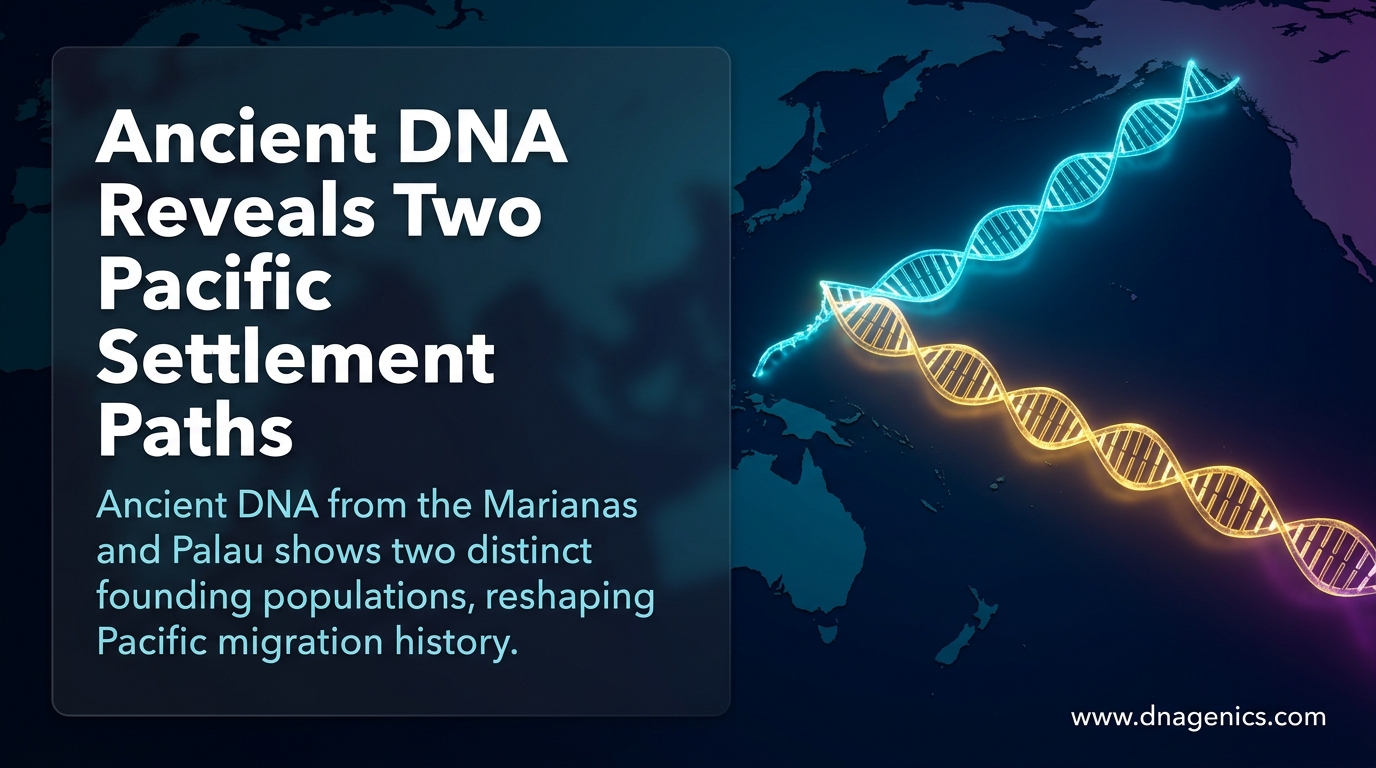
The first people to cross the open Pacific did not arrive through a single wave of migration. Ancient DNA from the Mariana Islands and Palau now shows a more complex story, with two neighboring island groups founded by different populations that had distinct genetic histories. For anyone interested in DNA ancestry, this is a powerful reminder that geography alone does not predict where people came from or how they moved across the ocean.
These islands matter because they sit in Remote Oceania, a region that required exceptional seafaring skill to reach. Migrants had to travel hundreds or even thousands of kilometers over open water in canoes, using navigation knowledge and confidence in the sea. The new genetic evidence helps explain how early Pacific migration unfolded, and why some island populations retained one ancestry profile while others already carried mixed ancestry before settlement.
Key Discoveries / Main Points
- The Marianas and Palau were settled by two different peoples, not one shared founding group.
- Ancient individuals from the Mariana Islands show essentially no detectable Papuan ancestry, making them unusual among Remote Oceanian populations.
- The first people in Palau already carried roughly 40% Papuan-related ancestry before the islands were settled, suggesting mixing happened earlier in eastern Indonesia or nearby regions.
- Genetic data support a broader model of multiple migration routes into the Pacific, rather than a single west-to-east expansion.
- The study highlights how population genetics can reveal migration history, sex-biased movement, and long-term continuity in island communities.
What This Means for Your DNA
For people exploring family history, the biggest takeaway is that ancestry is often more layered than a simple origin story. A DNA result can point to broad regional affinities, such as connections to Island Southeast Asia, Near Oceania, or populations related to ancient Pacific groups. But the Pacific case shows that two nearby islands can have very different founding populations, so genetic similarity does not always follow modern map boundaries.
This matters for anyone trying to understand ancestry testing, haplogroups, or deep maternal and paternal lines. A population can carry one set of ancestry components at one time, then change through later migration, intermarriage, or isolation. In the Pacific, some communities remained genetically stable for long periods, while others absorbed new ancestry in waves. That means a modern DNA result reflects a long chain of events, not a single migration moment.
For advanced users, this also shows why reference panels and statistical models matter. Ancient genomes are compared to present-day and ancient reference populations to estimate relatedness, not to declare direct identity. In other words, a result can show that a population is statistically similar to a reference group without proving a direct, one-to-one descent from that exact group.
Historical and Archaeological Context
The Pacific islands were among the last major regions settled by humans. Reaching the Marianas required a voyage of more than 2,000 kilometers of open ocean, one of the longest sea crossings known for its time. Archaeology has long suggested that the first settlers likely came from Island Southeast Asia, possibly through the Philippines or related regions, based on pottery traditions and other cultural clues.
Palau was settled a little later, and its ancient DNA tells a different story. The earliest Palauan individuals already show a blend of East Asian-related and Papuan-related ancestry, meaning that the people who arrived there were not genetically “pure” in the sense of a single source population. Instead, their ancestry had already mixed before settlement, likely somewhere in eastern Indonesia or nearby Wallacean regions. That makes Palau especially important for understanding how cultural and genetic exchange moved across the western Pacific before island colonization.
The broader regional picture is even more complex. The Lapita expansion into places like Vanuatu and Tonga followed yet another route, with early settlers showing little to no Papuan ancestry, followed by later Papuan-related gene flow. In Micronesia, central islands such as Pohnpei, Chuuk, and Kosrae were settled later still. Together, these patterns show that the Pacific was not settled by one simple stream of people, but by multiple episodes of movement, contact, and adaptation.
The Science Behind It
Ancient DNA studies recover genetic material from human remains and compare it with reference populations using genome-wide statistical tools. In this case, researchers analyzed ancient genomes from the Marianas, Palau, Vanuatu, and other Pacific islands, then modeled ancestry proportions using sources related to East Asian and Papuan populations. They also used dating methods to estimate when admixture occurred, which helped distinguish between mixing that happened before settlement and mixing that happened after people arrived on the islands.
One important technical point is that the Marianas and Palau were not interpreted from a single marker or a single family line. Instead, the conclusions came from genome-wide patterns across many individuals. That makes the findings stronger than older studies based only on archaeology or mitochondrial DNA. It also helps explain sex-biased migration, because autosomal DNA, mitochondrial DNA, and Y chromosome patterns can tell slightly different stories about who moved and who stayed.
In Simple Terms: Scientists compared ancient island DNA to reference populations from Asia and the Pacific. By seeing which groups each ancient genome most closely resembled, they could estimate where ancestry came from and whether mixing happened before or after settlement.
The Marianas stand out because ancient genomes from Guam and Saipan show almost no detectable Papuan-related ancestry, within the detection limits of the method. Palau is the opposite: ancient individuals consistently carry a mixed ancestry profile, with roughly 60% East Asian-related and 40% Papuan-related ancestry across a long time span. That kind of continuity is valuable because it suggests a stable founding population with only limited later change for nearly three millennia.
Why It Matters
This research changes how we think about the peopling of the Pacific. Instead of a single migration route, the evidence supports at least two distinct founding histories in neighboring island groups. That is important for migration history, population genetics, and the study of ancient DNA because it shows how quickly ancestry can diverge across short distances when seafaring, geography, and cultural networks differ.
It also points to the value of combining archaeology with genetics. Pottery styles, settlement dates, and oral geography can suggest where people came from, but DNA can test whether those cultural links reflect shared ancestry, later contact, or both. As more ancient genomes become available, researchers will be able to refine models of Pacific migration, better understand the spread of Austronesian languages, and reconstruct how island populations formed over time.
References / Further Reading
- Ancient genome studies on the Mariana Islands, Palau, Vanuatu, and Pacific migration published in Science, PNAS, Nature, Nature Ecology and Evolution, and Cell
- Archaeological research on early settlement in the Mariana Islands, Palau, and Central Micronesia
- Studies of population genetics and ancient DNA in Remote Oceania