A preparar o relatório

A carregar as informações e as referências disponíveis

Consultando el registro arqueológico...

Recopilando registros antiguos

Saltar para o conteúdo principal
Echoes of the Armenian Highlands
Cultura de destaque

Echoes of the Armenian Highlands

Archaeology and DNA illuminate life in Armenia from 1500 BCE to 330 CE

1500 BCE - 330 CE
Armenia (Caucasus)
Desplázate para começar
Capítulo I

A História

Comprender la cultura Echoes of the Armenian Highlands

Armenia_LBA_EIA (1500 BCE–330 CE): 54 ancient genomes from cemeteries and fortresses across Armenia link Late Bronze–Early Iron Age lifeways to a regional genetic mosaic dominated by mtDNA H, K, U, T, J. Archaeological contexts and DNA together trace continuity and contact in the highlands.

Time Period

1500 BCE – 330 CE

Region

Armenia (Caucasus)

Common Y-DNA

Undetermined / varied (limited consensus)

Common mtDNA

H (7), K (6), U (5), T (4), J (4)

Capítulo II

Cronologia

Momentos-chave da história desta cultura

900 BCE

Consolidation of Urartian Polities

The early 1st millennium BCE sees the rise of Urartian state systems in the Armenian highlands, reshaping settlement patterns and material culture across sites like Lori Berd and fortresses in the region.

Capítulo III

Origins & Emergence

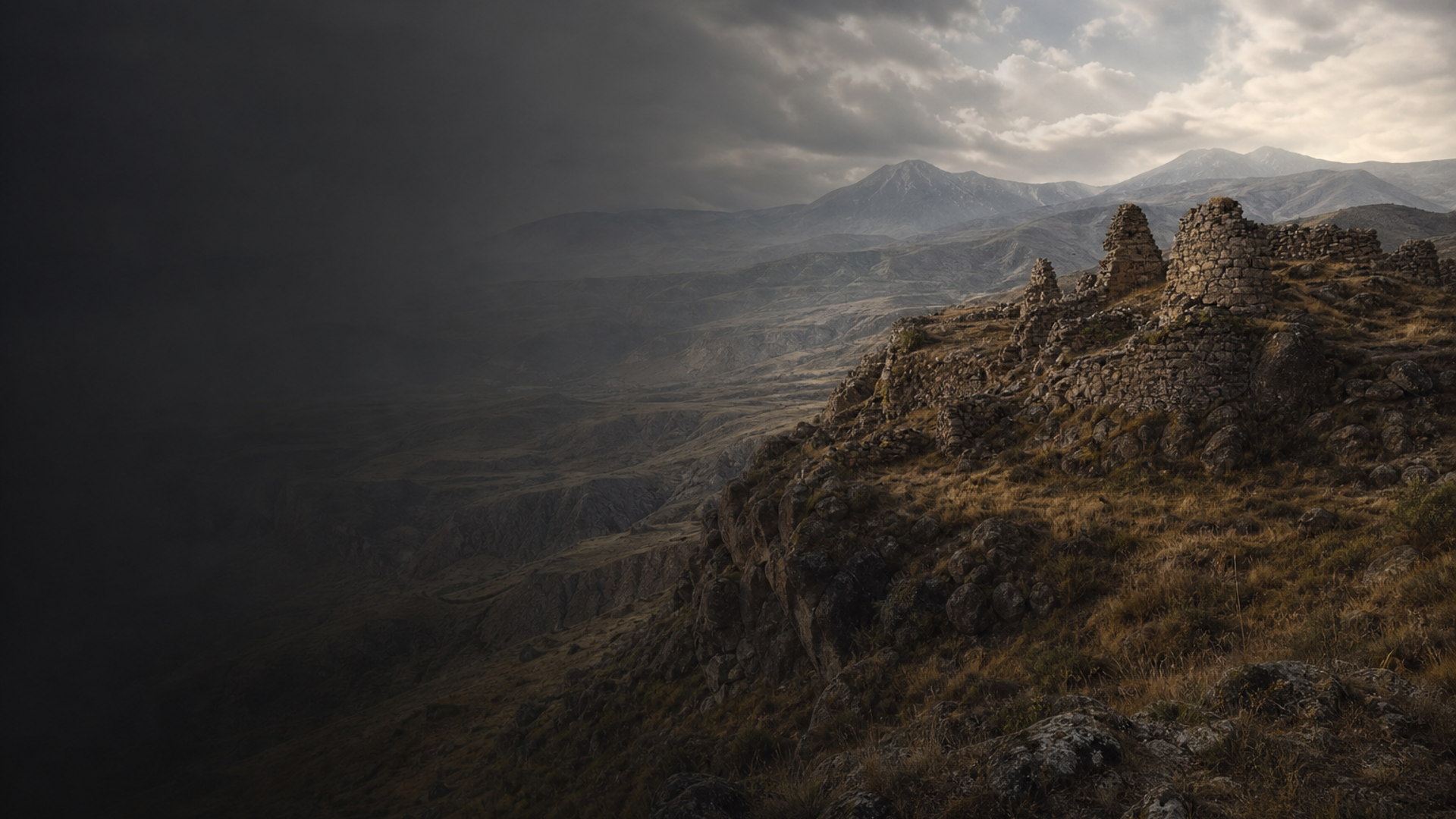
The human landscape of the Armenian highlands between 1500 BCE and 330 CE unfolds like a palimpsest: older Bronze Age traditions persisted even as new networks of exchange and political organization reshaped daily life. Archaeological complexes such as Bardzryal and Bagheri Tchala, along with cemetery sites at Lchashen, Noratus and Lori Berd, preserve stratified layers of settlement, metallurgy and burial practice. Excavated fortifications — the Black Fortress among them — and richly furnished graves indicate communities engaged in long-distance trade, craft specialization, and defensive architecture.

Ancient DNA from 54 individuals provides a regional lens on these processes. Genome-wide patterns in the wider Caucasus suggest a blend of local highland ancestries with episodic inflows from nearby Anatolia, the Iranian plateau, and the Eurasian steppe; Armenia_LBA_EIA samples appear to sit within this regional continuum. Where the archaeological record gives form — ceramics, tomb types, metalwork — genetic data begins to map movement of people and lineage continuity. Limited evidence suggests neither abrupt population replacement nor simple isolation; instead, the picture is one of long-term continuity punctuated by episodes of contact and admixture. Caution is warranted: some site-specific datasets remain small, and many cultural changes can reflect ideas and trade rather than wholesale demographic shifts.

  • Sites include Bardzryal, Bagheri Tchala, Lchashen, Noratus, Lori Berd
  • 1500 BCE–330 CE marks Late Bronze to Early Iron Age transitions
  • Genomes indicate regional continuity with episodic external influences
Capítulo IV

Daily Life & Society

Stone ramparts and sunlit courtyards, river terraces and mountain pastures: archaeological contexts paint a vivid portrait of subsistence and social patterning. Excavations at Nerkin Getashen and Lchashen uncover households engaged in mixed farming — cereals, pulses, and herding of sheep and cattle — while metallurgical debris and finished bronze objects attest to skilled metalworking and craft specialization. Cemeteries such as Noratus and Bover reveal a range of burial customs: inhumations with grave goods, variations in jewelry and weaponry, and occasional monumental tombs that speak to social differentiation.

Material culture shows connections beyond the highlands. Exotic goods and stylistic motifs imply trade routes linking Armenia to Anatolia, Mesopotamia and the Iranian plateau. Fortified settlements like the Black Fortress suggest concerns with defense and control of territory, perhaps reflecting competition over resources or trade corridors. Daily life was shaped by seasonal mobility — transhumant pastoralism remained important — while urbanizing tendencies and emerging political entities (for example, the rise of Urartian polities in the early Iron Age) reorganized labor and craft. Archaeological data indicates a society capable of both local resilience and wide exchange, where household economies and interregional networks coexisted.

  • Mixed farming and pastoralism complemented specialized crafts
  • Burial diversity at Noratus, Bover, Lchashen indicates social variation
Capítulo V

Genetic Profile

The Armenia_LBA_EIA dataset of 54 individuals provides a moderate-sized window into maternal lineages and genome-wide ancestry of Late Bronze to Early Iron Age populations in the Armenian highlands. MtDNA haplogroups in the assemblage show a concentration in common West Eurasian lineages: H (7), K (6), U (5), T (4), and J (4). These matrilineal markers are widespread across Europe, Anatolia and the Near East and suggest continuity with broader regional maternal pools rather than isolation.

Y-chromosome signals for this culture are less uniform in published summaries and do not point to a single dominant paternal lineage; phrasing them as “undetermined/varied” reflects the current state of evidence. Genome-wide contexts for the Caucasus region indicate admixture between local highland ancestry, southern (Anatolian/Iranian-related) components, and varying amounts of steppe-derived gene flow at different times. The Armenia_LBA_EIA genomes fit within this mosaic: they neither demand a sweeping population replacement nor imply genetic stasis. With 54 samples the conclusions are reasonably robust at a regional scale, but site-level variation can be substantial; for sites with small sample sizes the genetic interpretations remain preliminary. Future sampling and direct radiocarbon pairing will refine timing and source proportions of admixture events.

  • MtDNA dominated by H, K, U, T, J lineages
  • Genome-wide ancestry reflects local highland roots with Anatolian, Iranian, and steppe influences
Capítulo VI

Legacy & Modern Connections

The archaeology and genetics of Armenia_LBA_EIA form part of a long, continuing human story in the highlands. Cultural practices recorded in cemeteries and fortresses echo in later historical traditions, and genetic continuity—tempered by episodic admixture—links ancient inhabitants to populations that would inhabit the region into historical times. Modern Armenians derive ancestry from a tapestry of these ancient threads, but direct one-to-one lineages are difficult to assert: demographic processes over millennia include migrations, elite turnovers, and local continuity.

This suite of sites anchors conversations about language, state formation, and identity in the early first millennium BCE and later. Archaeological data indicates complex societies capable of production, trade and territorial control; genetic data shows how people moved, mixed, and persisted. Together, they create a cinematic yet scientifically grounded narrative: the highlands as a crossroads where mountains conserve memory, stones record craft, and genomes carry the faint signatures of ancient journeys.

  • Continuity with later populations tempered by admixture events
  • Archaeology and DNA together show the highlands as a crossroads of people and ideas
Com IA

Assistente de IA

Haz preguntas sobre la cultura Echoes of the Armenian Highlands

Assistente de IA por DNAGENICS

Desbloquear esta função
Pregunta sobre la cultura Echoes of the Armenian Highlands. El asistente con IA puede explicar hallazgos genéticos, contexto histórico, pruebas arqueológicas y conexiones modernas, con sus límites de interpretación.
Exemplo de análise com IA

La cultura Echoes of the Armenian Highlands representa un capítulo de la historia humana...

A análise genética permite estudar semelhanças com populações anteriores e possíveis adaptações. As amostras de DNA antigo fornecem informações para investigar padrões migratórios e relações entre populações, com limites que dependem do estudo e do contexto arqueológico.

Esta é uma antevisão da análise com IA. Aceder ao assistente completo para explorar informações sobre:

  • Composição e similaridade genética
  • Padrões migratórios e origens
  • Vida cotidiana e práticas culturais
  • Contexto genético moderno

Explore mais culturas antigas

Descubra a história de civilizações de diferentes partes do mundo antigo




