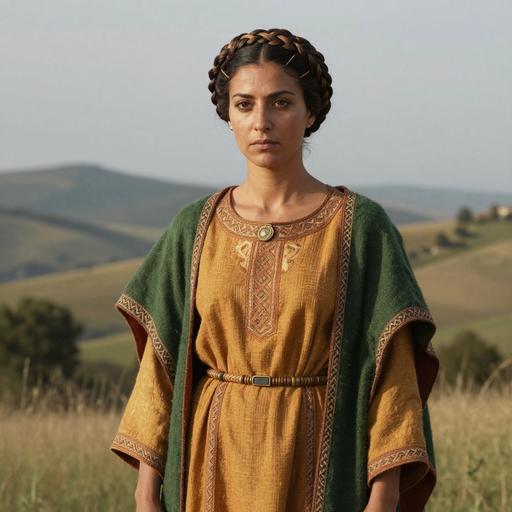
部门背景
mtDNA 谱系分支 H5A1G1 的历史背景
Origins and Evolution
H5A1G is a downstream branch of H5A1, itself part of haplogroup H5, which sits inside the broadly distributed European maternal macro-haplogroup H. Based on phylogenetic position and coalescence estimates for closely related subclades, H5A1G most likely arose in the early to mid-Holocene (around ~6 kya) in the Near East or the central Mediterranean. Its formation would have occurred after the initial arrival of Neolithic farmers into Europe and during a period of substantial population movement and local differentiation, making it a post‑Neolithic and largely regional lineage.
Mutational markers that define H5A1G are downstream of those that define H5 and H5A1; as with many rare mtDNA subclades, its identification in population screens typically depends on full mitochondrial genome sequencing or targeted testing of diagnostic coding-region mutations beyond control-region motifs.
Subclades (if applicable)
H5A1G appears to be an intermediate, relatively shallow clade with limited and geographically localized downstream diversity. Where deeper substructure exists, it tends to be regionally restricted — for example showing minor branches concentrated on Mediterranean islands or within specific local populations (Ischia, Sardinia, Sicily, or other island/peninsular contexts in published datasets). Because of its rarity, many apparent sub-branches are known from only a few full mitogenomes and require more sampling to resolve confidently.
Geographical Distribution
The distribution of H5A1G is geographically focused but spans parts of southern and western Europe and adjacent regions: primarily Southern Europe (Italy, Greece, the Balkans and Mediterranean islands), with moderate occurrences in Western Europe (France, Iberia) and lower to moderate frequencies in parts of Eastern Europe. It is also detected in the Near East and Anatolia, the Caucasus, low-to-moderate frequencies in the Maghreb (North Africa), and in some Jewish maternal lineages (reflecting Levantine connections and later diasporas). Sporadic low-frequency observations occur in parts of Central Asia and other Mediterranean-adjacent populations, typically reflecting long-range historical contacts or recent gene flow rather than primary centers of diversity.
Historical and Cultural Significance
H5A1G's age and distribution are consistent with a lineage that was carried into Europe by Neolithic farmers and then redistributed and locally amplified during later movements and demographic events. Localized founder effects and island/peninsular accumulation patterns indicate that H5A1G occasionally increased in frequency in small or semi-isolated communities. Its occurrence in some Jewish and Levantine-descended maternal lines suggests that parts of its distribution also reflect Near Eastern maternal continuity and diasporic movement.
While direct association with a single archaeological complex is difficult for a low-frequency mtDNA subclade, H5A1G is plausibly tied to Neolithic agricultural expansions as a primary vector, with later contributions from Mediterranean Bronze Age trade and Iron Age/ Classical era population movements (e.g., Phoenician, Greek, Roman periods) that shaped maternal lineages in coastal and island regions.
Conclusion
H5A1G is best understood as a relatively young, regionally concentrated mtDNA lineage within H5 that illuminates Neolithic and post‑Neolithic maternal connections between the Near East and Mediterranean Europe. Its rarity and patchy distribution make it a useful marker for studying local founder events, island and peninsular genetic drift, and certain Levantine-derived maternal histories (including some Jewish maternal lineages). Continued full mitogenome sampling in undersampled Mediterranean and Near Eastern populations will refine its phylogeny and clarify fine-scale historical dispersal patterns.
关键点
- Origins and Evolution
- Subclades (if applicable)
- Geographical Distribution
- Historical and Cultural Significance
- Conclusion