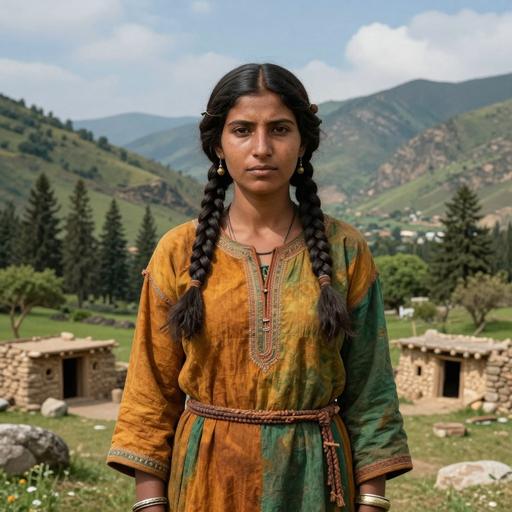
部门背景
mtDNA 谱系分支 M35 的历史背景
Origins and Evolution
mtDNA haplogroup M35 is a downstream lineage of the South Asian clade M3, itself part of the macro-haplogroup M. Given its phylogenetic position, M35 most likely originated in the South Asian subcontinent sometime after the emergence of M3 (which is estimated around ~25 kya), with a plausible time depth in the Late Pleistocene to early Holocene (~16 kya). M35 is defined in mtDNA trees by a combination of control-region and coding-region mutations that distinguish it from other M3 subclades; targeted whole-mitogenome sequencing has clarified its boundaries and internal diversity in recent population studies.
The lineage probably arose among hunter-gatherer or early sedentary groups in South Asia and persisted through shifts in subsistence and demography (Mesolithic-to-Neolithic transitions). Its present-day diversity and geographic spread reflect both deep local continuity and later dispersal events (localized expansions, gene flow across neighboring regions, and demographic processes during the Holocene).
Subclades (if applicable)
M35 contains several internal branches observed at low to moderate frequency in population surveys; some of these subclades show localized clustering in particular tribal or caste groups. Because many published studies rely on partial control-region data, deeper resolution of M35 substructure has improved only recently with complete mitogenome studies. Ongoing sequencing of more modern and ancient samples continues to refine named subclades and internal coalescence ages.
Geographical Distribution
M35 is largely concentrated in South Asia, with the highest frequencies and diversity in the Indian subcontinent. It is detected among both tribal (indigenous) populations and diverse caste groups across India, and it occurs at moderate to low frequencies in Sri Lanka, Pakistan, Bangladesh and Nepal. Outside South Asia, M35 appears sporadically in Central and Southeast Asia — typically at low frequency and usually interpreted as the result of historical or prehistoric gene flow out of the subcontinent. Small numbers of individuals carrying M35 are also present in modern diasporas in Europe and the Americas, reflecting recent migrations.
Ancient DNA records for M35 are limited but consistent with a South Asian origin: where ancient mitogenomes from the region have been recovered, M-derived lineages (and M3 and its subclades) appear in Late Pleistocene and Holocene contexts, indicating long-term regional persistence.
Historical and Cultural Significance
Because M35 predates major Holocene cultural complexes, its importance is primarily as a marker of deep maternal continuity in South Asia rather than a signature of a single archaeological culture. It likely contributed maternally to populations involved in Mesolithic and early Holocene foraging and later to communities that adopted agriculture and formed Chalcolithic and Bronze Age societies in the region. In later periods, M35 lineages would have been carried into complex societies such as those of the Indus Valley (Harappan) and subsequent Bronze-Iron Age communities through local demographic processes.
From a population-genetics standpoint, M35 (together with other M3 subclades) helps researchers reconstruct population structure, migration, and continuity in South Asia, and it serves as a useful contrast to West Eurasian mtDNA lineages (e.g., haplogroup R-derived clades) that arrived or expanded in different timeframes.
Conclusion
mtDNA haplogroup M35 is a regionally important maternal lineage rooted in the South Asian M3 clade, with an origin likely in the Late Pleistocene to early Holocene and a present-day distribution concentrated in the Indian subcontinent. Continued mitogenome sequencing and the recovery of additional ancient DNA from South Asia will refine the internal topology and chronological framework of M35 and improve understanding of its role in the deep maternal genetic landscape of South Asia.
关键点
- Origins and Evolution
- Subclades (if applicable)
- Geographical Distribution
- Historical and Cultural Significance
- Conclusion