Menu
Store
Blog
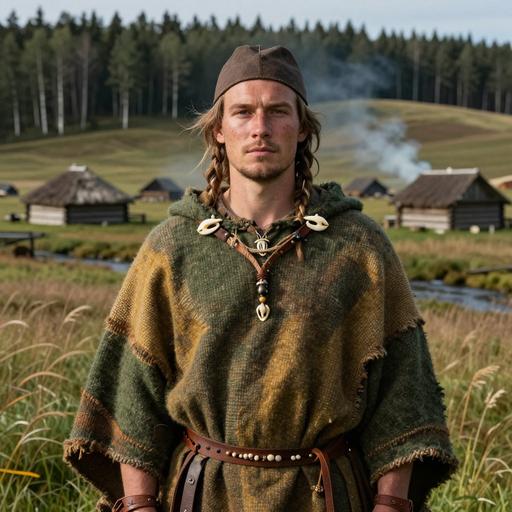
Portrait reconstruction of FRA301
Ancient Individual

A man buried in Sweden in the Bronze Age era

FRA301
2131 BCE - 1942 BCE
Male
Swedish Frälsegården Steppe-Influenced Culture
Sweden
Scroll to begin
Chapter I

Identity

The biological and cultural markers that define this ancient individual

Sample ID

FRA301

Date Range

2131 BCE - 1942 BCE

Biological Sex

Male

mtDNA Haplogroup

T2b5

Y-DNA Haplogroup

Not available

Cultural Period

Swedish Frälsegården Steppe-Influenced Culture

Chapter II

Place

Where this individual was discovered

Country Sweden
Locality Frälsegården
Coordinates 58.1644, 13.4547
Chapter III

Time

When this individual lived in the broader context of human history

FRA301 2131 BCE - 1942 BCE
Chapter IV

Story

The narrative of this ancient life

The concept of a \Swedish Frälsegården Steppe-Influenced Culture of Nordic" appears to blend various historical, cultural, and geographical elements. To create a comprehensive and detailed description, I'll provide a speculative and creative account based on the premise suggested by the name.

Overview:

The Swedish Frälsegården Steppe-Influenced Culture of Nordic is a unique cultural fusion that emerges in a period of dynamic exchange between the Nordic regions and the vast Eurasian steppes. This culture encompasses aspects of the feudal Swedish society, characterized by landholding nobility (frälse), influenced by the nomadic pastoral traditions of the steppe peoples. It represents a nexus of Scandinavian resilience and adaptive insights from the nomadic tribes, thriving between the late medieval period and the early modern era.

Historical Context:

Frälsegården refers to the noble estates in Sweden, which during the late medieval period (approximately 13th to 16th centuries) became the center of economic and social power. During this time, Nordic regions experienced significant transformation due to increased trade, exploration, and intermittent conflicts. The nomadic cultures from the Eurasian steppes, such as the Mongols and various Turkic tribes, left indelible influences on the societies they interacted with through trade routes like the Silk Road and during periods of territorial expansion and conquest.

Cultural Synthesis:

  1. Social Structure:

    • The Swedish frälse (nobility) were landowning classes with specialized rights and responsibilities, akin to feudal lords. The steppe influence introduced a more flexible, meritocratic aspect to their social organization, allowing individuals from humble origins to rise through martial prowess or merit—similar to the practices observed among steppe nomads.
  2. Military Practices:

    • The steppe influence brought enhancements to military strategies, emphasizing mobility, cavalry proficiencies, and the use of composite bows. The Nordic regions adapted these techniques, resulting in a hybrid military doctrine that enhanced the defensive and raiding capabilities of Swedish forces.
  3. Economic Adaptations:

    • The integration of steppe innovations in agriculture and animal husbandry improved efficiencies on the frälsegården estates. Practices such as rotational grazing and the breeding of hardier livestock, influenced by nomadic techniques, increased agricultural productivity and sustainability.
  4. Art and Architecture:

    • The artistic styles of this culture were marked by a synthesis of Nordic motifs with steppe symbolism. This included the incorporation of intricate geometric patterns and animal motifs in silverwork, textiles, and wood carvings. Architecturally, structures began to reflect a blend of sturdy Nordic construction with steppe-influenced tent-like features and openness.
  5. Religion and Beliefs:

    • While predominantly Christian, the society showed evidence of syncretism, with spiritual practices drawing from steppe shamanistic traditions. This resulted in a nuanced worldview that appreciated the cyclical, nature-focused beliefs of the steppe peoples while adhering to Christian doctrines.
  6. Culinary Traditions:

    • The diet incorporated steppe influences, embracing fermentation techniques, dairy-centric dishes, and preservation methods that allowed for greater food security through severe Nordic winters. Dishes like cured meats, sourdough breads, and fermented dairy products became staples, alongside traditional Nordic seafood.

Impact and Legacy:

The Swedish Frälsegården Steppe-Influenced Culture represents a period of cultural cross-pollination, wherein contact with the Eurasian steppes revitalized and enriched Nordic society. This culture contributed to the resilience and adaptability of Swedish communities, setting the stage for Sweden’s later prominence in regional and global affairs. It exemplifies a historical narrative of convergence, where distant cultures, through trade, warfare, and alliances, exchanged ideas and practices that would leave lasting impressions on their societies.

While mostly speculative, this blend paints a picture of Sweden as a dynamic participant in wider Eurasian exchanges, crafting a legacy that is both uniquely Scandinavian and globally connected."

Chapter V

Context

Other ancient individuals connected to this sample

Sources

References

Scientific publications and genetic data

Scientific Publication

Repeated plague infections across six generations of Neolithic Farmers

Authors Seersholm FV, Sjögren KG, Koelman J
Abstract

In the period between 5,300 and 4,900 calibrated years before present (cal. BP), populations across large parts of Europe underwent a period of demographic decline1,2. However, the cause of this so-called Neolithic decline is still debated. Some argue for an agricultural crisis resulting in the decline3, others for the spread of an early form of plague4. Here we use population-scale ancient genomics to infer ancestry, social structure and pathogen infection in 108 Scandinavian Neolithic individuals from eight megalithic graves and a stone cist. We find that the Neolithic plague was widespread, detected in at least 17% of the sampled population and across large geographical distances. We demonstrate that the disease spread within the Neolithic community in three distinct infection events within a period of around 120 years. Variant graph-based pan-genomics shows that the Neolithic plague genomes retained ancestral genomic variation present in Yersinia pseudotuberculosis, including virulence factors associated with disease outcomes. In addition, we reconstruct four multigeneration pedigrees, the largest of which consists of 38 individuals spanning six generations, showing a patrilineal social organization. Lastly, we document direct genomic evidence for Neolithic female exogamy in a woman buried in a different megalithic tomb than her brothers. Taken together, our findings provide a detailed reconstruction of plague spread within a large patrilineal kinship group and identify multiple plague infections in a population dated to the beginning of the Neolithic decline.

Use code for 40% off Expires Feb 27