Menu
Store
Blog
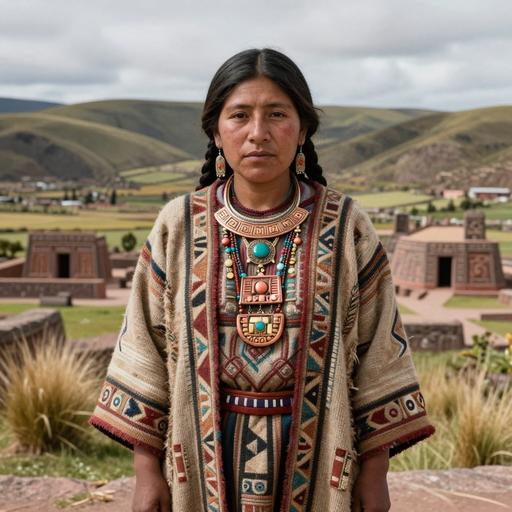
Portrait reconstruction of TW033
Ancient Individual

A woman buried in Bolivia in the Pre-Columbian South America era

TW033
1393 CE - 1439 CE
Female
Tiwanaku Culture at Totocachi, Bolivia
Bolivia
Scroll to begin
Chapter I

Identity

The biological and cultural markers that define this ancient individual

Sample ID

TW033

Date Range

1393 CE - 1439 CE

Biological Sex

Female

mtDNA Haplogroup

B2

Cultural Period

Tiwanaku Culture at Totocachi, Bolivia

Chapter II

Place

Where this individual was discovered

Country Bolivia
Locality Totocachi
Chapter III

Time

When this individual lived in the broader context of human history

TW033 1393 CE - 1439 CE
Chapter IV

Story

The narrative of this ancient life

The Tiwanaku culture, also known as Tiahuanaco, was a pre-Columbian civilization that flourished in the Andean region of South America. It reached its peak between approximately 500 and 1000 AD, making it one of the most influential and enduring cultures of the Andean civilizations. The heart of the Tiwanaku culture was centered around the site of Tiwanaku near the southeastern shore of Lake Titicaca, in present-day Bolivia, not far from Totocachi. This civilization is renowned for its monumental architecture, sophisticated agricultural practices, and extensive influence across the Andean region.

Location and Geographical Context:

Totocachi, along with the broader region surrounding Tiwanaku, is situated in the high Andean plateau at an elevation of about 3,800 meters (12,500 feet) above sea level. The harsh, high-altitude environment posed significant challenges, but it also fostered unique adaptations in agriculture, society, and architecture that defined the Tiwanaku culture.

Social and Political Organization:

The Tiwanaku civilization is thought to have been one of the first expansive states in the Andean region. It featured a complex social and political organization that allowed it to exert control over a vast territory, influencing areas that are now part of Bolivia, Chile, Peru, and Argentina. This was achieved through a network of trade, shared religious practices, and perhaps even warfare and colonization. The city's elites, likely a priestly or aristocratic class, controlled both spiritual and economic life, organizing labor for massive construction projects and agricultural production.

Economic Practices:

Tiwanaku's economy was diverse, heavily reliant on high-altitude agriculture, which was augmented by a complex system of raised field farming known as \suka kollus." This innovative technique involved creating elevated planting beds surrounded by water channels, which improved drainage, protected against frost, and maintained soil fertility. The Tiwanaku people cultivated a variety of crops suited to the high-altitude environment, including potatoes, quinoa, and oca. Animal husbandry was also central to the economy, primarily involving the domestication of llamas and alpacas for transport, wool, and meat.

Art and Architecture:

The architectural achievements of the Tiwanaku culture are most prominently on display in the site of Tiwanaku itself, though Totocachi as a part of the region also shares in this monumental legacy. Tiwanaku is famed for its stone architecture, with structures like the Akapana Pyramid, the semi-subterranean temple, and the Gateway of the Sun. These constructions demonstrate a high degree of engineering skill, with precisely cut stones fitted together without mortar. Art in the Tiwanaku culture is characterized by intricate ceramics, textiles, and metalwork. Iconography often features complex geometric patterns and stylized figures, reflecting religious and cosmological themes.

Religion and Cosmology:

Tiwanaku's religious life was deeply intertwined with its artistic and architectural expressions. The civilization's spiritual beliefs centered around a pantheon of deities, with a particular emphasis on Viracocha, the creator god. Religious practices and cosmology were likely venerations of natural elements like the sun, moon, and stars, aligned with agricultural cycles. Tiwanaku served as an important ceremonial center, drawing people from far-flung regions for pilgrimages and religious observances.

Influence and Decline:

The influence of Tiwanaku extended across the Andean region, manifesting through trade networks and cultural exchange. However, by around 1000 AD, the civilization began to decline, possibly due to climatic changes affecting agriculture, internal strife, or pressures from external groups. Despite the fall of its powerful state structure, elements of the Tiwanaku culture persisted, influencing later Andean civilizations, including the Inca, who recognized Tiwanaku as a significant spiritual and cultural predecessor.

In summary, the Tiwanaku culture around Totocachi in the broader Tiwanaku region represents a peak in pre-Columbian Andean civilizations, distinguished by its architectural ingenuity, advanced agricultural techniques, and profound cultural achievements. Its legacy is evident in the archaeological remains that continue to attract scholars and visitors, offering insights into the sophisticated society that once thrived at the top of the world."

Chapter V

Genetics

The genetic ancestry of this ancient individual

Ancient Genetic Admixture

This analysis compares the DNA profile of TW033 with ancient reference populations, showing the genetic composition in terms of prehistoric ancestral groups.

Ancient Native Americans 77.3%
Ancient Asians 16.3%
Neolithic Farmers 4.5%
Western Steppe Pastoralists 2.0%

Modern Genetic Admixture

This analysis compares the DNA profile with present-day reference populations, showing what percentage of genetic makeup resembles modern populations from different regions.

America 91.4%
America 91.4%
Native American 91.4%
Asia 8.3%
Northern Asian 8.3%
Siberian 8.0%

Closest Modern Populations

These are the modern populations showing the closest statistical alignment to A woman buried in Bolivia in the Pre-Columbian South America era, ranked by genetic distance. Lower distance values indicate closer statistical similarity.

1
Piapoco
1.7584
2
Wichi
1.8868
3
Aymara
2.2994
4
Yukpa
2.4035
5
Karitiana
2.5502
6
Bolivian Lapaz
3.5411
7
Surui
3.5939
8
Colla
3.9555
9
Cachi
4.6612
10
Mixe
5.1668
Chapter VI

Context

Other ancient individuals connected to this sample

Sources

References

Scientific publications and genetic data

Scientific Publication

Ancient genomes reveal long-range influence of the pre-Columbian culture and site of Tiwanaku

Authors Popović D, Molak M, Ziółkowski M
Abstract

Tiwanaku civilization flourished in the Lake Titicaca basin between 500 and 1000 CE and at its apogee influenced wide areas across the southern Andes. Despite a considerable amount of archaeological data, little is known about the Tiwanaku population. We analyzed 17 low-coverage genomes from individuals dated between 300 and 1500 CE and demonstrated genetic continuity in the Lake Titicaca basin throughout this period, which indicates that the substantial cultural and political changes in the region were not accompanied by large-scale population movements. Conversely, the ritual center of Tiwanaku revealed high diversity, including individuals with primarily local genetic ancestry and those with foreign admixture or provenance from as far as the Amazon. Nonetheless, most human offerings associated with the Akapana platform exhibited pure Titicaca basin ancestry and dated to ca. 950 CE—the onset of Tiwanaku’s decline as a sociopolitical center. Our results strengthen the view of Tiwanaku as a complex and far-reaching polity.

G25 Coordinates

The G25 coordinates for sample TW033 can be used for detailed admixture analysis in our G25 Studio tool.

TW033,0.05651176,-0.31418126,0.1132493,0.10264536,-0.11627954,-0.01059168,-0.31099464,-0.36549462,-0.015078,-0.01706186,0.00078102,-0.00108336,-0.00134482,0.02570956,-0.00577814,-0.00062832,0.0063968,0.00267222,0.00027288,-0.00193986,-0.00126036,0.0081394,-0.00252062,-0.00569,-0.00641113
Analyze in G25 Studio
Use code for 40% off Expires Feb 27