Menu
Store
Blog
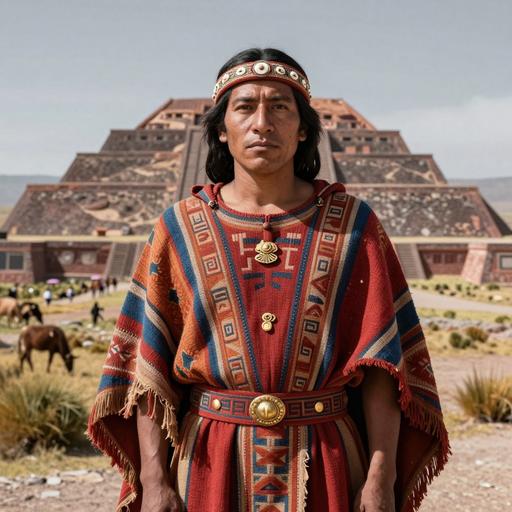
Portrait reconstruction of TW008
Ancient Individual

A man buried in Bolivia in the Pre-Columbian South America era

TW008
778 CE - 989 CE
Male
Tiwanaku Culture at Akapana, Bolivia
Bolivia
Scroll to begin
Chapter I

Identity

The biological and cultural markers that define this ancient individual

Sample ID

TW008

Date Range

778 CE - 989 CE

Biological Sex

Male

mtDNA Haplogroup

B2

Y-DNA Haplogroup

Q1b1a1a1w

Cultural Period

Tiwanaku Culture at Akapana, Bolivia

Chapter II

Place

Where this individual was discovered

Country Bolivia
Locality Akapana
Chapter III

Time

When this individual lived in the broader context of human history

TW008 778 CE - 989 CE
Chapter IV

Story

The narrative of this ancient life

The Tiwanaku culture, also known as Tiahuanaco, was a pre-Columbian civilization that flourished in the Andean region of South America. Situated near the southeastern shore of Lake Titicaca in present-day Bolivia, the Tiwanaku civilization thrived from around 300 to 1000 AD. The Akapana pyramid is one of the most significant structures within the Tiwanaku archaeological site, serving as a key testament to the architectural and cultural achievements of this ancient society.

Overview of the Tiwanaku Culture

Geographical Setting: The Tiwanaku civilization was centered around its capital city of the same name, located in the Andean highlands. The region's challenging environment, featuring high altitudes and dramatic temperature fluctuations, played a role in shaping the resilient and resourceful nature of its people.

Society and Economy: The Tiwanaku society is believed to have been hierarchically organized, with a ruling elite overseeing agricultural production, trade, and religious activities. Tiwanaku was a hub of trade networks that extended across large areas of present-day Bolivia, Peru, and Chile. The economy was primarily based on agriculture, with the cultivation of crops such as potatoes, quinoa, and maize, supported by sophisticated agricultural techniques like raised field irrigation systems (known as \sukakollos") that improved crop yields in the harsh climate.

Architecture and Engineering: Tiwanaku's architectural prowess is exemplified by its monumental structures made with precisely cut stones without the use of mortar. The Akapana pyramid is among the most prominent of these, demonstrating advanced engineering skills. It is a terraced, earthen mound faced with a cut-stone surface, shaped roughly like a stepped pyramid with seven levels. Its function is believed to be both religious and administrative.

The Akapana Pyramid

Design and Structure: The Akapana pyramid stands as a large, terraced platform with a sunken court on its summit, reflecting the Tiwanaku's sophisticated understanding of construction and drainage systems. Originally, it was adorned with polished stone facades and drainage channels to direct rainwater. The structure's alignment and dimensions suggest a deep connection to Tiwanaku cosmology and religious practices.

Symbolism and Function: Akapana is thought to have served as a sacred space where religious ceremonies were conducted, possibly involving astronomical observations. The Tiwanaku people held a complex belief system that likely included ancestor worship and reverence for natural deities, with Akapana playing a vital role in the expression and reinforcement of their spiritual worldviews.

Cultural and Religious Significance: The Tiwanaku culture emphasized spiritual connection with the cosmos, as evidenced by Akapana's design, which embodies significant celestial alignments. This helped them in merging natural and constructed environments into their religious practices, reinforcing the importance of ritual and myth in daily life.

Legacy and Influence

The Tiwanaku civilization made substantial contributions to Andean culture, influencing successor cultures such as the Inca with their architectural, agricultural, and astronomical knowledge. The remnants of Tiwanaku's monumental architecture, especially places like Akapana, continue to captivate archaeologists and historians, offering insights into their complex society and illustrating the ingenuity and adaptability of pre-Columbian civilizations in handling environmental challenges.

Modern Relevance

Today, Tiwanaku is recognized as a UNESCO World Heritage Site, attracting scholars and tourists alike who seek to understand its historical significance and marvel at its architectural achievements. The ongoing archaeological research at Akapana and surrounding areas continues to provide valuable information about the political, cultural, and economic life of this remarkable Andean civilization. Despite the passage of centuries, the legacy of the Tiwanaku people remains an integral part of Bolivia's cultural heritage, celebrated for their profound contributions to the history and development of the Andean region."

Chapter V

Genetics

The genetic ancestry of this ancient individual

Ancient Genetic Admixture

This analysis compares the DNA profile of TW008 with ancient reference populations, showing the genetic composition in terms of prehistoric ancestral groups.

Ancient Native Americans 82.5%
Ancient Asians 12.7%
Western Steppe Pastoralists 4.8%

Modern Genetic Admixture

This analysis compares the DNA profile with present-day reference populations, showing what percentage of genetic makeup resembles modern populations from different regions.

America 94.1%
America 94.1%
Native American 94.1%
Asia 3.8%
Northern Asian 3.8%
Mongolian 2.0%
Siberian 1.7%
Africa 1.1%
West African 1.1%
Nigerian 1.1%
Europe 0.8%
Northwestern European 0.8%
Finnish 0.8%

Closest Modern Populations

These are the modern populations showing the closest statistical alignment to A man buried in Bolivia in the Pre-Columbian South America era, ranked by genetic distance. Lower distance values indicate closer statistical similarity.

1
Aymara
2.1946
2
Piapoco
2.2789
3
Yukpa
2.5028
4
Wichi
2.6872
5
Bolivian Lapaz
2.8154
6
Colla
3.3562
7
Cachi
3.6198
8
Mixe
3.6322
9
Karitiana
4.2073
10
Mayan
4.5047
Chapter VI

Context

Other ancient individuals connected to this sample

Sources

References

Scientific publications and genetic data

Scientific Publication

Ancient genomes reveal long-range influence of the pre-Columbian culture and site of Tiwanaku

Authors Popović D, Molak M, Ziółkowski M
Abstract

Tiwanaku civilization flourished in the Lake Titicaca basin between 500 and 1000 CE and at its apogee influenced wide areas across the southern Andes. Despite a considerable amount of archaeological data, little is known about the Tiwanaku population. We analyzed 17 low-coverage genomes from individuals dated between 300 and 1500 CE and demonstrated genetic continuity in the Lake Titicaca basin throughout this period, which indicates that the substantial cultural and political changes in the region were not accompanied by large-scale population movements. Conversely, the ritual center of Tiwanaku revealed high diversity, including individuals with primarily local genetic ancestry and those with foreign admixture or provenance from as far as the Amazon. Nonetheless, most human offerings associated with the Akapana platform exhibited pure Titicaca basin ancestry and dated to ca. 950 CE—the onset of Tiwanaku’s decline as a sociopolitical center. Our results strengthen the view of Tiwanaku as a complex and far-reaching polity.

G25 Coordinates

The G25 coordinates for sample TW008 can be used for detailed admixture analysis in our G25 Studio tool.

TW008,0.05562926,-0.31817426,0.11071786,0.10156228,-0.11490864,-0.01626772,-0.29921538,-0.35165892,-0.01439882,-0.01634838,0.00215666,-0.00056844,-0.00151108,0.02544042,-0.00581442,-0.00037172,0.00615454,0.00340226,0.00117944,-0.00169022,-9.352E-05,0.00703602,-0.00254984,-0.00483944,-0.00521388
Analyze in G25 Studio
Use code for 40% off Expires Feb 27