Menu
Store
Blog
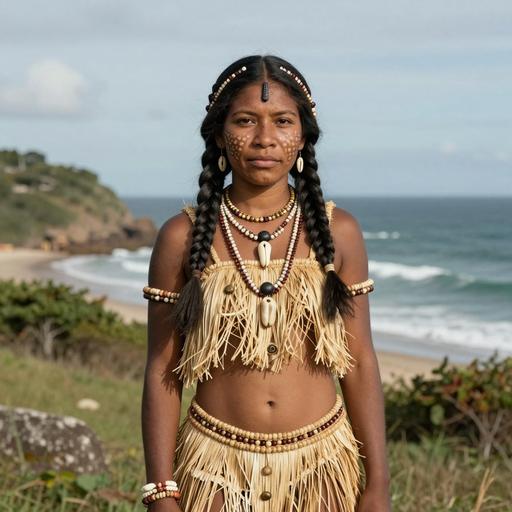
Portrait reconstruction of JBT019
Ancient Individual

A woman buried in Brazil in the Shell Mound era

JBT019
553 CE - 646 CE
Female
Sambaqui Culture of Jabuticabeira II
Brazil
Scroll to begin
Chapter I

Identity

The biological and cultural markers that define this ancient individual

Sample ID

JBT019

Date Range

553 CE - 646 CE

Biological Sex

Female

mtDNA Haplogroup

B2

Cultural Period

Sambaqui Culture of Jabuticabeira II

Chapter II

Place

Where this individual was discovered

Country Brazil
Locality Jabuticabeira II (South Coast)
Chapter III

Time

When this individual lived in the broader context of human history

JBT019 553 CE - 646 CE
Chapter IV

Story

The narrative of this ancient life

The Sambaqui Culture, specifically at the Jabuticabeira II site, is a fascinating aspect of the pre-Columbian era in Brazil. The term \sambaqui" comes from the Tupi word "tamba'ki," which means "shell mound." These mounds are primarily composed of accumulated seashells intermixed with fish bones, ashes, and various artifacts, reflecting the daily and ritualistic activities of the people who lived there. The Sambaqui Culture is known for its mounds along the Brazilian coast, with Jabuticabeira II being among the most studied due to its rich archaeological finds.

Geographical Context:

The Jabuticabeira II site is located in the southern part of Brazil, in the state of Santa Catarina. This region is characterized by a subtropical climate, coastal landscapes, and rich biodiversity. The proximity to the ocean influenced the Sambaqui Culture significantly, providing abundant marine resources.

Temporal Context:

The Jabuticabeira II site dates back to a period between approximately 2,500 to 1,400 years ago, during the late Holocene epoch. This timeframe places it well before European contact, in an era marked by indigenous development and adaptation to the coastal environment.

Cultural Practices:

Subsistence and Economy:

The inhabitants of Jabuticabeira II were primarily hunter-gatherers with an economic system heavily reliant on marine and estuarine resources. Their diet consisted mainly of fish, shellfish, and other seafood, supplemented by terrestrial hunting and gathering of plants. Evidence suggests a sophisticated understanding of their environmental resources and cyclical harvesting strategies.

Social Structure:

The size and complexity of the shell mounds suggest a structured society with distinct social roles. The investment in constructing large communal mounds implies coordinated labor and possibly an organized leadership or group consensus in decision-making processes.

Burial Practices:

One of the most intriguing aspects of Jabuticabeira II is its burial practices. Burials within the sambaquis often included grave goods such as tools, ornaments, and decorative items made from bone, stone, and shell. These items indicate a belief in an afterlife or a ritualistic honoring of the dead. The care with which these burials were made suggests a society that valued its ancestors and had complex spiritual or religious beliefs.

Artifacts and Craftsmanship:

Artifacts recovered from the site include polished stone axes, decorative items, and tools made from animal bones and shells. These artifacts display a high level of craftsmanship and indicate a developed aesthetic sense. Decorative motifs might have held symbolic meanings or denoted social status.

Environmental Interaction:

The part played by the environment in shaping the Sambaqui Culture cannot be overstated. The coastal location provided abundant food resources but also required adaptation to environmental changes such as rising sea levels and shifting sand dunes. The construction of the shell mounds themselves might have served practical purposes, such as creating elevated spaces to avoid periodic flooding.

Decline and Legacy:

The decline of the Sambaqui Culture at Jabuticabeira II is still a subject of study, with hypotheses ranging from environmental changes to resource depletion and social transformations. Despite this decline, the Sambaqui mounds remain an important cultural heritage, providing insights into the lives of pre-Columbian peoples of Brazil.

Modern Significance:

Today, the Sambaqui mounds, including those at Jabuticabeira II, are significant archaeological sites. They offer invaluable insights into the social, economic, and spiritual life of early Brazilian coastal inhabitants. These sites are also important for understanding the broader narrative of human adaptation to diverse environments and the cultural richness before European colonization.

In conclusion, the Sambaqui Culture of Jabuticabeira II is a testament to the ingenuity and resilience of indigenous South American societies. It showcases a complex interplay between humans and their environment, a rich cultural and spiritual life, and an enduring legacy that continues to intrigue archaeologists and anthropologists worldwide."

Chapter V

Context

Other ancient individuals connected to this sample

Sources

References

Scientific publications and genetic data

Scientific Publication

Genomic history of coastal societies from eastern South America

Authors Ferraz T, Suarez Villagran X, Nägele K
Abstract

Sambaqui (shellmound) societies are among the most intriguing archaeological phenomena in pre-colonial South America, extending from approximately 8,000 to 1,000 years before present (yr BP) across 3,000 km on the Atlantic coast. However, little is known about their connection to early Holocene hunter-gatherers, how this may have contributed to different historical pathways and the processes through which late Holocene ceramists came to rule the coast shortly before European contact. To contribute to our understanding of the population history of indigenous societies on the eastern coast of South America, we produced genome-wide data from 34 ancient individuals as early as 10,000 yr BP from four different regions in Brazil. Early Holocene hunter-gatherers were found to lack shared genetic drift among themselves and with later populations from eastern South America, suggesting that they derived from a common radiation and did not contribute substantially to later coastal groups. Our analyses show genetic heterogeneity among contemporaneous Sambaqui groups from the southeastern and southern Brazilian coast, contrary to the similarity expressed in the archaeological record. The complex history of intercultural contact between inland horticulturists and coastal populations becomes genetically evident during the final horizon of Sambaqui societies, from around 2,200 yr BP, corroborating evidence of cultural change.

Use code for 40% off Expires Mar 01