Introduction
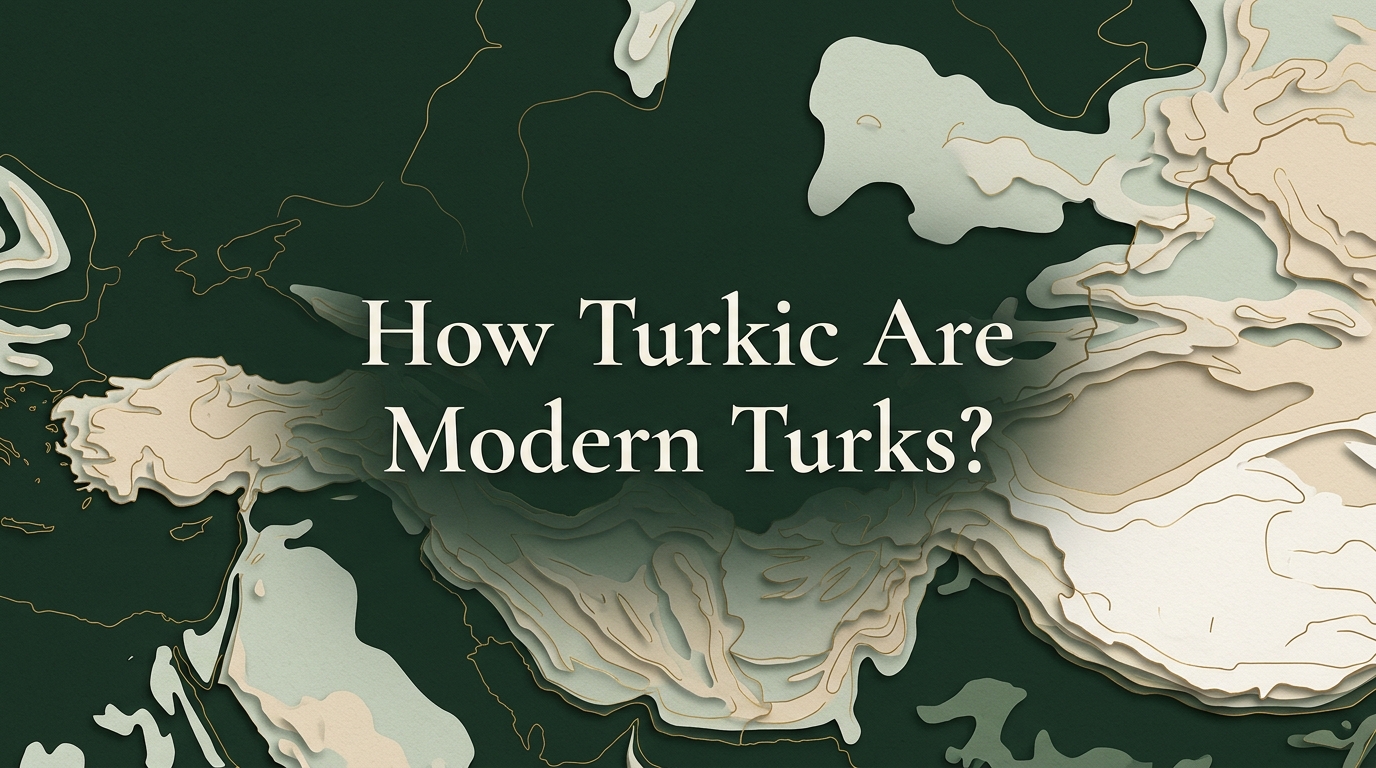
Modern Turkey presents a fascinating ancestry question: its national language belongs to the Turkic language family, yet the genetic profiles of people in Turkey tend to be much closer to neighbouring West Asian and eastern Mediterranean populations than to present-day Kazakhs, Mongols, or many Siberian groups. This is not a contradiction. Languages, political identities, and DNA can spread through related but different historical processes.
The arrival of Turkic-speaking groups in Anatolia transformed the region's language, ruling structures, and cultural history. Genetics helps estimate the biological contribution of these migrations, while also showing the large role played by people already living in Anatolia. Ancient DNA, Y-chromosome data, and genome-wide population genetics all point to the same broad conclusion: Central Asian ancestry in modern Turks is genuine, geographically varied, and a minority component alongside substantial local West Asian ancestry.
This topic can provoke overly simple claims, such as that modern Turks are either wholly Central Asian or have no genetic connection to medieval Turkic migrants. Neither description fits the available evidence. Instead, the data reveal a layered population history involving medieval Turkmen settlement, local Anatolian continuity, later Balkan and Caucasus migration, and centuries of intermarriage.
Key Discoveries / Main Points
Genome-wide DNA places most Turkish regional populations within the broader West Asian and eastern Mediterranean genetic landscape. Central Anatolian Turks show closest statistical similarity to Azerbaijanis, followed by populations such as Kurds, Iranians, Armenians, Cappadocian Greeks, Syrians, and Byzantine-era Anatolians.
East Eurasian ancestry, a useful marker of Central Asian-related input because it was absent in the sampled pre-Turkic Anatolian baseline, averages about 9.4% in central Anatolian Turks. It varies substantially by region, from roughly 2% in parts of eastern Turkey to over 14% in the Aegean in the models examined.
Medieval Anatolian Turks carried more East Eurasian-related ancestry than many modern Turkish populations. Individuals buried in western Anatolia between the late fourteenth and sixteenth centuries were estimated at about 17.7 to 18%, compared with about 9% in Turks today in a comparable framework.
Central Asian Turkic ancestry is larger than East Eurasian ancestry alone, because medieval Turkic populations were themselves genetically mixed. Models using different Central Asian reference groups estimate a minority Turkic-associated contribution, often about 12 to 34% across much of Turkey, with a median near 19% in central Anatolia and lower estimates in the east.
Y-DNA haplogroups provide a narrower, paternal-only view. In a study of 523 Turkish men, 3.4% carried haplogroups C, Q, or O, lineages more common in East and Central Asia. This supports a detectable paternal legacy, but it cannot measure total ancestry by itself.
What This Means for Your DNA
For people exploring Turkish DNA ancestry, a test result usually reflects many generations of shared ancestry with populations around Anatolia, the Caucasus, the Balkans, Iran, Mesopotamia, and the eastern Mediterranean. It should not be read as a direct percentage of a modern ethnic identity. Consumer ancestry categories are statistical comparisons with company reference panels, and their labels can change as those panels and methods improve.
A Central Asian-related signal in an autosomal DNA result may be consistent with ancestry connected to historical Turkic migrations, but it is rarely specific enough to identify one tribe, migration event, or medieval ancestor. The signal can also overlap with ancestry carried by other steppe-associated populations. The strongest interpretation comes from combining autosomal results with documented family origins, DNA matches, and, where possible, regional historical context.
Your family location within Turkey matters. The study models found higher East Eurasian-related ancestry among Yörük pastoralists and in several western and southern regions, while the eastern and Black Sea regions showed lower averages. These are population-level patterns, not rules for individuals. Two people whose families both identify as Turkish can have meaningfully different ancestry profiles because their ancestors came from different provinces and communities.
Y-DNA and mitochondrial DNA can add another layer to ancestry research. A Y-DNA haplogroup follows one direct paternal line only, while mitochondrial DNA follows one direct maternal line only. Both represent very small branches of a family tree. A man with a haplogroup common in West Asia may still have Central Asian-related ancestry elsewhere in his autosomal DNA, just as a man with haplogroup Q or C may have overwhelmingly Anatolian ancestry overall.
Historical and Archaeological Context
Turkic-speaking groups entered Anatolia in a major historical setting rather than an empty landscape. Following the Seljuk victory over Byzantium at Manzikert in 1071, Turkmen groups moved into a region populated by Greek, Armenian, and other communities. The Seljuk Sultanate of Rum, which ruled much of central Anatolia from 1077 to 1308, established Turkish political authority in a predominantly local population.
Migration continued over centuries. Mongol expansion and pressure in the thirteenth century encouraged additional Turkmen groups to move westward, including toward frontier zones in western Anatolia. The later Ottoman state grew from this setting and incorporated diverse communities across Anatolia, southeastern Europe, and the Black Sea region. These developments help explain why Turkish population genetics reflects both an Anatolian foundation and several later ancestry layers.
The regional gradient in the genetic models broadly fits this history. Western and southern Anatolia received important Turkmen settlement during the medieval period, while eastern Anatolia and the Black Sea coast retained substantial local Armenian, Georgian, and Greek-speaking communities that could later become Turkish-speaking. During the nineteenth and early twentieth centuries, large numbers of Muslim migrants from the Balkans and Caucasus also settled in Anatolia. The population exchange of 1923 added another major demographic change.
Ancient DNA makes the timeline especially informative. Samples indicate substantial genetic continuity in Anatolia from the Bronze Age through the Byzantine period, before the arrival of Turkic-speaking settlers, with no identified East Eurasian component in the Byzantine Anatolian reference samples discussed here. Medieval Turkish burials then show a clear East Eurasian-related shift. This sequence supports migration and admixture, rather than a complete replacement of Anatolia's earlier population.
The Science Behind It
Researchers use several complementary approaches to reconstruct population history. Genome-wide analysis compares hundreds of thousands of DNA markers across the genome, allowing scientists to measure genetic similarity and model a target population as a mixture of reference populations. In the Global25-based analysis summarized here, 334 Turks from 46 provinces were grouped into eight regions, with Yörüks and Balkan Turks considered separately. Their profiles were compared with nearby populations, ancient Byzantine Anatolians, medieval Georgians, Balkan references, and Central Asian Turkic-associated groups.
East Eurasian ancestry was estimated using 16 models that included a local Anatolian or Caucasus-related source, a Balkan-related source, and northern Han Chinese or Mongolian sources representing the East Eurasian end of the ancestry spectrum. The resulting regional estimates ranged from 2.1% in the eastern sample to 17.2% among Yörüks. The method also reproduced known simulated mixtures reasonably well: when 10% Karakhanid-related ancestry was added to Byzantine Anatolian ancestry, models recovered about 10% on average, although individual source combinations produced a wider range.
A second set of models estimated the broader Central Asian Turkic-associated layer using medieval Karakhanids, medieval Kipchaks, modern Turkmens, or Turkic-period Mongolian groups as alternatives. This distinction matters because these source populations were not genetically identical. For example, the cited models estimate East Eurasian ancestry at about 56% in Karakhanids, 48% in Kipchaks, and 33% in present-day Turkmens. Therefore, the inferred proportion depends partly on which historically plausible source is selected.
In Simple Terms: DNA models work like comparing a paint mixture with possible paint sources. Anatolian populations supplied most of the base colour, while medieval Turkic migrants added a smaller Central Asian-related component. The precise percentage changes depending on which ancient or modern reference group is used, but the overall pattern remains: modern Turkish ancestry is mostly local West Asian, with a real minority contribution linked to Turkic-era migration.
Y-chromosome research answers a different question. Because the Y chromosome generally passes from father to son, it tracks only paternal descent. The 2004 survey found that most sampled Turkish Y-DNA belonged to haplogroups shared widely across Europe and the Near East, while C, Q, and O made up 3.4%. Haplogroup N, grouped with the majority in that report, is largely northern Eurasian and may also reflect some steppe-related history. These frequencies are informative, but they cannot be converted directly into a person's total Central Asian ancestry.
Why It Matters
The genetics of modern Turks illustrates an important principle in DNA ancestry research: cultural change can be profound even when migrant ancestry is not the majority of a population's genome. Turkic language and identity spread through migration, political power, settlement, conversion, social integration, and the formation of new communities. The result was not a simple replacement of Byzantine Anatolia, nor merely a language change without migration.
Future ancient DNA from more regions of Anatolia, more medieval burials, and better-sampled Central Asian populations can refine these estimates. For now, the evidence supports a balanced interpretation. Turkish ancestry is deeply rooted in Anatolia and neighbouring West Asia, while retaining a measurable Central Asian Turkic legacy that varies by region, historical community, and family history.
References / Further Reading
- Cinnioglu, C. et al. (2004). Y-chromosome variation in Turkey, analysis of 523 men.
- Hodoglugil, U. and Mahley, R. W. (2012). Genome-wide estimates of Central Asian-related ancestry in Turkish populations.
- Yunusbayev, B. et al. (2015). Identical-by-descent evidence for genetic links between western Turkic populations and southern Siberia or Mongolia.
- Lazaridis, I., Reich, D. et al. (2022). Ancient DNA research on Anatolian genetic continuity and medieval Turkish ancestry.