דילוג לתוכן הראשי
תיקי DNA

Slab-Grave Echoes of Mongolia

Early Iron Age communities in Mongolia seen through stone graves and DNA

1441 CE - 400 BCE
Mongolia (Khentii, Uvurkhangai, Khuvsgul, Tuv, Sükhbaatar)

הסיפור

Archaeological and genetic evidence from 14 individuals (1441–400 BCE) illuminates the Slab Grave communities of Mongolia. Stone-lined burials across Khentii, Uvurkhangai, Khuvsgul, Tuv and Sükhbaatar reveal an East Eurasian genetic profile with predominant Y haplogroup Q and maternal lineages D, C and F.

Time Period

1441–400 BCE

Region

Mongolia (Khentii, Uvurkhangai, Khuvsgul, Tuv, Sükhbaatar)

Common Y-DNA

Q (6/14 predominant), N (1/14)

Common mtDNA

D (4), C (3), F (2), G (1), C5c (1)

ציר הזמן

1441 BCE

Earliest dated individuals in this dataset

Radiocarbon dates from analyzed burials begin around 1441 BCE, anchoring Slab Grave presence in the early first millennium BCE in Mongolia.

Origins & Emergence

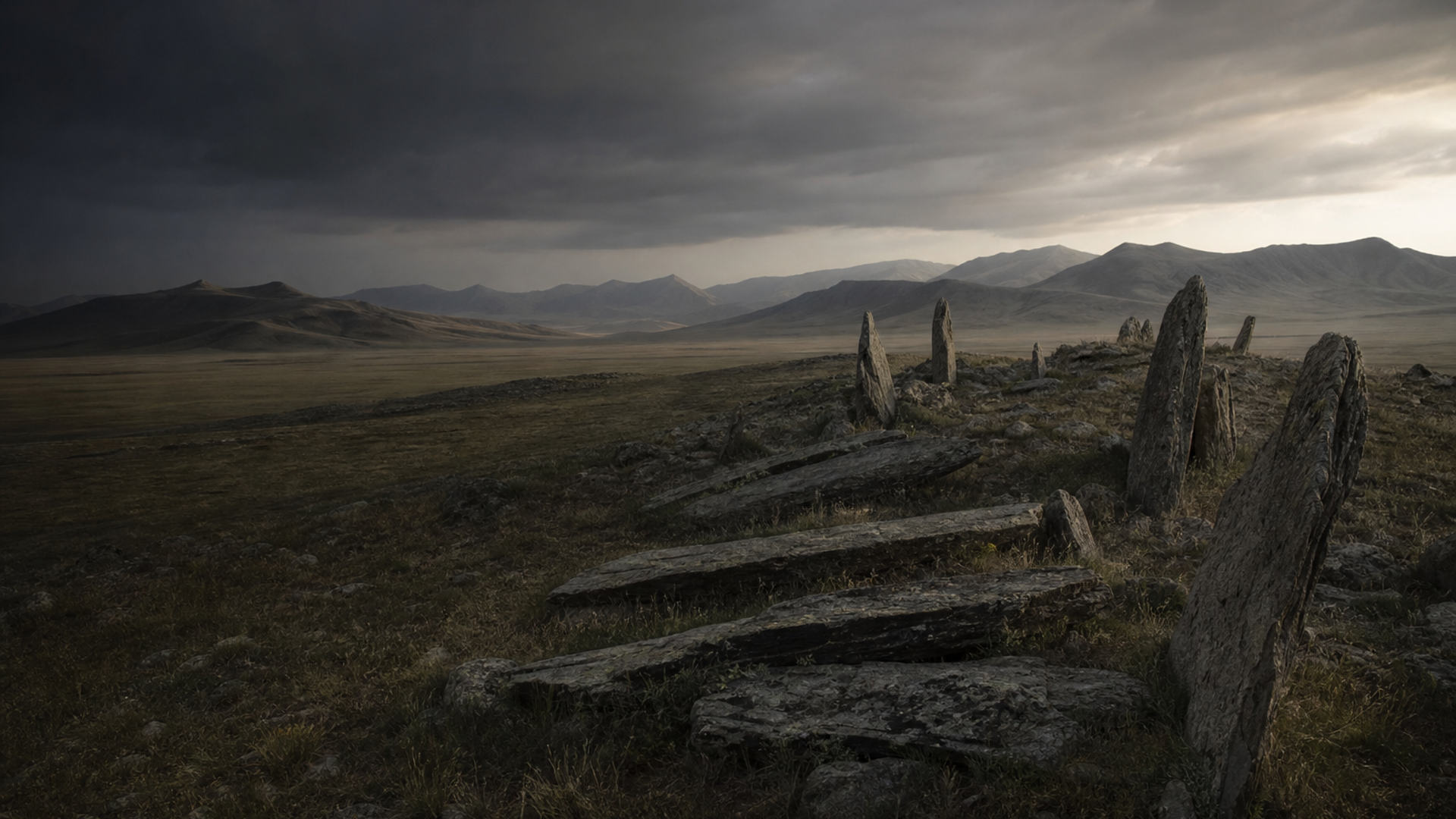
The Slab Grave tradition emerges across the eastern Eurasian steppe as a stark, persistent landscape of stone — low cairns and flat slabs sheltering orderly inhumations. Archaeological data from sites such as Baaran-Khavtsal (Sükhbaatar aimag), Shunkhlai Uul (Uvurkhangai), Tariat Brigad (Tuv aimag) and Erhel nuur (Khuvsgul) show continuity in funerary architecture between the later Bronze Age and the Early Iron Age. Radiocarbon-calibrated samples in this dataset span 1441–400 BCE, placing these burials firmly in the first half of the first millennium BCE, though the Slab Grave phenomenon likely has deeper roots.

Material traces — slab-lined graves, simple personal items, and regional patterns of burial orientation — suggest communities organized around mobile pastoralism with localized ritual traditions. Limited evidence suggests some regional variation in grave goods and monument size, hinting at social differentiation at a local scale. Archaeology indicates the Slab Grave horizon acted as a cultural backbone across northern and central Mongolia, a visual grammar of stones marking memory across plains and lakes. As always, the archaeological record is incomplete: radiocarbon coverage is uneven, and interpretations of cultural transmission remain provisional.

  • Stone-slab and cairn burials across multiple aimags (provinces)
  • Radiocarbon range for analyzed samples: 1441–400 BCE
  • Funerary continuity suggests regional pastoral networks

Daily Life & Society

Archaeological evidence paints a cinematic scene of seasonal movement and resilient adaptation. The Slab Grave dead were often interred without elaborate tomb architecture, implying communities focused on mobility and herd management rather than monumental urbanism. Faunal remains from nearby habitation sites and regional surveys indicate reliance on domestic sheep, goats, and horses — a pastoral economy tuned to Mongolia’s wide steppe and forest-steppe ecotones.

Grave assemblages in this sample set are generally modest; where objects occur they include utilitarian items and personal ornaments rather than large metal hoards. This pattern suggests social life centered on household and herd, with status perhaps expressed through livestock wealth and ephemeral displays rather than durable, portable treasures. Archaeological data indicates seasonal camps and transhumant routes linked the upland lakes of Khuvsgul with the river valleys of Khentii and the plains of Tuv and Sükhbaatar. Climate variability and wetland resources (for example, near Erhel nuur) would have structured mobility, grazing, and seasonality.

Cultural identity appears bound to landscape and memory — the slabs themselves become a communal script, readable across generations — but many specifics of social hierarchy and ritual remain poorly resolved without larger, context-rich excavations.

  • Pastoral economy: sheep, goat and horse herding inferred from regional data
  • Modest grave goods suggest household or herd-based wealth

Genetic Profile

The genetic portrait from 14 individuals assigned to Mongolia_EIA_SlabGrave_1 reveals a predominantly East Eurasian uniparental signature. Y-chromosome haplogroup Q dominates the male sample (6 individuals), with a smaller presence of haplogroup N (1 individual). These paternal lineages are consistent with northern and northeastern Eurasian distributions and have deep histories on the steppe and in adjacent Siberia. Maternal lineages are overwhelmingly East Eurasian: mtDNA haplogroups D (4), C (3), F (2), G (1) and a lineage classified as C5c (1) — lineages broadly associated with populations of northeastern Asia and the Amur and Transbaikal regions.

Taken together, uniparental markers point to a community rooted in East Eurasian gene pools. However, uniparental data alone cannot quantify genome-wide ancestry proportions or detect low-level admixture from western steppe sources. Archaeological contexts paired with genome-wide ancient DNA would be required to test for the presence and timing of any western Eurasian admixture. With a sample size of 14 individuals, conclusions about population-wide structure are informative but preliminary: they indicate strong East Eurasian continuity in these Slab Grave burials, and a genetic affinity to other ancient Siberian and Mongolian groups, but broader sampling is needed to resolve regional variability and demographic change.

  • Predominant paternal haplogroup Q (6/14) and occasional N (1/14)
  • Maternal pool dominated by East Eurasian mtDNA: D, C, F, G

Legacy & Modern Connections

The stones of Slab Grave memorials still mark the Mongolian landscape; genetically, the lineages observed in this dataset resonate with modern populations of Mongolia and neighboring Siberia. The prevalence of East Eurasian maternal and paternal markers suggests these communities contributed to the deep ancestry of later Mongolian steppe groups. Archaeological continuity in burial forms and geographic spread implies cultural resilience and local adaptation across centuries.

Nevertheless, connecting these 14 genomes directly to specific later peoples (for example, the historically recorded Xiongnu or later medieval Mongol polities) requires caution. Temporal and geographic gaps remain, and genome-wide evidence is needed to chart admixture events and demographic shifts. In short, the Slab Grave people left a durable cultural script in stone and a genetic echo in East Eurasian lineages — a legacy visible in both archaeology and DNA, but one that invites further sampling and analysis to reveal its full role in shaping Mongolia’s genetic and cultural history.

  • Genetic affinities suggest contribution to later Mongolian ancestries
  • Further genome-wide sampling needed to map continuity and admixture

עוזר הבינה המלאכותית

עוזר הבינה המלאכותית מאת DNA Genics

פתיחת התכונה הזו
שאלו שאלות על תרבות Slab-Grave Echoes of Mongolia. העוזר יכול להסביר ממצאים גנטיים, הקשר היסטורי, ראיות ארכאולוגיות וקשרים לעת המודרנית.
דוגמה לניתוח בבינה מלאכותית

מבט על תרבות Slab-Grave Echoes of Mongolia

דגימות DNA קדום עוזרות לחוקרים לחקור דפוסי נדידה וקשרים גנטיים בין אוכלוסיות קדומות.

זו תצוגה מקדימה של הניתוח. העוזר המלא מאפשר לעיין בנושאים הבאים:

  • הרכב גנטי ודמיון גנטי
  • דפוסי נדידה ומקורות
  • חיי יומיום ומנהגים תרבותיים
  • קשרים גנטיים בני זמננו