דילוג לתוכן הראשי
תיקי DNA

Xagħra Circle: Voices from Bronze‑Age Gozo

Three ancient genomes from the Xagħra Circle illuminate a ritual island community — but conclusions remain preliminary.

2900 CE - 2350 BCE
Xagħra Circle, Gozo (Malta)

הסיפור

Ancient DNA from three individuals (2900–2350 BCE) at Xagħra Circle, Gozo, Malta, offers a tentative glimpse into the Maltese Temple Culture. Archaeology and genetics hint at diverse connections across the central Mediterranean; low sample counts make these patterns provisional.

Time Period

c. 2900–2350 BCE

Region

Xagħra Circle, Gozo (Malta)

Common Y-DNA

A (1), G (1) — limited sample

Common mtDNA

H2 (1), G (1) — limited sample

ציר הזמן

2500 BCE

Intensive ritual use at Xagħra Circle

Archaeological evidence indicates continued mortuary and ritual activity at the Xagħra Circle during the late temple period, around 2500 BCE.

Origins & Emergence

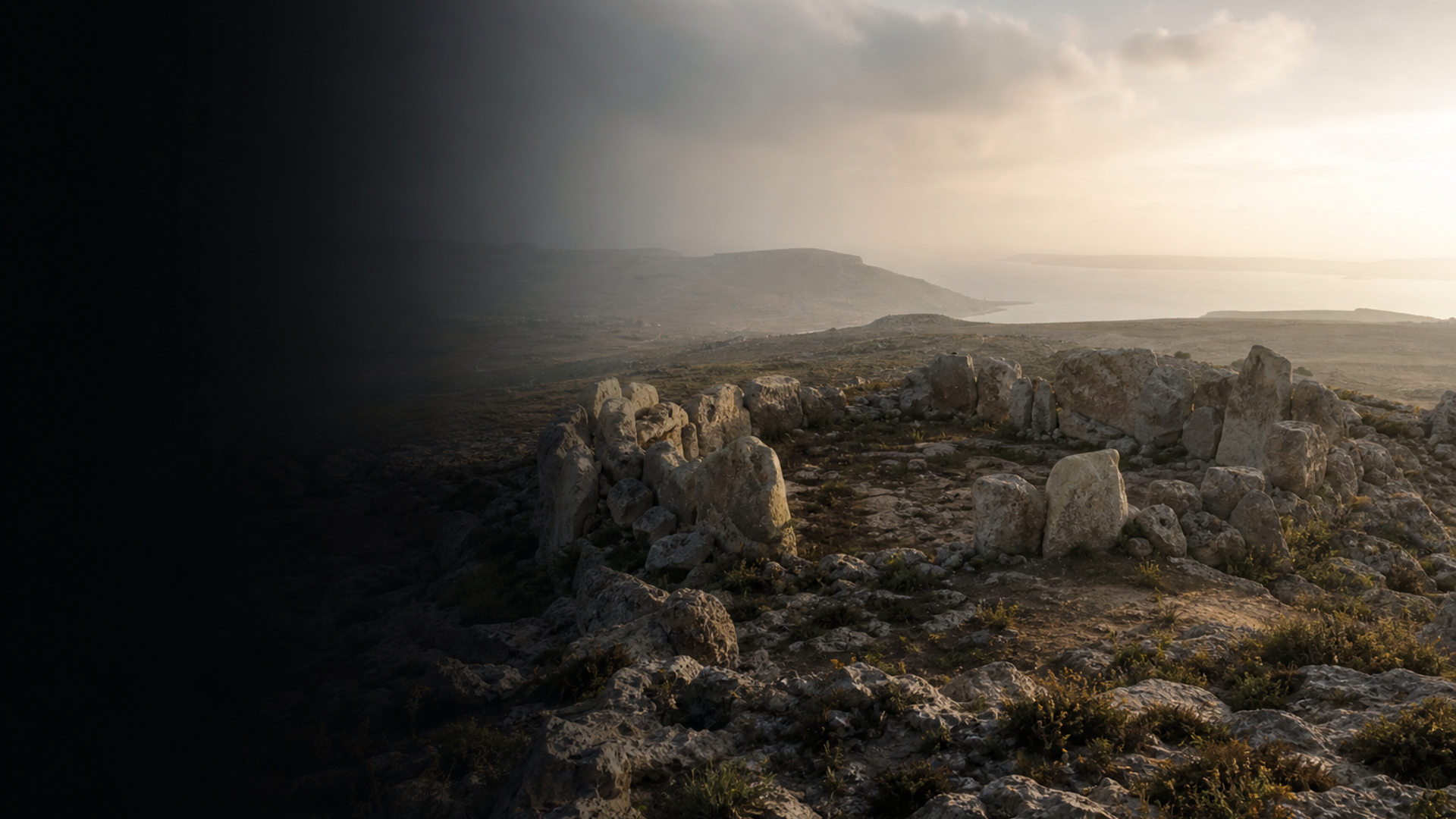
The people who used the Xagħra Circle on Gozo lived during the later Neolithic to early Bronze Age transition (c. 2900–2350 BCE), a moment when Malta’s distinctive temple-building tradition — the Maltese Temple Culture (Xagħra) — was in its final centuries of use. Archaeological data from the Xagħra Circle, a monumental chambered complex on Gozo, indicates repeated ritual activity, complex mortuary practice, and the deposition of human bone, artifacts, and carved stone.

Material culture ties the site to a regional tradition of monumental architecture on Malta and Gozo, but also shows stylistic echoes of wider central Mediterranean exchange. The available radiocarbon dates and stratigraphic sequences place the sampled individuals within the late phases of island temple use and early Bronze Age transformations.

Limited genetic evidence (three individuals) makes population-level reconstructions tentative. Nevertheless, the combination of excavated context, mortuary patterning, and the few genomes recovered allows a cautious narrative: island communities maintained ritual centers while interacting with maritime networks, and genetic traces suggest heterogeneity rather than a single uniform lineage.

  • Xagħra Circle (Gozo) active in late temple era, c. 2900–2350 BCE
  • Monumental mortuary architecture linked to Maltese Temple Culture (Xagħra)
  • Archaeology indicates local ritual continuity alongside Mediterranean contacts

Daily Life & Society

Archaeological evidence from the Xagħra Circle and surrounding sites paints a picture of island life organized around mixed subsistence, craft specialization, and intense ritual. Farmers cultivated cereals and kept livestock adapted to island conditions; maritime resources supplemented diets. Material remains — worked stone, polished tools, and portable art — suggest skilled craftsmanship and symbolic production tied to communal rites.

The monumental architecture of Xagħra implies organized labor and social investments in shared sacred places. Funerary deposits and curated human remains indicate complex beliefs about ancestry and community identity. At the same time, artifacts with non‑local raw materials imply exchange across the central Mediterranean, linking Gozo to Sicily, southern Italy, and perhaps farther afield via seafaring routes.

Because direct household contexts for the three sampled individuals are limited, reconstructions of everyday identity must remain cautious. The archaeological record, however, supports a vision of small, tightly knit island communities that balanced subsistence, craft, and ritual life against the backdrop of shifting networks in the Bronze Age Mediterranean.

  • Mixed farming, herding, and maritime foraging supported island life
  • Monumental ritual spaces imply organized labor and shared beliefs

Genetic Profile

Three ancient genomes recovered from burial contexts at Xagħra Circle provide a slender but intriguing genetic window (sample count = 3). Y‑chromosome calls were assigned to haplogroups A (1) and G (1), while mitochondrial haplogroups included H2 (1) and G (1). The counts do not sum to three in every category because one or more individuals lacked resolvable Y or mtDNA calls or were of the opposite sex for a given marker.

Haplogroup G (Y) has established presence in Neolithic and later European contexts and can reflect ties to early farming populations or later admixture. The appearance of a Y haplogroup labeled A is unexpected for the central Mediterranean in this period; haplogroup A is rare in Europe today and is primarily observed in parts of Africa and Asia. Given the very small sample size, this single occurrence must be treated cautiously: possibilities include authentic but rare lineages, post‑depositional contamination, or analytical uncertainty. Likewise, mtDNA H2 fits within known European maternal diversity, while mtDNA G — more common in parts of Asia today — could indicate longer‑range connections or drift in small island populations.

Archaeogenetic interpretation therefore emphasizes uncertainty: these genomes hint at a heterogeneous genetic landscape in Bronze‑Age Malta, perhaps reflecting maritime connectivity and small‑population dynamics, but broader sampling is required to test these patterns. Any population‑level claims are preliminary when based on fewer than ten samples.

  • Small dataset (n=3): results are provisional and require more samples
  • Y: A (1) — unexpected; G (1) — consistent with Neolithic/Bronze Age Europe

Legacy & Modern Connections

The Xagħra Circle stands as a dramatic emblem of Malta’s prehistoric past: a carved landscape where ritual architecture encoded memory and community ties. Genetic data from these three individuals cannot by themselves map direct ancestry to modern Maltese populations, but they illustrate how islanders were part of wider webs of contact. Small population sizes on islands amplify genetic drift, so rare lineages can persist or disappear unpredictably across millennia.

For modern audiences, the value of combining archaeology and DNA lies in storytelling grounded in uncertainty: bones, monuments, and genomes together reveal people who maintained sacred places, navigated the Mediterranean, and left complex biological legacies. Future, larger-scale sampling across Malta and neighboring regions will clarify how these early islanders contributed to the genetic tapestry of the central Mediterranean.

  • Current DNA is insufficient to link directly to modern Maltese ancestry
  • Combining archaeology and genetics highlights island connectivity and drift

עוזר הבינה המלאכותית

עוזר הבינה המלאכותית מאת DNA Genics

פתיחת התכונה הזו
שאלו שאלות על תרבות Xagħra Circle: Voices from Bronze‑Age Gozo. העוזר יכול להסביר ממצאים גנטיים, הקשר היסטורי, ראיות ארכאולוגיות וקשרים לעת המודרנית.
דוגמה לניתוח בבינה מלאכותית

מבט על תרבות Xagħra Circle: Voices from Bronze‑Age Gozo

דגימות DNA קדום עוזרות לחוקרים לחקור דפוסי נדידה וקשרים גנטיים בין אוכלוסיות קדומות.

זו תצוגה מקדימה של הניתוח. העוזר המלא מאפשר לעיין בנושאים הבאים:

  • הרכב גנטי ודמיון גנטי
  • דפוסי נדידה ומקורות
  • חיי יומיום ומנהגים תרבותיים
  • קשרים גנטיים בני זמננו