Menu
Store
Blog
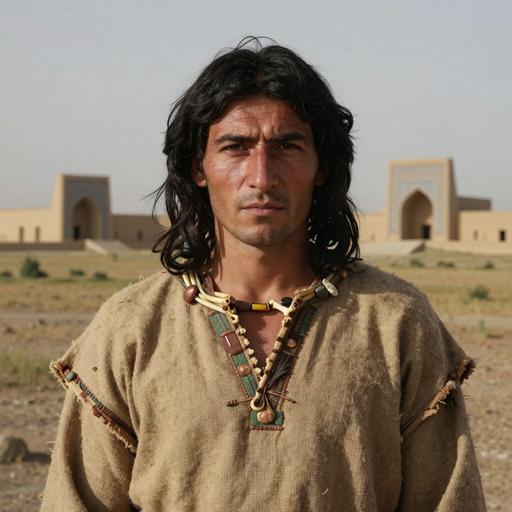
Portrait reconstruction of I11028
Ancient Individual

A man buried in Uzbekistan in the Eneolithic era

I11028
3332 BCE - 2937 BCE
Male
Eneolithic Bustan
Uzbekistan
Scroll to begin
Chapter I

Identity

The biological and cultural markers that define this ancient individual

Sample ID

I11028

Date Range

3332 BCE - 2937 BCE

Biological Sex

Male

mtDNA Haplogroup

W1

Y-DNA Haplogroup

J-Y26741

Cultural Period

Eneolithic Bustan

Chapter II

Place

Where this individual was discovered

Country Uzbekistan
Locality Bustan
Coordinates 37.6667, 67.0000
Chapter III

Time

When this individual lived in the broader context of human history

I11028 3332 BCE - 2937 BCE
Chapter IV

Story

The narrative of this ancient life

The Eneolithic, also known as the Chalcolithic or Copper Age, marks a transitional period between the Neolithic and the Bronze Age, characterized by the use of copper tools alongside stone tools. The Bustan culture in Uzbekistan is a significant archaeological culture representing the Eneolithic phase in Central Asia.

Geographic and Environmental Context

The Bustan culture is primarily associated with the area near present-day Bustan in Uzbekistan, particularly in the fertile oasis regions and the deltas of the Amu Darya and Syr Darya rivers. This geographical setting provided the inhabitants with rich resources for agriculture, animal husbandry, and other cultural developments. The region's climate during this era was likely more favorable than today, with lush vegetation supporting various plant and animal life.

Cultural and Technological Characteristics

1. Metallurgy: The defining feature of the Eneolithic period is the emergence of metalworking, particularly the use of copper. Archaeologists have unearthed evidence of sophisticated methods for smelting and shaping copper, though stone tools continued to be widely used. The mastery of copper likely contributed to advances in tool-making, trade, and technology.

2. Agriculture and Economy: The Bustan culture was based on sedentary agriculture, with evidence pointing towards the cultivation of crops such as wheat and barley. Irrigation systems might have been employed to sustain the agricultural activities, given the arid climate. Livestock, including cattle, sheep, and goats, were likely integral to Bustan's economy, providing meat, milk, and materials for clothing and tools.

3. Settlement Patterns: Settlements of the Bustan culture were typically small, modest villages, with structures made from mud-brick or wattle and daub. These settlements were strategically located near water sources and arable land. Evidence of storage facilities suggests a level of surplus production and planning.

4. Art and Craftsmanship: Artifacts from this period, such as pottery, tools, and jewelry, reveal a culture with skilled artisans. Ceramics were often decorated with intricate patterns and designs, indicating aesthetic as well as practical uses. The presence of items like beads, amulets, and figurines suggests the importance of personal adornment and possibly spiritual beliefs.

5. Social Organization: The exact social structure of the Bustan people is not well-documented; however, the evidence suggests a tribal or clan-based society. The emergence of agriculture and metallurgy might have led to increased social stratification, as certain individuals or groups controlled essential resources and crafts.

Burial Practices and Religious Beliefs

Burial sites associated with the Bustan culture provide insights into their beliefs and social structures. Graves often contained pottery, tools, and personal items, indicating a belief in an afterlife or the importance of providing for the deceased in the next world. The orientation and construction of burial sites might reflect ritualistic or religious practices, although specific deities or detailed mythologies remain largely speculative.

Trade and Interaction

The Bustan culture was not isolated; it likely engaged in trade with neighboring cultures, facilitating the exchange of goods, ideas, and technologies. Copper, a valuable commodity, might have played a crucial role in establishing trade networks. The movement of materials such as obsidian and semi-precious stones suggests a broad geographic interaction sphere.

Legacy and Influence

The Eneolithic Bustan culture laid the groundwork for subsequent cultural and technological developments in Central Asia. The advancements in agriculture, metallurgy, and social organization during this period helped pave the way for the rise of more complex societies in the Bronze Age.

In conclusion, the Bustan culture of the Eneolithic era represents a significant phase in Central Asian prehistory, marked by the early use of metal, the development of agriculture, and emerging social complexities. Further archaeological research continues to shed light on this enigmatic culture's role and contributions to the broader tapestry of human history in the region.

Chapter V

Genetics

The genetic ancestry of this ancient individual

Ancient Genetic Admixture

This analysis compares the DNA profile of I11028 with ancient reference populations, showing the genetic composition in terms of prehistoric ancestral groups.

Neolithic Farmers 68.0%
Ancient Asians 19.8%
Western Steppe Pastoralists 7.3%
European Hunter-Gatherers 4.9%

Modern Genetic Admixture

This analysis compares the DNA profile with present-day reference populations, showing what percentage of genetic makeup resembles modern populations from different regions.

Asia 100.0%
Central Asian, Northern Indian & Pakistani 61.1%
Pakistan 48.6%
Indian 12.4%
Northern West Asian 39.0%
Mesopotamian 26.8%
Caucasian 12.1%

Closest Modern Populations

These are the modern populations showing the closest statistical alignment to A man buried in Uzbekistan in the Eneolithic era, ranked by genetic distance. Lower distance values indicate closer statistical similarity.

1
Iranian Persian Khorasan
5.3335
2
Iranian Mazandarani O
5.6692
3
Azerbaijani Dagestan
5.9161
4
Turkmen O
5.9353
5
Karachay
5.9452
6
Iranian Mazandarani
6.0633
7
North Ossetian
6.0984
8
Parsi Pakistan
6.1410
9
Tat Dagestan Nyugdi
6.1647
10
Kumyk
6.1732
Chapter VI

Context

Other ancient individuals connected to this sample

Sources

References

Scientific publications and genetic data

Scientific Publication

The formation of human populations in South and Central Asia

Authors Narasimhan VM, Patterson N, Moorjani P
Abstract

By sequencing 523 ancient humans, we show that the primary source of ancestry in modern South Asians is a prehistoric genetic gradient between people related to early hunter-gatherers of Iran and Southeast Asia. After the Indus Valley Civilization's decline, its people mixed with individuals in the southeast to form one of the two main ancestral populations of South Asia, whose direct descendants live in southern India. Simultaneously, they mixed with descendants of Steppe pastoralists who, starting around 4000 years ago, spread via Central Asia to form the other main ancestral population. The Steppe ancestry in South Asia has the same profile as that in Bronze Age Eastern Europe, tracking a movement of people that affected both regions and that likely spread the distinctive features shared between Indo-Iranian and Balto-Slavic languages.

G25 Coordinates

The G25 coordinates for sample I11028 can be used for detailed admixture analysis in our G25 Studio tool.

I11028,0.09395488,0.0721794,-0.07296192,-0.00152268,-0.05690688,0.00779028,0.00893718,-0.00199232,-0.0423859,-0.02068302,-0.00456374,0.0054846,-0.01516838,0.00354808,0.00843746,-0.0123717,0.01393078,-0.00499094,-0.00670646,0.00960872,0.00920668,-0.00075732,0.00639368,-0.00622948,-0.00588958
Analyze in G25 Studio
Use code for 40% off Expires Feb 26