Menu
Store
Blog
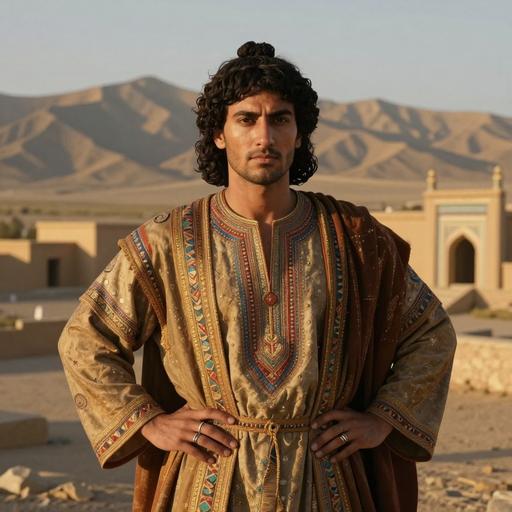
Portrait reconstruction of I12257
Ancient Individual

A man buried in Tajikistan in the Iron Age era

I12257
200 BCE - 100 CE
Male
Kushan Ksirov
Tajikistan
Scroll to begin
Chapter I

Identity

The biological and cultural markers that define this ancient individual

Sample ID

I12257

Date Range

200 BCE - 100 CE

Biological Sex

Male

mtDNA Haplogroup

J1b6

Y-DNA Haplogroup

R-M207

Cultural Period

Kushan Ksirov

Chapter II

Place

Where this individual was discovered

Country Tajikistan
Locality Ksirov
Coordinates 37.4156, 68.1737
Chapter III

Time

When this individual lived in the broader context of human history

I12257 200 BCE - 100 CE
Chapter IV

Story

The narrative of this ancient life

The Kushan era, particularly in the region of what is now modern-day Tajikistan, represents a fascinating confluence of cultures, histories, and influences. This period, characterized by the Kushan Empire's dominance, is a significant epoch in Central Asian and South Asian history, spanning approximately from the 1st to the 3rd centuries CE. The influence of the Kushan Empire extended across a vast territory that included northern India, parts of Central Asia, and the Iranian plateau, incorporating a multitude of cultures and traditions.

Historical Context

The Kushan Empire was formed by the Yuezhi, a nomadic people who migrated from the steppes of Central Asia. After settling in the Bactrian region (modern-day Afghanistan) around the 1st century BCE, they established a powerful empire under the leadership of Kujula Kadphises, followed by prominent rulers like Vima Kadphises and Kanishka the Great. While the primary base of the Kushan power was in Bactria, their influence spread across the northwestern Indian subcontinent and parts of what is today Iran and Tajikistan.

Cultural Influences

The Kushan period is notable for its remarkable cultural syncretism. The empire served as a melting pot of Greek, Persian, Indian, and Central Asian influences. This is evident in various aspects of Kushan life, including:

  • Art and Architecture: The Kushans are renowned for their distinctive contributions to Buddhist art, often associated with the Gandhara school. This style exhibits a fusion of Greek and Buddhist iconography, producing some of the earliest known representations of the Buddha in human form. Kushan art often included motifs and techniques from Hellenistic, Persian, and Indian traditions, leading to unique architectural innovations seen in the stupas and monasteries of the time.

  • Religion: The Kushan Empire was religiously pluralistic. While it is particularly known for its patronage of Buddhism, Zoroastrianism and various local beliefs were also practiced. King Kanishka is often credited with promoting Buddhism, which helped spread the religion along the Silk Road. This synthesis of religious ideas facilitated the exchange of spiritual and philosophical concepts across vast regions.

  • Economy and Trade: The location of the Kushan Empire along the Silk Road facilitated the movement of goods, ideas, and technologies between the East and West. The Kushans played a crucial role in enhancing trade between the Roman Empire, Persia, India, and China. They minted gold coins that attest to their wealth and commercial prowess, often depicting Greek, Indian, and Zoroastrian deities, which highlight their diverse cultural connections.

Societal Influence

The Kushans were known for their relatively sophisticated administrative system. They maintained a strong central authority while allowing for localized governance across their territories, which likely contributed to the stability and longevity of their empire. Their society was characterized by a class system that included aristocrats, merchants, artisans, and farmers, reflecting a complex social structure similar to those of contemporaneous empires.

Decline and Legacy

The decline of the Kushan Empire came in the 3rd century CE, partly due to the rise of the Sassanian Empire in Persia and internal pressures from various local rulers. Despite its fall, the legacy of the Kushan Empire endured through its artistic and cultural contributions, which influenced subsequent Indian empires, including the Gupta Empire. The fusion of cultural and religious ideas that marked Kushan rule had a lasting impact on the development of Buddhism and the interconnectedness of Eurasian civilizations.

The historical regions of Ksirov in Tajikistan and Kushan in what is now Afghanistan preserve the echoes of this grand empire. The archaeological remains continue to provide insights into the Kushan world, reflecting a period of remarkable cultural interaction and historical significance.

Chapter V

Genetics

The genetic ancestry of this ancient individual

Ancient Genetic Admixture

This analysis compares the DNA profile of I12257 with ancient reference populations, showing the genetic composition in terms of prehistoric ancestral groups.

Neolithic Farmers 53.3%
Western Steppe Pastoralists 28.9%
Ancient Asians 14.4%
European Hunter-Gatherers 3.4%

Modern Genetic Admixture

This analysis compares the DNA profile with present-day reference populations, showing what percentage of genetic makeup resembles modern populations from different regions.

Asia 60.2%
Northern West Asian 43.4%
Caucasian 43.4%
Central Asian, Northern Indian & Pakistani 16.8%
Pakistan 16.8%
Europe 23.4%
Northwestern European 23.4%
Northwestern European 16.0%
Finnish 7.3%
Africa 9.7%
West African 5.7%
Ghanaian, Liberian, Sierra Leonean 5.7%
Congolese & Southern East African 4.0%
South East African 4.0%
America 6.8%
America 6.8%
Native American 6.8%

Closest Modern Populations

These are the modern populations showing the closest statistical alignment to A man buried in Tajikistan in the Iron Age era, ranked by genetic distance. Lower distance values indicate closer statistical similarity.

1
Tatar Mishar
5.5112
2
Tatar Kazan
6.3004
3
Komi A
6.9701
4
Russian Leshukonsky
7.7790
5
Saami Kola
7.9044
6
Finnish North
8.2538
7
Russian Krasnoborsky
8.3269
8
Russian Pinezhsky
8.3974
9
Besermyan
8.4255
10
Finnish Central
8.4882
Chapter VI

Context

Other ancient individuals connected to this sample

Sources

References

Scientific publications and genetic data

Scientific Publication

The formation of human populations in South and Central Asia

Authors Narasimhan VM, Patterson N, Moorjani P
Abstract

By sequencing 523 ancient humans, we show that the primary source of ancestry in modern South Asians is a prehistoric genetic gradient between people related to early hunter-gatherers of Iran and Southeast Asia. After the Indus Valley Civilization's decline, its people mixed with individuals in the southeast to form one of the two main ancestral populations of South Asia, whose direct descendants live in southern India. Simultaneously, they mixed with descendants of Steppe pastoralists who, starting around 4000 years ago, spread via Central Asia to form the other main ancestral population. The Steppe ancestry in South Asia has the same profile as that in Bronze Age Eastern Europe, tracking a movement of people that affected both regions and that likely spread the distinctive features shared between Indo-Iranian and Balto-Slavic languages.

G25 Coordinates

The G25 coordinates for sample I12257 can be used for detailed admixture analysis in our G25 Studio tool.

I12257,0.1146811,0.0335549,0.07211024,0.04246112,0.0100527,0.00628992,0.00335234,0.0116101,0.01151468,0.00142346,0.00553512,0.00170592,-0.0098733,-0.00411904,0.01352612,-0.00417562,-0.01658642,0.00618104,0.00564536,-0.00069758,0.0104796,-0.00502172,-1.36E-05,0.01471894,0.00611698
Analyze in G25 Studio
Use code for 40% off Expires Feb 26