Menu
Store
Blog
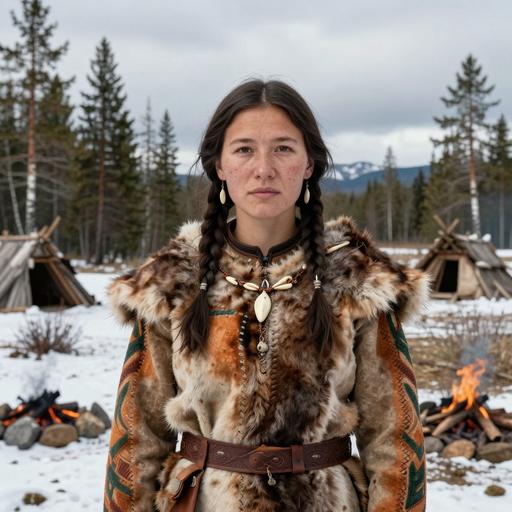
Portrait reconstruction of I1958
Ancient Individual

A woman buried in Russia in the Hunter-Gatherer era

I1958
4723 BCE - 4550 BCE
Female
Hunter-Gatherer Tyumen
Russia
Scroll to begin
Chapter I

Identity

The biological and cultural markers that define this ancient individual

Sample ID

I1958

Date Range

4723 BCE - 4550 BCE

Biological Sex

Female

mtDNA Haplogroup

U

Cultural Period

Hunter-Gatherer Tyumen

Chapter II

Place

Where this individual was discovered

Country Russia
Locality Siberia. western. Tyumen Oblast
Coordinates 56.0362, 69.3389
Chapter III

Time

When this individual lived in the broader context of human history

I1958 4723 BCE - 4550 BCE
Chapter IV

Story

The narrative of this ancient life

The Hunter-Gatherer cultures of the Tyumen region in Siberia represent an intriguing chapter in the prehistoric era, marked by adaptation, resourcefulness, and the enduring human spirit in one of the world's most challenging environments. The region, with its vast stretches of taiga, tundra, and rich river systems, offered a diverse yet demanding landscape for early human societies. This era is predominantly characterized by mobile groups whose survival depended on their intricate understanding of the local ecology and seasonal cycles.

Environment and Geography

Tyumen, located in Western Siberia, is characterized by its wide river valleys, dense forests, and harsh climatic conditions. The region experiences long, strenuous winters and short summers, necessitating advanced survival strategies. The region's rivers, notably the Ob and the Irtysh, played a critical role in sustaining these communities, providing abundant aquatic resources and facilitating movement and trade.

Social Structure and Lifestyles

The social structure of these hunter-gatherer groups was likely egalitarian, with community cohesion and survival being paramount. Leadership roles may have been temporary and situational, based on individual skills and expertise. These societies were typically small, comprising extended family units, and their size could vary with seasonal resource availability.

Daily life was dictated by the rhythms of nature. Communities followed migratory patterns of game such as reindeer, elks, and smaller mammals, which were essential for their diet and also provided materials for clothing and tools. Gathering played an indispensable role; the Tyumen landscape offered a variety of edible plants, nuts, and berries, which were significant supplements to their diet.

Tools and Technology

The material culture of the Tyumen hunter-gatherers was defined by their well-crafted tools and artifacts. Stone implements, such as spear points, scrapers, and blades, were common, fashioned from locally available flint. Bone and antler were also utilized for tools and decorative items, signaling both practical and cultural dimensions of their society.

Hunting technology was advanced for the time, with evidence of sophisticated hafting techniques and composite tools designed for efficiency and sustainability. The presence of fishing tools, such as bone fish hooks and nets, indicates the crucial role aquatic resources played in their subsistence strategy.

Art and Symbolism

While direct evidence of art is sparse, the presence of ornamental objects and personal adornments suggests that these communities engaged in symbolic expression. Such artifacts, often crafted from ivory, bone, and stone, likely held cultural, spiritual, or social significance, portraying elements of their worldview or social identity.

Spiritual and Cultural Life

Spiritual beliefs were likely intertwined with their natural surroundings, with animals and natural phenomena playing an integral role in their cosmology. The use of totems, rituals, or shamans might have been practice to mediate their relationship with the environment and ensure successful hunts and communal well-being.

Adaptation and Resilience

Key to the survival of Hunter-Gatherer groups in Tyumen was their adaptability to the extreme environmental conditions. Seasonal migrations were planned with precision, ensuring that communities could exploit resources most efficiently. Their deep ecological knowledge, passed down through generations, enabled them to thrive in the Siberian wilderness.

Conclusion

The Hunter-Gatherer cultures of Tyumen exemplify the resilience and resourcefulness of early human societies in not only surviving but adapting creatively to an environment that, at face value, seems relentlessly inhospitable. The legacy of these communities is etched into the cultural and archaeological fabric of Siberia, offering insights into the enduring relationship between humans and their environment. Through continued research and exploration, the understanding of this rich cultural heritage continues to deepen, highlighting the sophisticated lifeways of these ancient peoples.

Chapter V

Genetics

The genetic ancestry of this ancient individual

Ancient Genetic Admixture

This analysis compares the DNA profile of I1958 with ancient reference populations, showing the genetic composition in terms of prehistoric ancestral groups.

Western Steppe Pastoralists 47.9%
Ancient Asians 38.9%
Ancient Africans 7.6%
Ancient Native Americans 5.7%

Modern Genetic Admixture

This analysis compares the DNA profile with present-day reference populations, showing what percentage of genetic makeup resembles modern populations from different regions.

Europe 50.5%
Northwestern European 32.2%
Scandinavian 18.7%
Finnish 13.4%
Eastern European 18.4%
Asia 27.2%
Northern Asian 23.5%
Siberian 23.5%
Central Asian, Northern Indian & Pakistani 3.7%
Pakistan 3.7%
America 21.0%
America 21.0%
Native American 21.0%
Oceania 1.2%
Melanesian 1.2%
Papuan 1.2%

Closest Modern Populations

These are the modern populations showing the closest statistical alignment to A woman buried in Russia in the Hunter-Gatherer era, ranked by genetic distance. Lower distance values indicate closer statistical similarity.

1
Mari
8.3518
2
Khanty O1
9.0563
3
Udmurt
9.6804
4
Chuvash
9.8646
5
Tlingit
10.4083
6
Bashkir
10.4390
7
Besermyan
10.5392
8
Saami
10.8023
9
Tatar Siberian
12.1653
10
Tatar Kazan
13.0348
Chapter VI

Context

Other ancient individuals connected to this sample

Sources

References

Scientific publications and genetic data

Scientific Publication

The formation of human populations in South and Central Asia

Authors Narasimhan VM, Patterson N, Moorjani P
Abstract

By sequencing 523 ancient humans, we show that the primary source of ancestry in modern South Asians is a prehistoric genetic gradient between people related to early hunter-gatherers of Iran and Southeast Asia. After the Indus Valley Civilization's decline, its people mixed with individuals in the southeast to form one of the two main ancestral populations of South Asia, whose direct descendants live in southern India. Simultaneously, they mixed with descendants of Steppe pastoralists who, starting around 4000 years ago, spread via Central Asia to form the other main ancestral population. The Steppe ancestry in South Asia has the same profile as that in Bronze Age Eastern Europe, tracking a movement of people that affected both regions and that likely spread the distinctive features shared between Indo-Iranian and Balto-Slavic languages.

G25 Coordinates

The G25 coordinates for sample I1958 can be used for detailed admixture analysis in our G25 Studio tool.

I1958,0.10121478,-0.07392372,0.08986086,0.06292774,-0.03569748,0.0010227,-0.03399794,-0.03808212,-0.00911454,-0.0331694,0.02268564,-0.01003008,0.02292288,-0.02640944,-0.02114404,-0.02140068,-0.01045466,-0.00636094,-0.02983924,-0.02507444,0.0109378,0.00536624,-0.03243122,0.00735528,-0.00445026
Analyze in G25 Studio
Use code for 40% off Expires Feb 26