Menu
Store
Blog
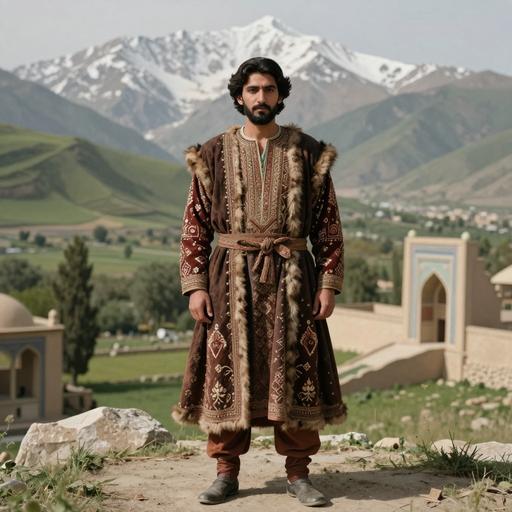
Portrait reconstruction of I2959
Ancient Individual

A man buried in Pakistan in the Medieval era

I2959
1041 CE - 1217 CE
Male
Ghaznavid Udegram
Pakistan
Scroll to begin
Chapter I

Identity

The biological and cultural markers that define this ancient individual

Sample ID

I2959

Date Range

1041 CE - 1217 CE

Biological Sex

Male

mtDNA Haplogroup

M5a1

Y-DNA Haplogroup

R-Z93

Cultural Period

Ghaznavid Udegram

Chapter II

Place

Where this individual was discovered

Country Pakistan
Locality Swat Valley. Udegram
Coordinates 34.7432, 72.3142
Chapter III

Time

When this individual lived in the broader context of human history

I2959 1041 CE - 1217 CE
Chapter IV

Story

The narrative of this ancient life

The Ghaznavid Empire, which flourished during the Islamic Golden Age, was a prominent Persianate Muslim dynasty that extended its influence across vast regions, including parts of present-day Iran, Afghanistan, Pakistan, and India, from 977 to 1186 CE. One of the significant locations that highlight the cultural and architectural legacy of the Ghaznavids is Udegram, situated in the Swat Valley of modern-day Pakistan. This period and region reflect a profound intersection of Islamic and local traditions, enriched by strategic and cultural significance.

Historical Context

The Ghaznavid Empire was established by Sultan Mahmud of Ghazni, who transformed the city of Ghazni into a major center of Islamic culture and power. Known for their military conquests and patronage of intellectuals, the Ghaznavids played a crucial role in spreading Islam across the Indian subcontinent. The empire's expansion into the region encompassing Udegram signified both the military prowess and cultural ambitions of the dynasty.

Udegram's Strategic and Cultural Significance

Udegram is one of many sites that became integrated into the Ghaznavid realm due to its strategic location in the Swat Valley, a key area that served as a corridor between the Indian subcontinent and Central Asia. The valley was not only significant for military campaigns but also became a melting pot of diverse cultural influences due to the networks of trade and exchange facilitated by the Ghaznavids.

Architecture and Urban Development

The Ghaznavids left a significant architectural legacy in the territories they controlled, characterized by the use of sophisticated Persianate styles. In Udegram, for instance, archaeological excavations have revealed remnants of forts, mosques, and other structures that showcase the blend of Persian architectural elements with local styles. The fortresses built in these regions—often incorporating robust defensive features—highlight the military foresight of the Ghaznavids.

Cultural and Religious Influence

During the Ghaznavid era, Udegram would have likely experienced an infusion of Islamic culture, while also retaining elements of its indigenous traditions. This amalgamation is evident in the realm of art, education, and religion. The Ghaznavids are noted for their promotion of Persian culture and the Persian language, which became a lingua franca across their empire, facilitating trade and cultural exchange.

Furthermore, the Ghaznavid rulers were patrons of Islamic scholars, poets, and artists. This patronage helped facilitate the spread of Islamic philosophical and scientific advancements during the Islamic Golden Age. Scholars such as Al-Biruni, who wrote extensively on the people, culture, and lands of India, were heavily supported by the Ghaznavid court.

Interaction with Local Communities

The Islamic spread initiated by the Ghaznavids often resulted in the synthesis of Islamic customs with local traditions. In places like Udegram, this cultural interplay could be seen in the adaptation of Islamic practices with pre-existing societal norms, leading to a unique local expression of Islam that resonated with indigenous people.

Decline and Legacy

The decline of the Ghaznavid Empire began in the late 11th century due to internal strife, the rise of rival dynasties, and pressure from emerging powers such as the Seljuks. By the 12th century, the Ghaznavids had lost much of their territory, including regions like Udegram.

Despite their eventual downfall, the legacy of the Ghaznavids in Udegram and other regions remains influential. Their contributions to architecture, culture, and Islamic dissemination continue to be subjects of study in understanding the complex historical tapestry of South Asia during the medieval period.

Overall, the Ghaznavid era in Udegram exemplifies a time of dynamic cultural exchange and significant historical developments, integral to the broader narrative of Islamic history and South Asian heritage.

Chapter V

Genetics

The genetic ancestry of this ancient individual

Ancient Genetic Admixture

This analysis compares the DNA profile of I2959 with ancient reference populations, showing the genetic composition in terms of prehistoric ancestral groups.

Neolithic Farmers 45.2%
Ancient Asians 28.5%
Western Steppe Pastoralists 15.1%
European Hunter-Gatherers 11.2%

Modern Genetic Admixture

This analysis compares the DNA profile with present-day reference populations, showing what percentage of genetic makeup resembles modern populations from different regions.

Asia 85.8%
Central Asian, Northern Indian & Pakistani 44.9%
Pakistan 26.8%
Indian 18.1%
Northern West Asian 37.6%
Caucasian 29.5%
Mesopotamian 8.1%
Arab, Egyptian & Levantine 2.8%
Arabian 2.6%
Northern Asian 0.5%
Siberian 0.5%
Europe 12.5%
Northwestern European 8.5%
Scandinavian 8.5%
Eastern European 3.9%
America 1.2%
America 1.2%
Native American 1.2%
Africa 0.5%

Closest Modern Populations

These are the modern populations showing the closest statistical alignment to A man buried in Pakistan in the Medieval era, ranked by genetic distance. Lower distance values indicate closer statistical similarity.

1
Pashtun Afghanistan North
2.1461
2
Pashtun Afghanistan
2.2562
3
Pashtun Afghanistan Paktia
2.8134
4
Pashtun Afghanistan Northeast
2.9814
5
Tajik Afghanistan
3.1701
6
Pashtun Uthmankhel
3.3042
7
Pashtun Pakistan Bettani
3.3256
8
Pashtun Pakistan Khattak Nowshera
3.3393
9
Pamiri Ishkashim
3.4294
10
Pashtun Tarkalani
3.4350
Chapter VI

Context

Other ancient individuals connected to this sample

Sources

References

Scientific publications and genetic data

Scientific Publication

The formation of human populations in South and Central Asia

Authors Narasimhan VM, Patterson N, Moorjani P
Abstract

By sequencing 523 ancient humans, we show that the primary source of ancestry in modern South Asians is a prehistoric genetic gradient between people related to early hunter-gatherers of Iran and Southeast Asia. After the Indus Valley Civilization's decline, its people mixed with individuals in the southeast to form one of the two main ancestral populations of South Asia, whose direct descendants live in southern India. Simultaneously, they mixed with descendants of Steppe pastoralists who, starting around 4000 years ago, spread via Central Asia to form the other main ancestral population. The Steppe ancestry in South Asia has the same profile as that in Bronze Age Eastern Europe, tracking a movement of people that affected both regions and that likely spread the distinctive features shared between Indo-Iranian and Balto-Slavic languages.

G25 Coordinates

The G25 coordinates for sample I2959 can be used for detailed admixture analysis in our G25 Studio tool.

I2959,0.0798788,0.03640662,-0.0639372,0.04215916,-0.05791548,0.02588702,0.00228196,-0.00040524,-0.01591698,-0.02143104,7.854E-05,-0.00319624,0.00445994,-0.00820724,0.00924526,0.01192328,-0.00394326,-0.00028336,-0.00187376,-0.00962234,-0.00259596,-0.00125248,-0.00140686,0.00134108,-0.00139087
Analyze in G25 Studio
Use code for 40% off Expires Feb 26