Menu
Store
Blog
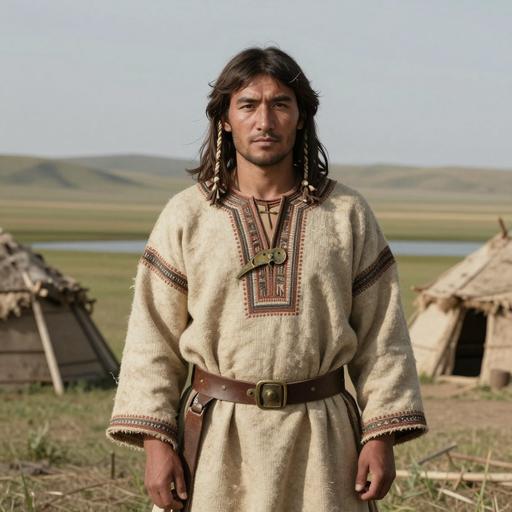
Portrait reconstruction of I3860
Ancient Individual

A man buried in Kazakhstan in the Middle Late Bronze Age era

I3860
1739 BCE - 1546 BCE
Male
Mid-Late Bronze Oy-Dzhaylau
Kazakhstan
Scroll to begin
Chapter I

Identity

The biological and cultural markers that define this ancient individual

Sample ID

I3860

Date Range

1739 BCE - 1546 BCE

Biological Sex

Male

mtDNA Haplogroup

R1b1

Y-DNA Haplogroup

R-Z93

Cultural Period

Mid-Late Bronze Oy-Dzhaylau

Chapter II

Place

Where this individual was discovered

Country Kazakhstan
Locality Oy-Dzhaylau III
Coordinates 42.6894, 73.1175
Chapter III

Time

When this individual lived in the broader context of human history

I3860 1739 BCE - 1546 BCE
Chapter IV

Story

The narrative of this ancient life

The Mid-Late Bronze Age Oy-Dzhaylau culture is a distinctive phase within the broader Andronovo cultural horizon, predominantly flourishing in the region that is present-day Kazakhstan. This culture is part of a complex network of Bronze Age communities that occupied the Eurasian Steppe, known for their significant contributions to the development of pastoral nomadism, metallurgy, and early Indo-Iranian languages.

Geographic and Temporal Context

The Oy-Dzhaylau phase is typically dated to the mid-2nd millennium BCE, approximately between 1500 BCE and 1200 BCE, marking it as part of the later stages of the Andronovo cultural complex. This culture is primarily associated with the sprawling steppes of central and eastern Kazakhstan, an area characterized by vast grasslands, which would have supported extensive pastoral activities.

Economy and Subsistence

The economy of the Oy-Dzhaylau people was predominantly based on pastoralism. They managed large herds of cattle, sheep, and horses, which were crucial to their way of life. These animals provided not only meat and milk but also materials like wool and leather for clothing and other domestic uses. Horse domestication, in particular, played a significant role in their mobility, allowing them to maintain and manage large grazing territories.

Agriculture also played a subsidiary role in their subsistence strategy. Evidence of cereal cultivation, such as barley and wheat, has been found at various sites, suggesting that farming supplemented their main pastoral economy.

Settlement Patterns and Architecture

Oy-Dzhaylau settlements varied from semi-permanent to permanent dwellings, reflecting a mixed economy of pastoralism and agriculture. The settlements typically consisted of circular or oval dwellings, often semi-subterranean, constructed with wood and clay. The arrangement of these settlements indicates a degree of social organization and planning, likely driven by their economic activities and environmental conditions.

The architecture suggests adaptations to the harsh climates of the steppe, providing insulating properties against both the cold winters and the hot summers.

Material Culture and Technology

The Oy-Dzhaylau people are noted for their advanced metallurgical skills, particularly in bronze working. They produced a variety of tools, weapons, and ornaments crafted from bronze, including axes, sickles, and knives. The presence of mined and smelted local ores indicates a deep understanding of metallurgy, which was central to their economy and daily life.

Ceramic production was another notable aspect of their material culture, with pottery often characterized by intricate geometric designs and patterns. These ceramics were used for both domestic purposes and ritualistic activities.

Social Organization and Culture

The social structure of the Oy-Dzhaylau culture appears to have been hierarchically organized, potentially with tribal or clan-based systems. Burial practices provide insights into their social organization. Kurgans (burial mounds) were common, often containing high-status individuals accompanied by grave goods indicative of their wealth and social standing. These were usually accompanied by offerings of animals, particularly horses, underscoring their importance in Oy-Dzhaylau culture.

Religion and Beliefs

Religious beliefs of the Oy-Dzhaylau people likely involved a pantheon of nature deities, as suggested by the ritualistic artifacts and the prominent role of animal sacrifices in their burial practices. Evidence of fire rituals has also been discovered, aligning with broader Indo-Iranian religious customs that emphasize the sanctity of fire.

Interaction and Legacy

The Oy-Dzhaylau culture interacted with neighboring cultures and played a significant role in the transmission of technologies, ideas, and practices across the Eurasian Steppe. This interaction likely facilitated the spread of Indo-Iranian languages, influencing the cultural and linguistic landscape of the region.

Overall, the Oy-Dzhaylau culture of the Mid-Late Bronze Age represents a crucial period in the cultural and technological evolution of the Eurasian Steppe, highlighting the sophistication and adaptability of these early pastoral societies. Their legacy is observed not only in the material remains but also in the profound impact they had on the subsequent cultural developments in Central Asia and beyond.

Chapter V

Genetics

The genetic ancestry of this ancient individual

Ancient Genetic Admixture

This analysis compares the DNA profile of I3860 with ancient reference populations, showing the genetic composition in terms of prehistoric ancestral groups.

Western Steppe Pastoralists 52.5%
European Hunter-Gatherers 16.8%
Ancient Asians 15.7%
Ancient Native Americans 8.3%
Neolithic Farmers 6.8%

Modern Genetic Admixture

This analysis compares the DNA profile with present-day reference populations, showing what percentage of genetic makeup resembles modern populations from different regions.

Europe 68.9%
Eastern European 55.3%
Northwestern European 13.7%
Finnish 13.7%
Asia 20.9%
Central Asian, Northern Indian & Pakistani 18.8%
Pakistan 18.8%
Northern Asian 2.1%
Siberian 2.1%
America 10.2%
America 10.2%
Native American 10.2%

Closest Modern Populations

These are the modern populations showing the closest statistical alignment to A man buried in Kazakhstan in the Middle Late Bronze Age era, ranked by genetic distance. Lower distance values indicate closer statistical similarity.

1
Besermyan
5.3653
2
Tatar Kazan
6.0719
3
Udmurt
6.1759
4
Chuvash
7.1975
5
Komi A
7.2995
6
Tatar Mishar
7.9206
7
Saami Kola
8.2284
8
Tatar Lipka
8.2325
9
Saami
8.5159
10
Russian Leshukonsky
8.8464
Chapter VI

Context

Other ancient individuals connected to this sample

Sources

References

Scientific publications and genetic data

Scientific Publication

The formation of human populations in South and Central Asia

Authors Narasimhan VM, Patterson N, Moorjani P
Abstract

By sequencing 523 ancient humans, we show that the primary source of ancestry in modern South Asians is a prehistoric genetic gradient between people related to early hunter-gatherers of Iran and Southeast Asia. After the Indus Valley Civilization's decline, its people mixed with individuals in the southeast to form one of the two main ancestral populations of South Asia, whose direct descendants live in southern India. Simultaneously, they mixed with descendants of Steppe pastoralists who, starting around 4000 years ago, spread via Central Asia to form the other main ancestral population. The Steppe ancestry in South Asia has the same profile as that in Bronze Age Eastern Europe, tracking a movement of people that affected both regions and that likely spread the distinctive features shared between Indo-Iranian and Balto-Slavic languages.

G25 Coordinates

The G25 coordinates for sample I3860 can be used for detailed admixture analysis in our G25 Studio tool.

I3860,0.10621628,-0.00651098,0.06049256,0.07137208,-0.01949374,0.0145969,-0.02029422,-0.02240236,-0.00830292,-0.03042074,0.01045062,-0.00852646,0.0143595,-0.00401138,-0.01280214,-0.01070942,-0.00668666,-0.00314494,-0.00933982,-0.0116173,-0.00250662,0.00477038,-0.01662646,0.00270018,-0.0052422
Analyze in G25 Studio
Use code for 40% off Expires Feb 26