Menu
Store
Blog
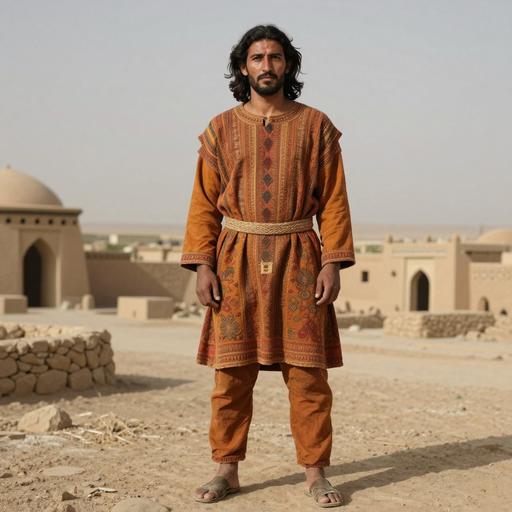
Portrait reconstruction of I6675
Ancient Individual

A man buried in Turkmenistan in the Late Bronze Age era

I6675
1600 BCE - 1000 BCE
Male
Late Bronze Sumbar
Turkmenistan
Scroll to begin
Chapter I

Identity

The biological and cultural markers that define this ancient individual

Sample ID

I6675

Date Range

1600 BCE - 1000 BCE

Biological Sex

Male

mtDNA Haplogroup

W3b

Y-DNA Haplogroup

R-P267

Cultural Period

Late Bronze Sumbar

Chapter II

Place

Where this individual was discovered

Country Turkmenistan
Locality Sumbar
Coordinates 37.9316, 58.4325
Chapter III

Time

When this individual lived in the broader context of human history

I6675 1600 BCE - 1000 BCE
Chapter IV

Story

The narrative of this ancient life

The Late Bronze Age Sumbar culture, associated with the Oxus Civilization, also known as the Bactria-Margiana Archaeological Complex (BMAC), is a fascinating chapter of ancient history centered in what is today Turkmenistan, as well as parts of Afghanistan, Uzbekistan, and Tajikistan. The era spans roughly from 2300 to 1700 BCE, marked by advanced urbanization, complex social structures, and rich cultural expressions.

Geographical Context

The Sumbar culture was situated in the fertile oases of the Amu Darya River and the Sumbar River Valley, an area characterized by harsh deserts interspersed with lush, arable land. The strategic positioning of this culture provided access to trade routes that connected Mesopotamia and the Iranian Plateau with the Indus Valley, facilitating a significant degree of cultural and material exchange.

Urban and Architectural Development

The Late Bronze Age Sumbar culture was notable for its impressive urban centers and architectural prowess. Settlements were characterized by substantial fortifications and the development of intricate city plans with advanced drainage systems. Palatial structures and civic buildings showcased the use of mud-brick and innovative engineering techniques, reflecting a highly organized society with significant administrative capabilities.

Economy and Trade

The economy of Sumbar was diverse, involving agriculture, animal husbandry, metallurgy, and trade. The region's fertility supported the cultivation of barley, wheat, and millet, alongside the herding of cattle, sheep, and goats. Proximity to natural resources enabled the extraction and processing of metals like copper, bronze, and gold, which were integral to both trade and the manufacturing of tools and ornamental items.

Trade played a crucial role in the Sumbar culture, facilitating the exchange of goods such as lapis lazuli, tin, carnelian, and textiles. The Oxus Civilization as a whole engaged in long-distance trade networks that reached as far as the Mesopotamian and Indus Valley civilizations, contributing to a rich tapestry of multicultural interactions.

Social and Political Structure

The social organization of the Sumbar culture seems to have been hierarchical, with evidence of centralized authority figures or elites who wielded considerable control over economic activities and religious practices. This is inferred from the lavishness of certain burial sites and the presence of seals and administrative tools that indicate a bureaucratic system.

Craftsmanship and artisanship were highly developed, with artisans producing intricate pottery, textiles, and metalwork. These goods not only satisfied local demand but were also exchanged across vast distances, showcasing a high degree of skill and aesthetic sensibility.

Religion and Art

Religion in the Sumbar culture likely involved a pantheon of deities associated with natural elements and fertility, as suggested by the discovery of temples and numerous religious artifacts. Artistic expression was manifest in the form of elaborate pottery, figurines, and decorative motifs featuring animals, geometric designs, and mythological themes.

Seals, amulets, and decorative items often depicted complex iconography, hinting at a rich mythology and spiritual life. Artistic styles show both local innovation and influences from neighboring cultures, reflecting the interconnectedness of the Oxus Civilization with other contemporary civilizations.

Decline and Legacy

The decline of the Sumbar culture around 1700 BCE remains a subject of scholarly investigation, though it is often attributed to environmental changes, shifts in trade routes, and possibly conflicts or invasions. Regardless, its legacy continued as elements of its culture were absorbed into succeeding civilizations, and its contributions to metallurgy, trade, and urban development influenced the broader trajectory of Central Asian history.

In summary, the Late Bronze Age Sumbar culture was a dynamic and sophisticated society that played a pivotal role in the Oxus Civilization. Through its achievements in urban planning, trade, craftsmanship, and cultural exchange, it left an indelible mark on the history of the region and beyond.

Chapter V

Genetics

The genetic ancestry of this ancient individual

Ancient Genetic Admixture

This analysis compares the DNA profile of I6675 with ancient reference populations, showing the genetic composition in terms of prehistoric ancestral groups.

Neolithic Farmers 72.0%
European Hunter-Gatherers 13.6%
Ancient Asians 9.8%
Western Steppe Pastoralists 4.8%

Modern Genetic Admixture

This analysis compares the DNA profile with present-day reference populations, showing what percentage of genetic makeup resembles modern populations from different regions.

Asia 100.0%
Northern West Asian 100.0%
Caucasian 100.0%

Closest Modern Populations

These are the modern populations showing the closest statistical alignment to A man buried in Turkmenistan in the Late Bronze Age era, ranked by genetic distance. Lower distance values indicate closer statistical similarity.

1
Iranian Mazandarani O
3.5329
2
Iranian Mazandarani
4.0660
3
Iranian Cosmopolitan Tehran
4.2730
4
Iranian Persian Fars
4.4828
5
Talysh Azerbaijan
4.5678
6
Azerbaijani Dagestan
4.5861
7
Iranian Persian Yazd
4.6079
8
Iranian Central
4.6589
9
Iranian Persian Shiraz
4.6767
10
Iranian Zoroastrian
4.7354
Chapter VI

Context

Other ancient individuals connected to this sample

Sources

References

Scientific publications and genetic data

Scientific Publication

The formation of human populations in South and Central Asia

Authors Narasimhan VM, Patterson N, Moorjani P
Abstract

By sequencing 523 ancient humans, we show that the primary source of ancestry in modern South Asians is a prehistoric genetic gradient between people related to early hunter-gatherers of Iran and Southeast Asia. After the Indus Valley Civilization's decline, its people mixed with individuals in the southeast to form one of the two main ancestral populations of South Asia, whose direct descendants live in southern India. Simultaneously, they mixed with descendants of Steppe pastoralists who, starting around 4000 years ago, spread via Central Asia to form the other main ancestral population. The Steppe ancestry in South Asia has the same profile as that in Bronze Age Eastern Europe, tracking a movement of people that affected both regions and that likely spread the distinctive features shared between Indo-Iranian and Balto-Slavic languages.

G25 Coordinates

The G25 coordinates for sample I6675 can be used for detailed admixture analysis in our G25 Studio tool.

I6675,0.09168122,0.09104428,-0.06837274,-0.015496,-0.05439522,0.00086184,0.00942352,-0.00419948,-0.0495941,-0.02373638,-0.00265074,0.0024366,-0.00977504,0.00065146,0.01288162,0.00115638,0.01379602,-0.00375206,-0.00514992,0.0010508,0.00892956,-0.0058945,0.0053752,-0.0135591,0.00067859
Analyze in G25 Studio
Use code for 40% off Expires Feb 26