Menu
Store
Blog
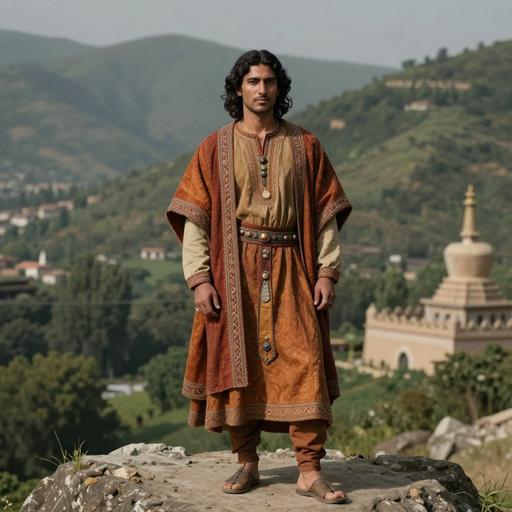
Portrait reconstruction of I7715
Ancient Individual

A man buried in Pakistan in the Middle Ages era

I7715
1279 CE - 1389 CE
Male
Medieval Barikot
Pakistan
Scroll to begin
Chapter I

Identity

The biological and cultural markers that define this ancient individual

Sample ID

I7715

Date Range

1279 CE - 1389 CE

Biological Sex

Male

mtDNA Haplogroup

M49

Y-DNA Haplogroup

J-F1614

Cultural Period

Medieval Barikot

Chapter II

Place

Where this individual was discovered

Country Pakistan
Locality Swat Valley. Barikot
Coordinates 34.7570, 72.3624
Chapter III

Time

When this individual lived in the broader context of human history

I7715 1279 CE - 1389 CE
Chapter IV

Story

The narrative of this ancient life

The Medieval Barikot era, located in present-day Pakistan, played a significant role in the broader landscape of the Islamic civilization during the medieval period. Positioned within the picturesque valley of Swat, Barikot was strategically located along trade routes that connected Central Asia, the Indian subcontinent, and the Middle East. This positioning allowed it to flourish as a cultural and economic hub, influencing and being influenced by the rich tapestry of Islamic civilization.

Geographic and Historical Context

Barikot, known in ancient texts as Bazira, is believed to have been a significant urban center during the Gandhara period and continued to hold importance into the medieval Islamic era. This area, with its proximity to the historic Silk Road, provided a strategic advantage in terms of trade and cultural exchange. During the medieval period, Barikot was part of a broader regional network that was influenced by successive Islamic empires, notably the Ghaznavid and Ghurid empires, which sought to control the region for its economic and strategic value.

Cultural Influence and Synthesis

The cultural landscape of Medieval Barikot was marked by a synthesis of pre-Islamic Gandhara cultural elements and Islamic traditions. This synthesis is evident in architectural styles, artistic expressions, and urban planning. The introduction of Islamic principles of art and architecture, including geometric patterns and calligraphy, blended with existing Buddhist and Hindu influences, creating a unique aesthetic that characterized the region.

Islamic scholars, traders, and mystics traveled through Barikot, contributing to its role as a point of intellectual and spiritual exchange. Sufism, in particular, found a fertile ground in this region, with the establishment of various khanqahs (Sufi lodges) and other religious and educational institutions. These institutions played a pivotal role in spreading Islamic teachings and fostering a sense of community and spiritual growth amidst diverse religious backgrounds.

Economic Aspects

Economically, Medieval Barikot thrived on trade, agriculture, and craftsmanship. Its location made it a vital node on the trade routes, facilitating the exchange of goods such as textiles, spices, and precious stones. The fertile valley also supported extensive agricultural activities, which included the cultivation of rice, wheat, and a variety of fruits and vegetables. The combination of trade and agriculture ensured a relatively stable and prosperous economic environment.

Crafts and industries, particularly those related to textile production and metalworking, were significant during this era. Artisans and craftsmen contributed to the local economy and were instrumental in the exchange of cultural and technological innovations across the region. The craftsmanship of Barikot was renowned for its high quality, reflecting both local traditions and the influences of Islamic artistic movements.

Social and Political Structure

The social fabric of Medieval Barikot was characterized by a complex hierarchy that included local chieftains, religious leaders, and the merchant class. The arrival of Islam introduced new socio-political dynamics, often blending with existing systems of governance. Islamic law and administration models were incorporated into local governance, creating a syncretic form of administration that balanced traditional hierarchical structures with the socio-political ideals of the Islamic world.

Politically, the area often found itself at the frontier between powerful empires, with control shifting at various times due to invasions, local uprisings, or shifting allegiances. These political dynamics added layers of complexity to the governance and societal organization of the region. Despite these challenges, Medieval Barikot maintained a level of autonomy, often leveraging its economic significance to navigate the political intricacies of the time.

Conclusion

The Medieval Barikot era within Islamic civilization is a testament to the region's ability to synthesize diverse cultural influences and maintain economic vitality amidst shifting political landscapes. It stands as an exemplary model of how Islamic culture and civilization integrated with local traditions to create a unique socio-economic and cultural milieu. The legacy of this era is reflected today in the rich archaeological and cultural history of the Swat Valley, making Barikot an invaluable piece of the broader narrative of Islamic civilization during the medieval period.

Chapter V

Genetics

The genetic ancestry of this ancient individual

Ancient Genetic Admixture

This analysis compares the DNA profile of I7715 with ancient reference populations, showing the genetic composition in terms of prehistoric ancestral groups.

Ancient Asians 41.4%
Neolithic Farmers 37.5%
Western Steppe Pastoralists 13.2%
European Hunter-Gatherers 6.0%
Ancient Oceanians 2.0%

Modern Genetic Admixture

This analysis compares the DNA profile with present-day reference populations, showing what percentage of genetic makeup resembles modern populations from different regions.

Asia 100.0%
Central Asian, Northern Indian & Pakistani 100.0%
Pakistan 99.2%
Indian 0.8%

Closest Modern Populations

These are the modern populations showing the closest statistical alignment to A man buried in Pakistan in the Middle Ages era, ranked by genetic distance. Lower distance values indicate closer statistical similarity.

1
Brahmin Gujarat
1.7153
2
Brahmin Gujarat Audichya
2.1825
3
Gujar Rajasthan
2.3563
4
Khatri O
2.3763
5
Punjabi Lahore
2.3891
6
Syed Uttar Pradesh West
2.4774
7
Brahmin Uttar Pradesh Awadh
2.5181
8
Pathan Bhopal
2.5442
9
Bhumihar Bihar
2.7162
10
Brahmin Himachal Pradesh
2.8690
Chapter VI

Context

Other ancient individuals connected to this sample

Sources

References

Scientific publications and genetic data

Scientific Publication

The formation of human populations in South and Central Asia

Authors Narasimhan VM, Patterson N, Moorjani P
Abstract

By sequencing 523 ancient humans, we show that the primary source of ancestry in modern South Asians is a prehistoric genetic gradient between people related to early hunter-gatherers of Iran and Southeast Asia. After the Indus Valley Civilization's decline, its people mixed with individuals in the southeast to form one of the two main ancestral populations of South Asia, whose direct descendants live in southern India. Simultaneously, they mixed with descendants of Steppe pastoralists who, starting around 4000 years ago, spread via Central Asia to form the other main ancestral population. The Steppe ancestry in South Asia has the same profile as that in Bronze Age Eastern Europe, tracking a movement of people that affected both regions and that likely spread the distinctive features shared between Indo-Iranian and Balto-Slavic languages.

G25 Coordinates

The G25 coordinates for sample I7715 can be used for detailed admixture analysis in our G25 Studio tool.

I7715,0.05712594,-0.02638154,-0.12621612,0.0900353,-0.07694562,0.05183438,0.00209048,0.00641638,0.01195696,0.00364324,-0.00662612,-0.0002322,-0.0018412,-0.00280706,0.00159288,0.00639814,0.00271264,0.00213134,0.00060226,-0.00778576,-0.00209264,-0.00234506,0.00072994,-0.00043894,-0.00384509
Analyze in G25 Studio
Use code for 40% off Expires Feb 26