Menu
Store
Blog
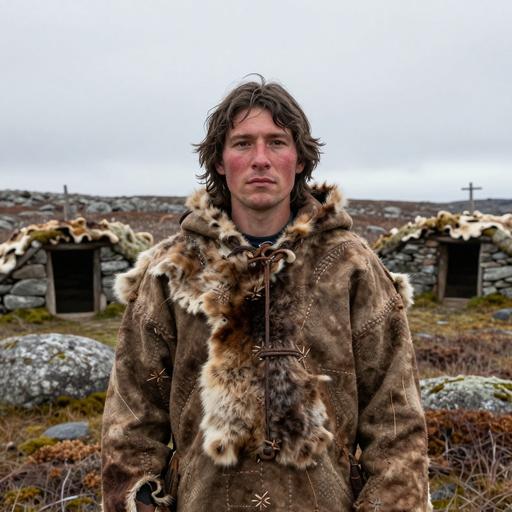
Portrait reconstruction of LateDorset-XIV-H_126
Ancient Individual

A man buried in Canada in the Pre-Columbian North America era

LateDorset-XIV-H_126
800 CE - 1500 CE
Male
Late Dorset Culture, Canada
Canada
Scroll to begin
Chapter I

Identity

The biological and cultural markers that define this ancient individual

Sample ID

LateDorset-XIV-H_126

Date Range

800 CE - 1500 CE

Biological Sex

Male

mtDNA Haplogroup

Not available

Y-DNA Haplogroup

Q-Z36017

Cultural Period

Late Dorset Culture, Canada

Chapter II

Place

Where this individual was discovered

Country Canada
Locality Truelove Lowland. North Devon Island
Chapter III

Time

When this individual lived in the broader context of human history

LateDorset-XIV-H_126 800 CE - 1500 CE
Chapter IV

Story

The narrative of this ancient life

The Late Dorset culture represents a significant period in the prehistoric history of Arctic regions in Canada, particularly spanning from approximately 500 to 1500 CE. This era is recognized as the final phase of the broader Dorset culture, which peaked before the arrival and expansion of the Thule people. Situated across the Arctic archipelago, as well as in parts of present-day Greenland, Nunavut, and Labrador, the Late Dorset peoples adapted to the challenging environment of the Arctic, characterized by its cold climate and ice-covered landscapes.

Cultural Characteristics:

  1. Technological Skills: The Late Dorset culture is notably marked by its sophisticated tool-making skills adapted to their harsh environment. They excelled in creating small, finely crafted tools typically made from stone, bone, and ivory. They produced distinctive items such as harpoon heads, knives, and scrapers, which were essential for hunting sea mammals like seals and whales, as well as terrestrial animals such as caribou.

  2. Art and Symbolism: Art played a crucial role in Late Dorset society, with evidence of intricate carvings on items like soapstone lamps, panels, and small figurines depicting humans and animals. These artifacts suggest a rich symbolic and spiritual life, perhaps indicating shamanistic practices or storytelling traditions. The carvings often exhibit abstract patterns, stylized motifs of animals, and are among the most sophisticated artistic expressions found within any Arctic culture at the time.

  3. Settlement and Subsistence Patterns: Late Dorset communities were semi-nomadic, migrating in accordance to the seasonal availability of resources. They typically established settlements near rich feeding grounds, and archaeological sites reveal dwellings that vary from skin tents used in summer to more substantial structures built using whale bones and stone during the winter months. Their diet primarily consisted of marine resources, and their hunting expertise was crucial for survival in the challenging Arctic environments.

  4. Social Organization: Although information on the social structure of the Late Dorset peoples is limited, the distribution and size of sites suggest small, mobile family units or bands were common. Collaboration and cooperation would have been essential for survival, particularly during hunting expeditions.

  5. Environmental and Climatic Adaptations: The Late Dorset culture thrived during what is known as the Neo-Glacial period, characterized by colder climates. Their adaptation strategies to these environments demonstrate resilience and ingenuity, from developing clothing suited for extreme temperatures to creating tools and techniques for hunting and processing animals efficiently.

  6. Interactions and Decline: The interaction between the Late Dorset culture and the incoming Thule people, who migrated from Alaska with advanced technologies such as bow and arrow and large whale-hunting boats, remains a subject of study. The eventual decline of the Late Dorset culture around 1500 CE is attributed to a combination of factors including environmental changes, resource depletion, and potential competition with the Thule for resources.

In conclusion, the Late Dorset culture signifies a pinnacle of adaptation and human ingenuity in prehistoric Arctic Canada. They maintained and developed unique cultural practices and technologies that allowed them to thrive in one of the most challenging environments in the world until external pressures and changing climates led to their gradual decline. Their legacy remains an integral aspect of the history and anthropology of Arctic indigenous cultures.

Chapter V

Context

Other ancient individuals connected to this sample

Sources

References

Scientific publications and genetic data

Scientific Publication

The genetic prehistory of the New World Arctic

Authors Raghavan M, DeGiorgio M, Albrechtsen A
Abstract

The New World Arctic, the last region of the Americas to be populated by humans, has a relatively well-researched archaeology, but an understanding of its genetic history is lacking. We present genome-wide sequence data from ancient and present-day humans from Greenland, Arctic Canada, Alaska, Aleutian Islands, and Siberia. We show that Paleo-Eskimos (~3000 BCE to 1300 CE) represent a migration pulse into the Americas independent of both Native American and Inuit expansions. Furthermore, the genetic continuity characterizing the Paleo-Eskimo period was interrupted by the arrival of a new population, representing the ancestors of present-day Inuit, with evidence of past gene flow between these lineages. Despite periodic abandonment of major Arctic regions, a single Paleo-Eskimo metapopulation likely survived in near-isolation for more than 4000 years, only to vanish around 700 years ago.

Use code for 40% off Expires Feb 27