דילוג לתוכן הראשי
תיקי DNA

Late Iron Age Armenia (Harjis–Sarukhan)

Seven genomes from Harjis cemetery and Sarukhan illuminate maternal links across the southern Caucasus

680 CE - 8 BCE
Armenia (Harjis cemetery; Sarukhan)

הסיפור

Genomes from 7 Late Iron Age burials (680–8 BCE) at Harjis and Sarukhan, Armenia show diverse maternal lineages (H5, H, U, T1, H2a). Archaeology and DNA together suggest local continuity with wider West Eurasian connections; conclusions remain preliminary due to small sample size.

Time Period

680–8 BCE

Region

Armenia (Harjis cemetery; Sarukhan)

Common Y-DNA

Not recovered / not reported in these 7 samples

Common mtDNA

H5, H, U, T1, H2a (each observed among 7 samples)

ציר הזמן

680 BCE

Earliest dated burial in Armenia_LIA set

One or more burials from Harjis and Sarukhan date to around 680 BCE, placing them in the Late Iron Age landscape of the Armenian Highlands.

8 BCE

Latest burial in the dataset

The most recent sampled burial falls close to 8 BCE, spanning several centuries of local occupation and change.

Origins & Emergence

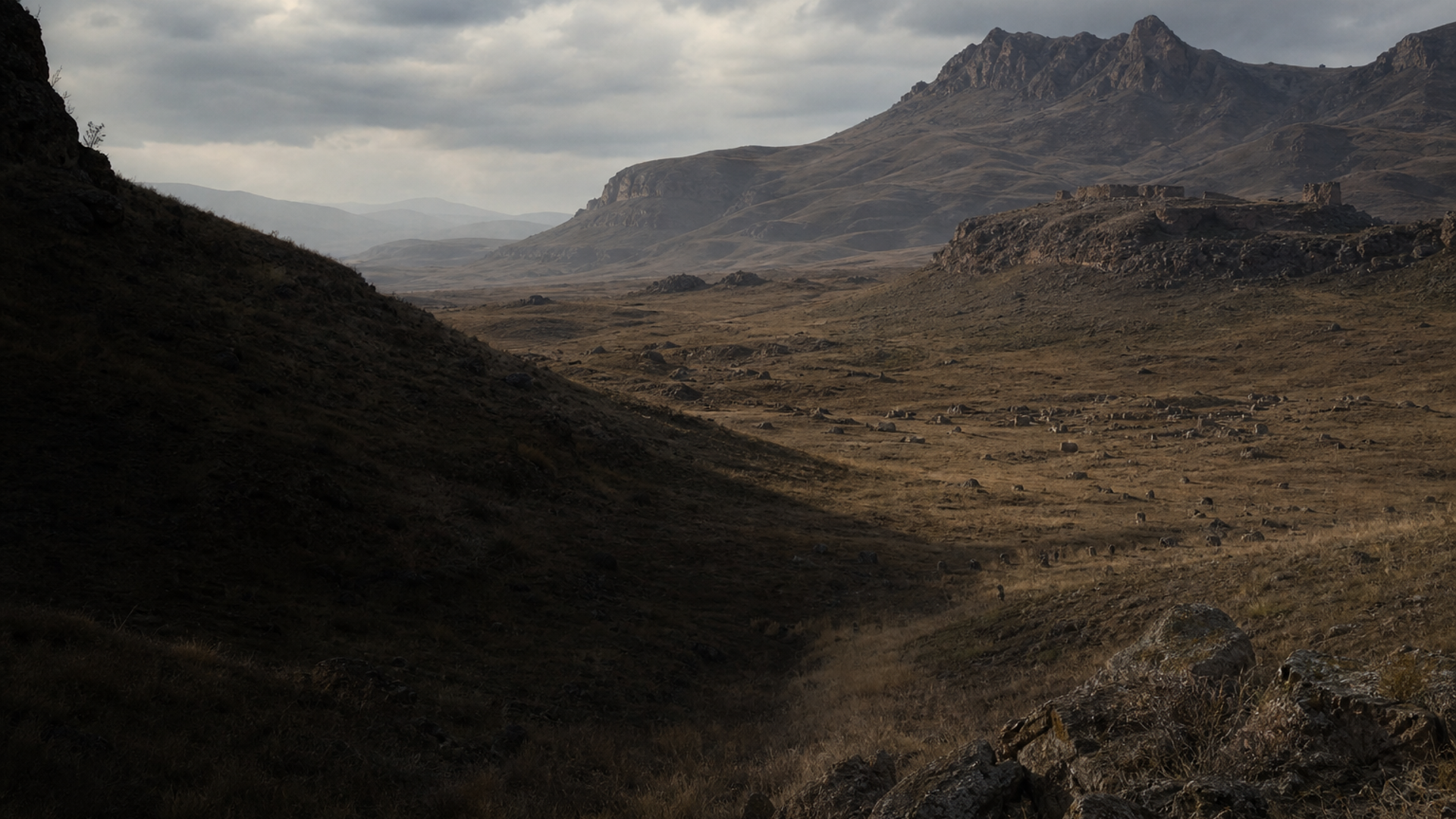
The Armenia_LIA grouping captures a cluster of human remains recovered from Late Iron Age contexts in the southern Caucasus, specifically the Harjis cemetery and the Sarukhan site in modern Armenia. Dated between 680 and 8 BCE, these burials fall within a dynamic interval after the height of the Urartian kingdom and during periods of Achaemenid influence and local polities. Archaeological data indicates continued use of established funerary landscapes: cemeteries remained focal points where communities negotiated memory, status, and identity.

Genetic sampling is limited — only seven genomes are available — so any narrative about population movements must be cautious. Yet, the maternal lineages observed point to a palette of West Eurasian haplogroups that were already widespread across the Near East and the Caucasus. In cinematic terms, these genomes are fragments of a long, layered tapestry: local threads of continuity woven together with strands brought by exchange, migration, and regional connectivity. The skeletal evidence and burial contexts tie these individuals to local traditions, while their mitochondrial DNA hints at broader networks of maternal ancestry connecting the Armenian Highlands to neighboring regions.

Limited evidence suggests continuity with earlier Bronze and Iron Age populations in the Caucasus, but the small sample count means that larger-scale demographic events (for example, population replacement or major migration) cannot be robustly inferred from these data alone.

  • Samples from Harjis cemetery and Sarukhan dated 680–8 BCE
  • Late Iron Age context after Urartian political fragmentation
  • Only 7 genomes — interpretations are preliminary

Daily Life & Society

Archaeological contexts for these Late Iron Age burials suggest communities rooted in the highland landscapes of Armenia, where mixed farming, herding, and local craft production structured daily life. Funerary assemblages and cemetery organization (where preserved) indicate social differentiation: some burials are richer in grave goods and arranged with deliberate orientation, while others are modest. These contrasts reflect a society negotiating status and identity in an era of shifting political allegiances.

Material culture across the region — pottery styles, metalwork, and textile fragments where preserved — shows both local continuity and external influences, pointing to trade and cultural exchange along routes that connected Anatolia, the Iranian plateau, and the Caucasus. Archaeological data indicates that communities may have maintained long-term residence at established cemeteries like Harjis, creating multilayered mortuary landscapes that preserve life histories of families and lineages.

Because osteological and contextual data from these particular samples are limited, reconstructions of diet, mobility, and household organization remain tentative. Future isotopic and broader genomic surveys would sharpen our view of daily subsistence, childhood movement, and the interplay between local tradition and regional interaction.

  • Cemeteries show social variation and long-term local use
  • Material culture indicates local traditions with external contacts

Genetic Profile

Genome-wide and mitochondrial results from the Armenia_LIA set (n=7) provide a preliminary window into maternal ancestry during the Late Iron Age. The mitochondrial haplogroups observed — H5, broader H, U, T1, and H2a — are lineages widely distributed across West Eurasia in both ancient and modern contexts. Haplogroup H and its subclades (including H5 and H2a) are commonly found across Europe and the Near East; U is an older West Eurasian lineage associated with deep European and Caucasus hunter-gatherer ancestries; T1 is frequent in the Near East and parts of Europe. Together, these haplogroups suggest maternal connections spanning the Armenian Highlands and adjacent regions.

Notably, no consistent Y-DNA signal is reported for these seven individuals, so paternal lineages and their patterns of continuity or change remain unresolved in this dataset. The small sample size (<10) limits statistical power: claims about population continuity, admixture events, or demographic turnovers must remain cautious. Archaeological evidence combined with these maternal signals suggests local continuity with low-to-moderate gene flow from neighboring areas rather than wholesale population replacement. Comparative analyses with other ancient Caucasus and Near Eastern genomes will be essential to place these individuals into regional population histories.

Overall, the genetic picture is evocative but fragmentary — a set of maternal echoes pointing to interconnected, long-established communities in the Armenian Highlands.

  • mtDNA: H5, H, U, T1, H2a — maternal links to West Eurasia
  • Y-DNA: not reported for these seven samples; conclusions are preliminary

Legacy & Modern Connections

The Armenia_LIA genomes are threads in a longer story of human presence in the Armenian Highlands. Archaeological continuity at burial grounds like Harjis suggests sustained local traditions, while mitochondrial diversity points to connections across West Eurasia that likely continued through the Classical and medieval periods. These genetic signatures do not map one-to-one onto language or culture, but they do indicate maternal ancestries that are part of the genetic landscape inherited by later populations in the Caucasus.

Because only seven individuals have been sampled, linking these genomes directly to modern Armenians or to specific historical groups would be premature. Nonetheless, the data gesture toward enduring regional ancestry components that appear in broader ancient DNA studies of the Caucasus. As more samples from diverse sites and periods are added, we will be able to trace how Late Iron Age communities contributed to the genetic makeup of subsequent populations, and how mobility, marriage networks, and political change shaped ancestry across centuries.

  • Maternal lineages reflect long-range West Eurasian connections
  • Small sample size — careful comparison with broader datasets is needed

עוזר הבינה המלאכותית

עוזר הבינה המלאכותית מאת DNA Genics

פתיחת התכונה הזו
שאלו שאלות על תרבות Late Iron Age Armenia (Harjis–Sarukhan). העוזר יכול להסביר ממצאים גנטיים, הקשר היסטורי, ראיות ארכאולוגיות וקשרים לעת המודרנית.
דוגמה לניתוח בבינה מלאכותית

מבט על תרבות Late Iron Age Armenia (Harjis–Sarukhan)

דגימות DNA קדום עוזרות לחוקרים לחקור דפוסי נדידה וקשרים גנטיים בין אוכלוסיות קדומות.

זו תצוגה מקדימה של הניתוח. העוזר המלא מאפשר לעיין בנושאים הבאים:

  • הרכב גנטי ודמיון גנטי
  • דפוסי נדידה ומקורות
  • חיי יומיום ומנהגים תרבותיים
  • קשרים גנטיים בני זמננו